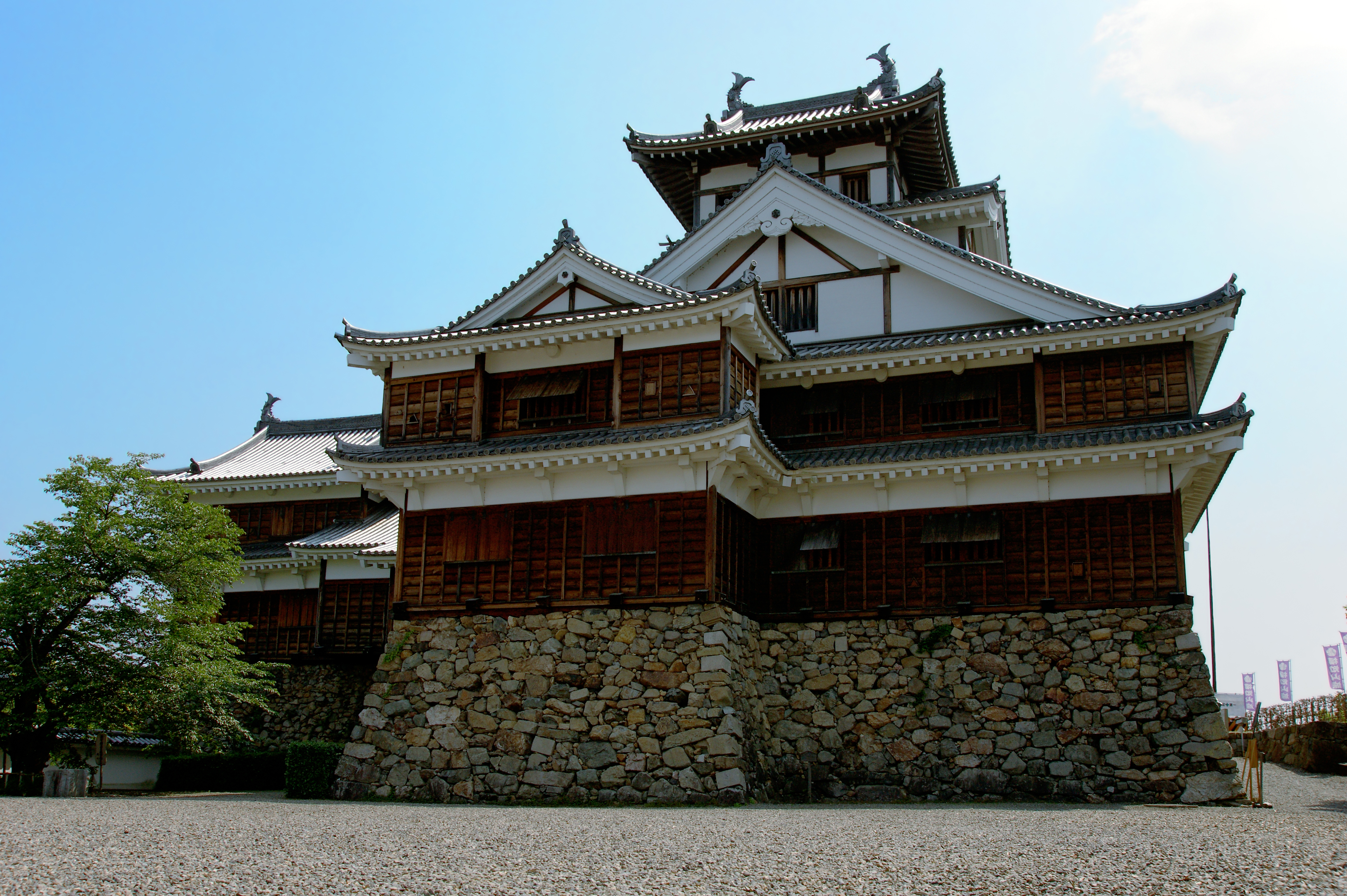
Fukuchiyama Castle
The man who built Fukuchiyama Castle is remembered as history's greatest traitor. In June 1582, Akechi Mitsuhide turned his army of 13,000 soldiers against his own lord, Oda Nobunaga, killing him at Honno-ji temple in Kyoto and upending Japan's march toward unification. Yet in Fukuchiyama, a small city in northern Kyoto Prefecture, Mitsuhide's legacy is something altogether different. Here he is remembered as the benevolent administrator who built flood controls, granted tax exemptions, developed the castle town, and constructed the fortress that still crowns the hilltop above the Yura River. The castle's reconstructed keep gleams white against the surrounding mountains, a monument to the complicated truth that history's villains are sometimes another town's heroes.
The General's Commission
Before Mitsuhide arrived, a fortification belonging to the Yokoyama family already occupied this hilltop above the confluence of rivers in the Fukuchiyama basin. In 1576, Oda Nobunaga ordered his general Mitsuhide to pacify Tanba Province, a mountainous region that had resisted central authority. Mitsuhide carried out the campaign systematically, and by 1579 he controlled the province. On the foundations of the Yokoyama fortification, he constructed a new castle in 1580, a proper early-modern fortress with stone walls and a commanding position. The castle spread across a curved, narrow ridge roughly 500 meters long, with a square central area of about 80 meters housing the main tower. Mitsuhide did not merely build a military strongpoint; he built a city around it, establishing the town of Fukuchiyama between the castle and the Yura River.
Fifty Meters of Darkness
Descend into the castle grounds and you will find Toyoiwa-no-I, the deepest well in any Japanese castle. The shaft plunges approximately 50 meters into bedrock, reaching underground spring water at around 30 meters. Mitsuhide reportedly had it dug to ensure a reliable water supply during siege conditions, a practical calculation that speaks to his reputation as a meticulous planner. The well remains one of the castle's most remarkable features, a vertical tunnel carved through solid rock that took extraordinary labor to complete. In an era when castles could fall to starvation and thirst as readily as to assault, a well this deep was a declaration that Fukuchiyama would not surrender easily. Many of the original stone walls that Mitsuhide's engineers constructed still stand around the well, their massive fitted blocks a physical link to the sixteenth century.
Thirteen Days and Centuries After
Mitsuhide's rule lasted only thirteen days after his betrayal of Nobunaga. Toyotomi Hideyoshi rushed back from a western campaign and crushed Mitsuhide's forces at the Battle of Yamazaki. Mitsuhide was killed fleeing the battlefield, and his kinsman Akechi Hidemitsu, who had held Fukuchiyama Castle, killed himself along with the remaining Akechi family members. The castle passed through several lords over the following centuries, serving the Tokugawa-era domain system until the Meiji Restoration of 1868 swept feudalism aside. In 1872, the government ordered most castle structures dismantled across Japan in an effort to modernize the country, and Fukuchiyama's buildings were torn down. For over a century, only the stone walls and the deep well survived on the hilltop.
A City Rebuilds Its Keep
In 1986, the citizens of Fukuchiyama mounted a spirited campaign to reconstruct their castle's tenshu, the main keep. The effort succeeded, and today the rebuilt tower houses a local history museum where visitors can explore the Akechi period and the castle's later centuries. The castle was recognized in 2017 when it was added to the Continued Top 100 Japanese Castles list, a testament to both the quality of its original stone fortifications and the community's dedication to preservation. Standing on the reconstructed tower's upper level, the view sweeps across the Fukuchiyama basin to the mountains of northern Kyoto Prefecture, the same landscape Mitsuhide surveyed when he governed here. The irony of the castle's story is inescapable: Fukuchiyama's most famous builder held it for barely two years before his ambition destroyed him, yet the city he created endures nearly five centuries later.
From the Air
Located at 35.297N, 135.130E in the city of Fukuchiyama, northern Kyoto Prefecture. The castle sits on a prominent hilltop at the confluence of rivers in the Fukuchiyama basin, surrounded by mountains. The white reconstructed keep is visible against the green hillside. Nearest airport is Osaka Itami (RJOO) about 80 km to the south, or Komatsu (RJNK) about 130 km to the north. The Sanin Main Line railway runs through the city below the castle. Best viewed at 3,000-5,000 feet AGL to appreciate the castle's commanding hilltop position above the river basin.