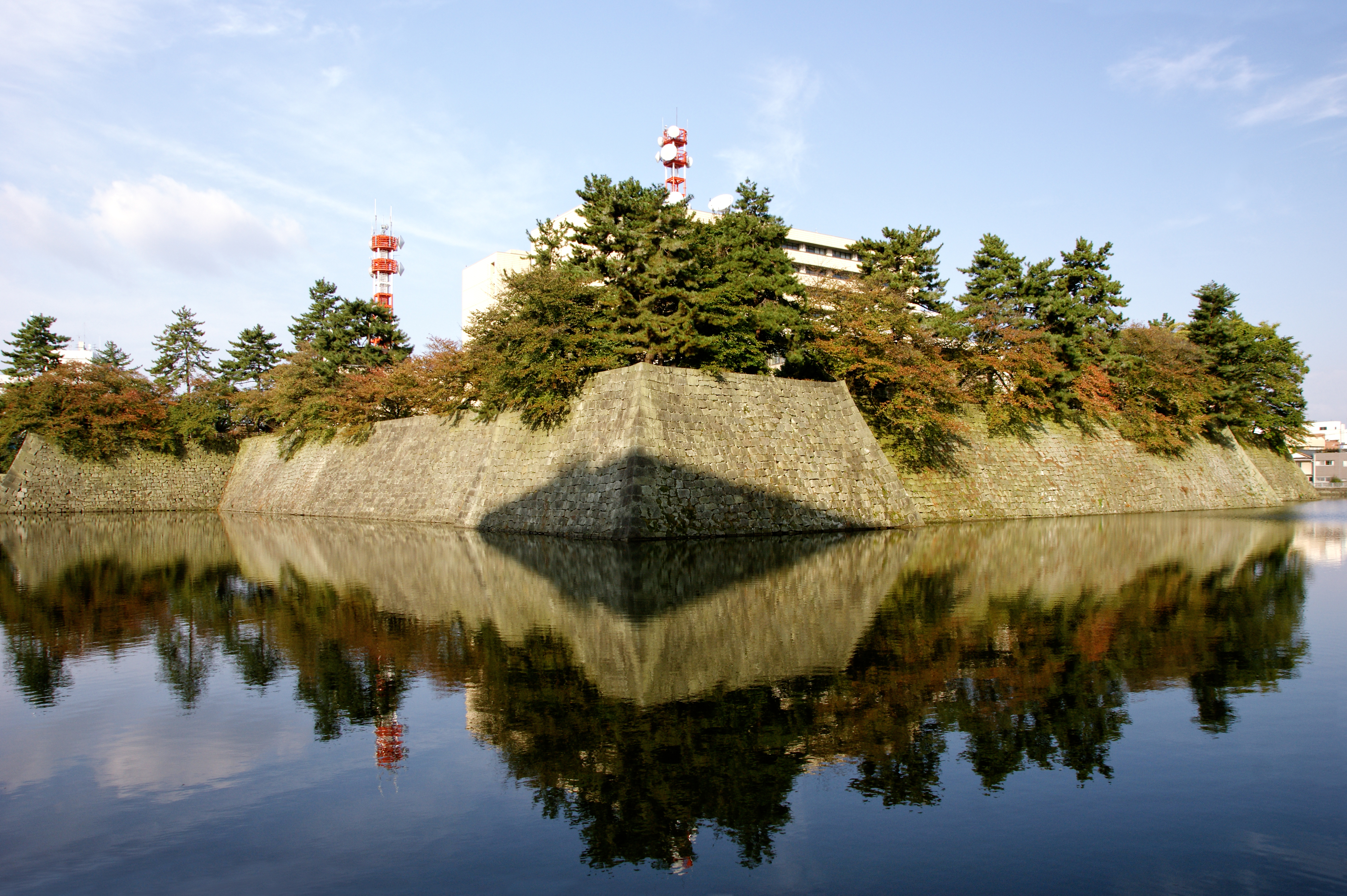
Fukui Castle
The well is still there. Somewhere beneath the stone foundations and government offices that now occupy the site of Fukui Castle, a spring called Fukunoi, the 'Good Luck Well,' once bubbled up through the earth. In 1624, the third lord of the domain liked the name so much that he renamed the entire castle and the city that had grown around it. Fukui, the city of good fortune, has survived earthquakes, firebombing, and centuries of political upheaval. The castle that gave it its name has not been so lucky. What remains today is a ruin of moats, stone walls, and a massive 37-meter foundation where a five-story tower once stood, all of it layered atop the ashes of an even older fortress destroyed in one of the most dramatic acts of defiance in samurai history.
The Nine-Story Ambition
The story of this site begins in 1573, when Oda Nobunaga, the warlord reshaping Japan through conquest, placed his trusted general Shibata Katsuie in charge of Echizen Province. The Asakura clan's old stronghold sat in a narrow valley, useless for Katsuie's ambitions. He chose instead the wide plains where the Ashimori and Yoshiko rivers converged and began building Kitanosho Castle in 1575. The inner bailey held a nine-story donjon, one of the tallest ever constructed in Japan. Katsuie laid out a surrounding castle town that became the seed of modern Fukui. He fought neighboring warlords, expanded into Kaga and Etchu Provinces, and seemed poised to become one of the most powerful men in Japan. Then Nobunaga was assassinated at the Honno-ji Incident in 1582, and everything changed.
Fire, Seppuku, and Ashes
With Nobunaga dead, Toyotomi Hideyoshi moved swiftly to seize power. Katsuie, trapped at Kitanosho by local instability, could not respond in time. War came the following year. After Katsuie's forces were crushed at the Battle of Shizugatake in 1583, the old general retreated to his castle for the last time. Rather than surrender, he killed his wife Oichi, Nobunaga's own younger sister, and then committed seppuku, setting the castle ablaze as his final act. The nine-story tower, the stone ramparts, the water moats, all of it burned. Kitanosho Castle had stood for just eight years. Today, a few stone foundations uncovered by archaeologists mark where it once rose, and a shrine to Shibata Katsuie stands near the site, honoring the general who chose death over submission.
A Son's Inheritance
Nearly two decades later, after the Battle of Sekigahara in 1600 delivered Japan to the Tokugawa clan, the victorious shogun Ieyasu awarded all of Echizen Province to his second son, Yuki Hideyasu. In 1601, Hideyasu began constructing a new castle directly over the ruins of Kitanosho, shifting the inner bailey slightly northward. Many of the old castle's stones were pulled from the rubble and reused. Surrounded by four water moats, the layout of the Honmaru and Ni-no-maru precincts was reportedly designed by Ieyasu himself, and construction took six years to complete. In 1604, Hideyasu was permitted to take the prestigious Matsudaira surname, cementing his family's bond to the Tokugawa dynasty. From this rebuilt fortress, 17 generations of Matsudaira lords would govern Fukui Domain for 270 years, until the Meiji Restoration swept feudalism aside.
What Fire and War Left Behind
The castle's five-story tenshu burned in 1669 and was never rebuilt. Its 37-meter stone foundation stood empty for centuries, a monument to ambition left unfinished. In 1871, the Meiji government demolished the remaining structures, filled in most of the moats, and converted the grounds to government offices. The daimyo's palace survived until 1945, when American firebombing during World War II destroyed it along with much of the city. Today, the Fukui Prefectural Government offices sit within the old castle grounds, surrounded by the surviving inner moats. Stone ramparts still rise from the water, and the Orokabashi covered bridge, restored in 2008, offers a tangible connection to the castle's Edo-period past. In 2017, the site was recognized as one of the Continued Top 100 Japanese Castles, acknowledging that even in ruin, the layered history of this place commands attention.
Two Castles, One Foundation
Standing at the edge of the moat, looking at the stone walls that incorporate blocks from both Kitanosho and Fukui Castle, you are seeing nearly five centuries of Japanese history compressed into a single site. The stones Shibata Katsuie cut in 1575 sit beside those placed by Yuki Hideyasu in 1601. The site witnessed Nobunaga's expansion, Hideyoshi's consolidation, and the Tokugawa peace that followed. It survived the transition from samurai rule to modern government, only to be gutted by war from the sky. A reconstruction movement is underway, and the Orokabashi bridge is the first visible result. But even without a rebuilt tower, the moats and foundations tell the story clearly: this is a place where power was won, lost, and rebuilt, again and again, on the same patch of ground.
From the Air
Fukui Castle sits at 36.066N, 136.221E in the heart of downtown Fukui city. From the air, look for the rectangular moat system surrounding government buildings in the city center, east of the Asuwa River. The stone-walled inner moat is the most visible feature from altitude. Nearest airports: Fukui Airport (RJNF) approximately 10 km to the north, and Komatsu Airport (RJNK) approximately 40 km northeast. The flat Echizen plain makes the castle site's urban moats distinctive against the surrounding grid of city streets.