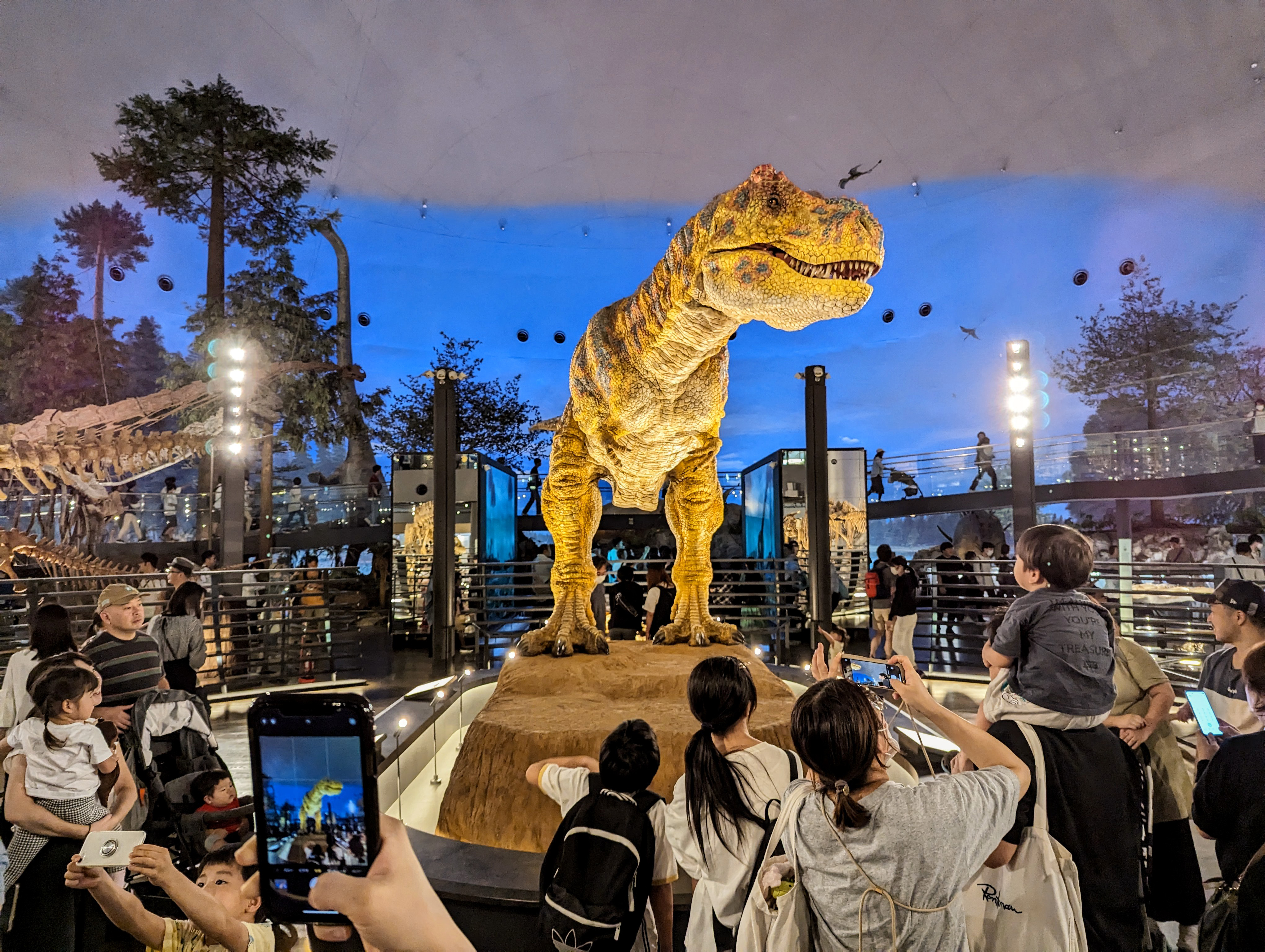
Fukui Prefectural Dinosaur Museum
In 1988, two teeth changed everything. They were small, serrated, unmistakably carnivorous, and they turned up in the mudstone banks of the Sugiyama branch of the Takinami River in Katsuyama, Fukui Prefecture. Previous digs at the same site had already produced a nearly complete crocodilian skeleton in 1982, but those teeth proved that dinosaurs had lived in this mountain-ringed corner of central Japan. A dozen years and billions of yen later, a shimmering silver dome designed by the architect Kisho Kurokawa rose over Nagaoyama Park, just 5.5 kilometers from the quarry itself. The Fukui Prefectural Dinosaur Museum opened on July 14, 2000, and it has since become one of Asia's foremost paleontological institutions, a place where five dinosaur species bear the Fukui name because they were first described from fossils found in the surrounding hills.
Five Dinosaurs Called Fukui
No other prefecture in Japan can claim a roster like this. Fukuiraptor kitadaniensis, a carnivore described in 2000, was the first dinosaur formally named from Fukui's rocks. Fukuisaurus tetoriensis, an herbivorous iguanodontian, followed in 2003. Then came Fukuititan nipponensis, a titanosauriform sauropod, in 2010. Fukuivenator paradoxus, a bizarre theropod displaying an unusual mosaic of features from different coelurosaur groups, was named in 2016. And Koshisaurus katsuyama, a basal hadrosauroid, was described in 2015. In 2019, the museum announced Fukuipteryx prima, an early bird from the Cretaceous that suggested the evolutionary history of basal avians was more complex than previously understood. All of these specimens came from the Lower Cretaceous Kitadani Formation of the Tetori Group, making Katsuyama the undisputed center of Japanese dinosaur paleontology.
Descent into Deep Time
Visitors enter the museum on the third floor and immediately step onto a 33-meter-long escalator that descends to the basement. The effect is deliberate: you travel downward through time. At the bottom lies Dino Street, a corridor lined with real fossils from around the world mounted on its walls. At the passage's end, a replica recreates the discovery of a nearly complete Camarasaurus skeleton found in Wyoming. The original bones of that same Camarasaurus are prepared and displayed on the first floor above. The main exhibition hall, World of Dinosaurs, contains more than 40 mounted skeletons, ten of them assembled from original fossil material. A nearly 200-square-meter diorama reconstructs a Jurassic landscape from Zigong, China. The hall itself is a pillarless dome, its open interior engineered to give the largest reconstructed dinosaurs room to dominate the space exactly as they would have dominated their Cretaceous world.
A Living Geopark
The museum is not an island. Since 2009, all of Katsuyama City has been designated a Japanese Geopark, and since 2014 the museum has operated a Field Station adjacent to the actual Kitadani Dinosaur Quarry, open from late April through early November. Visitors can tour the excavation site and even participate in supervised fossil-hunting activities. In February 2017, the fossil specimens of five named dinosaur species and their excavation site were collectively designated a Natural Monument of Japan. The Asia Dinosaur Association, established in 2013, headquartered its secretariat inside the museum, linking Fukui's research to a continental network. Sister museum agreements connect the institution to the Royal Tyrrell Museum in Alberta, the Carnegie Museum of Natural History in Pittsburgh, the Museum of the Rockies in Montana, and major Chinese paleontological institutions in Beijing and Zigong.
Kurokawa's Silver Shell
Kisho Kurokawa, one of the founders of Japan's Metabolist architecture movement, designed the museum as the centerpiece of an exposition hosted in Nagaoyama Park. The total construction cost reached approximately 14 billion yen, with 9.15 billion devoted to the building itself and 3.1 billion to the exhibits. The total floor space covers roughly 15,000 square meters, making it one of the largest paleontological museums in Japan. Outside the dome, rock specimens, a Triassic tree trunk, and a replica of a tyrannosaur skeleton laid out as if still embedded in stone greet visitors before they enter. The silver dome visible from the valley below has become an icon of Katsuyama, a beacon signaling that beneath the quiet rice paddies and forested mountains of Fukui, an entire lost world waits to surface.
From the Air
The Fukui Prefectural Dinosaur Museum sits at 36.083N, 136.507E in Nagaoyama Park outside Katsuyama, Fukui Prefecture. From the air, the museum's distinctive silver dome is visible against the surrounding green parkland and forested mountains. The Kuzuryu River valley provides a useful navigation corridor. The nearest airport is Komatsu Airport (RJNK), approximately 60 km to the north-northwest. Fukui Airport (RJNF) is roughly 30 km to the west but has limited scheduled service. Chubu Centrair International Airport (RJGG) lies about 180 km to the south. Terrain is mountainous with peaks exceeding 1,500 meters surrounding the valley; expect turbulence and variable visibility in mountain weather conditions. The museum site sits at approximately 200 meters elevation.