Fukuryu
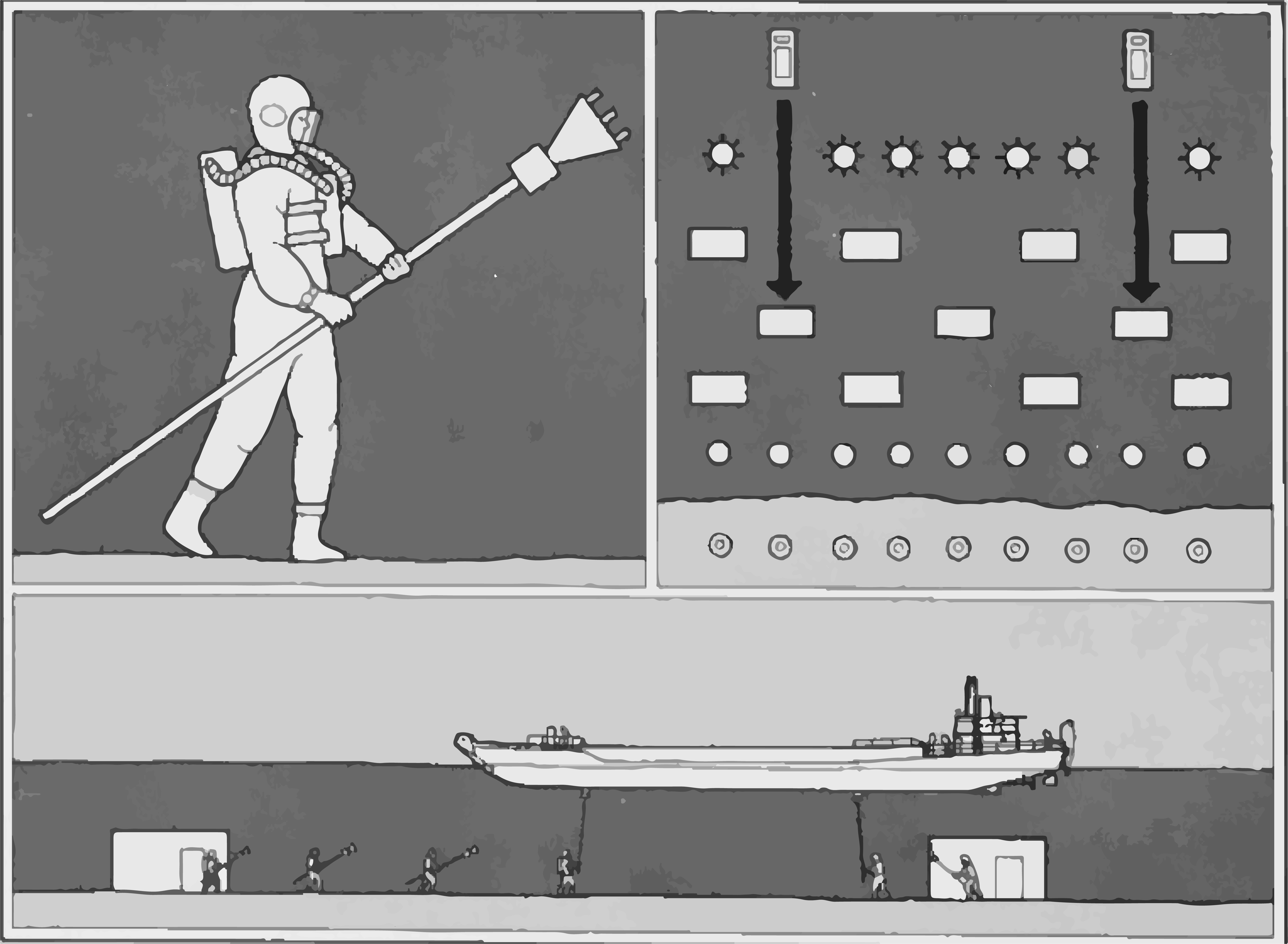
The name means "crouching dragon." In practice, the Fukuryu were men in diving suits, weighed down with lead, walking along the ocean floor with explosive-tipped bamboo poles, waiting for the shadow of an Allied landing craft to pass overhead. They were expected to die -- not as a side effect of their mission, but as its explicit design. Of the 6,000 men Imperial Japan planned to train for this role, 1,200 had completed preparation when the emperor's surrender broadcast made the invasion of the home islands unnecessary. The Fukuryu program, headquartered at the Yokosuka Naval Base on the western shore of Tokyo Bay, represents the furthest extreme of Japan's Special Attack doctrine -- a weapon system built entirely around the certainty that its operators would not survive.
Walking the Bottom
The concept was grimly straightforward. Each Fukuryu diver wore self-contained diving gear: a jacket, trousers, diving shoes, and a helmet bolted on with four fasteners. Lead weights held the diver on the seafloor. An air purification system with two 3.5-liter oxygen bottles sustained him, supplemented by liquid food rations. The equipment was designed to allow a man to walk at depth for up to ten hours. The divers were organized with military precision: six-man squads, five squads to a platoon, five combat platoons plus a maintenance platoon to a company, three companies to a battalion of roughly 540 men. Each diver's weapon was a Type 5 attack mine -- a contact-fused explosive charge fitted to the end of a bamboo pole. Concealed beneath the waves, the diver would thrust the pole upward against the hull of a passing landing craft. The resulting explosion would destroy both the vessel and the man holding the pole.
Lines of Defense Beneath the Waves
The tactical deployment plan was methodical. Off each beach identified as a potential Allied landing site, an inventory of mines was pre-positioned on the seafloor, anchored to the bottom for the submerged men to retrieve and use. The defensive layout consisted of three parallel strings of mines spaced fifty meters apart, running along the beach at wading and swimming depth. Individual divers would be stationed sixty meters apart along these lines, staggered so that every twenty-meter stretch of beach had a man ready to strike. The geometry was designed to ensure that no landing craft could reach the shore without passing within reach of at least one Fukuryu diver. Reinforced concrete shelters were planned along the seafloor to protect the men from the detonations of neighboring divers -- a detail that underscores how fully the planners had accepted that these explosions would be happening continuously, one man after another, as the invasion fleet approached.
Yokosuka and Beyond
The program's headquarters sat at Yokosuka, the major naval base on the western side of Tokyo Bay -- the same installation where, decades earlier, French engineer Leonce Verny had helped build Japan's first modern naval dockyard. By war's end, the 71st Arashi unit at Yokosuka had two fully trained battalions and four more in training. A second unit, the 81st Arashi at Kure Naval Base in Hiroshima Prefecture, was planned for 1,000 men, to be trained by 250 instructors transferred from Yokosuka. A third unit of equal size was designated for Kawatana, near Sasebo Naval Base in Nagasaki Prefecture. Together, the three bases would have fielded the full complement of 6,000 divers. Only Yokosuka's program reached operational readiness before the surrender. The only known attempted deployment of underwater suicide swimmers occurred on February 10, 1945, when Japanese divers attacked a surveying ship in Schonian Harbor in the Palau island group -- far from the home islands, and under circumstances that remain poorly documented.
The Dragon That Never Struck
The Fukuryu program existed within a broader constellation of desperation weapons that Imperial Japan prepared for Operation Ketsu-Go, the defense of the homeland. Kamikaze pilots, human-guided Kaiten torpedoes, explosive motorboats, and now men walking on the ocean floor -- each represented a calculated trade of one Japanese life for one Allied vessel or vehicle. The atomic bombings of Hiroshima and Nagasaki and the subsequent Japanese surrender on August 15, 1945, meant that the crouching dragons never faced their intended enemy. The 1,200 trained Fukuryu divers returned to civilian life, survivors of a program that had prepared them for certain death in shallow water. Today, a statue of a Fukuryu diver clutching his mine-tipped pole stands as a memorial. The Yokosuka base where they trained is still an active naval installation, now home to the Japan Maritime Self-Defense Force and the U.S. Seventh Fleet -- the same navy the Fukuryu were designed to destroy.
From the Air
The Fukuryu program was headquartered at Yokosuka Naval Base, located at approximately 35.10N, 139.72E on the western shore of Tokyo Bay. The base remains an active military installation (JMSDF and US Navy). Nearest civil airports: Tokyo Haneda (RJTT) approximately 15nm north and Naval Air Facility Atsugi (RJTA) approximately 15nm west. Yokosuka is visible from the air as a large port facility with distinctive naval piers along the bay's western shoreline. Caution: active military airspace restrictions apply around the base. Best observed from 3,000-4,000 feet AGL while transiting the western shore of Tokyo Bay.