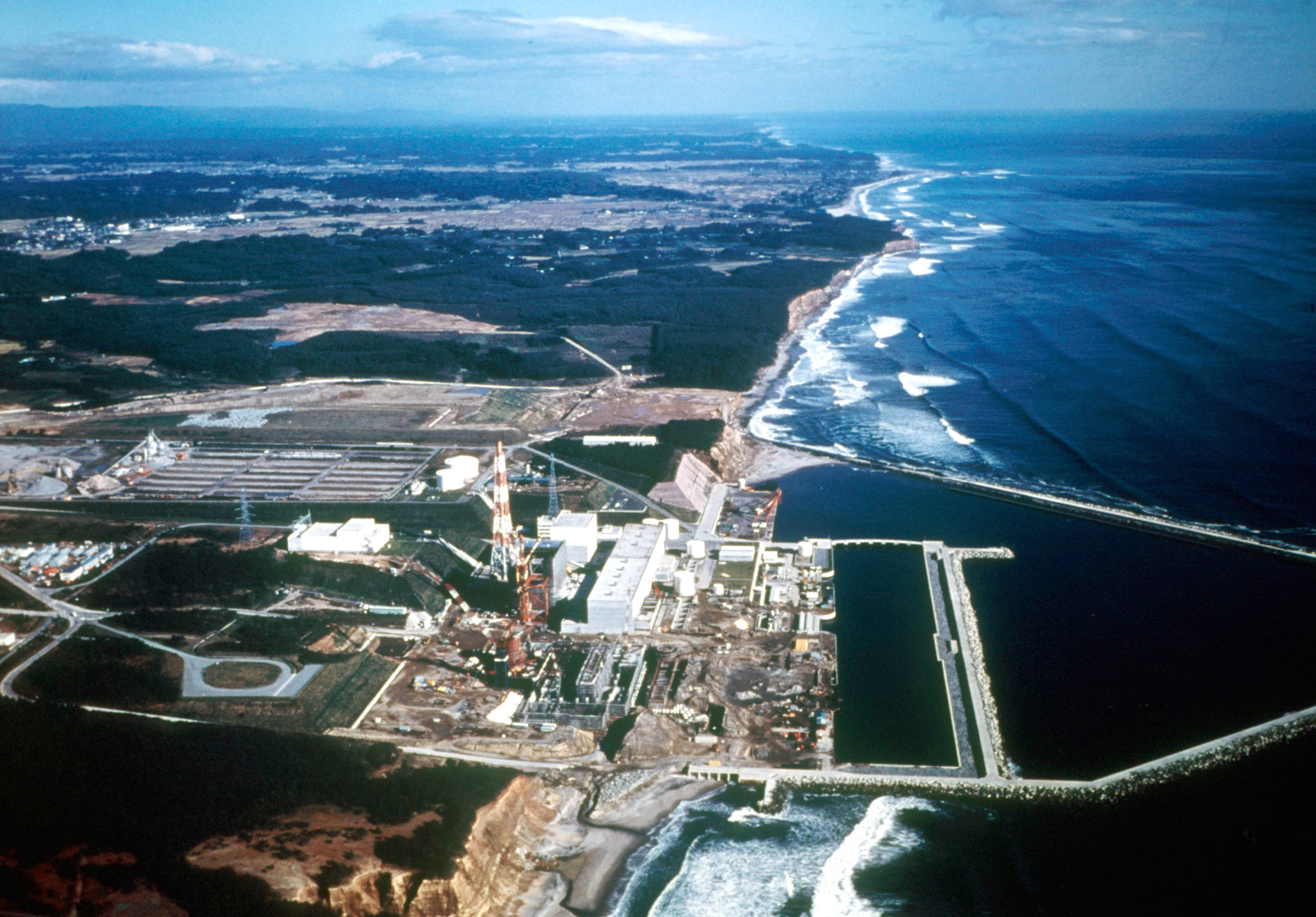
Fukushima Daiichi Nuclear Power Plant
They lowered the bluff. When Tokyo Electric Power Company built Fukushima Daiichi in the late 1960s on a coastal headland in the towns of Okuma and Futaba, the original clifftop stood well above sea level. TEPCO's engineers cut it down. Partly to anchor the reactor buildings on solid bedrock against earthquake risk, but also -- crucially -- because a lower elevation meant cheaper seawater pumps. Their tsunami models said the seawall would be enough. On March 11, 2011, waves from a magnitude 9.1 earthquake poured over those walls and into the basements where General Electric's design had placed the emergency diesel generators and batteries. Three reactors melted down. It became, alongside Chernobyl, one of only two Level 7 nuclear events in history.
Built on Borrowed Confidence
Fukushima Daiichi was the first nuclear plant designed, constructed, and operated jointly by General Electric and TEPCO, commissioned in 1971. Its six boiling water reactors generated a combined 4.7 gigawatts of electrical power, making it one of the 15 largest nuclear stations in the world. Architectural design for GE's units was handled by Ebasco Services; all construction was done by Kajima Corporation. Unit 1, a 460-megawatt BWR-3 reactor, began commercial operation on March 26, 1971. The plant's seismic design was based on the 1952 Kern County earthquake in California -- a choice that would prove fatally inadequate for the Tohoku coast. Mid-level engineers raised concerns during construction that placing emergency generators in the basement made them vulnerable to flooding. TEPCO chose to follow GE's original design specifications without modification. The U.S. Nuclear Regulatory Commission flagged the exact failure scenario -- loss of emergency generators in seismically active zones -- as a top risk in 1990. Japan's own Nuclear and Industrial Safety Agency cited the warning in 2004. TEPCO took no action.
Fourteen Minutes That Changed Everything
At 2:46 PM Japan Standard Time on March 11, 2011, one of the most powerful earthquakes in recorded history struck off the northeast coast of Japan. Three of Fukushima Daiichi's six reactors were operating; all three automatically scrammed. The emergency diesel generators kicked in to cool the decay heat. Then the tsunami arrived. Waves overtopped the seawalls and flooded the generator rooms. With no power to circulate coolant, Units 1, 2, and 3 began to overheat. Over the following days, hydrogen gas explosions tore through the reactor buildings of Units 1 and 3, with a suspected explosion in Unit 2 possibly breaching primary containment. Spent fuel pools in multiple units were at risk of exposure. Scientists later estimated the disaster released 18 quadrillion becquerels of caesium-137 into the Pacific Ocean. The individual reactor events were rated Level 5 on the International Nuclear Event Scale; the overall plant was classified Level 7 -- a major release of radioactive material with widespread health and environmental consequences.
The Exclusion Zone
On April 20, 2011, Japanese authorities declared the area surrounding Fukushima Daiichi a no-go zone, accessible only under government supervision. When the first journalists were allowed in that November, they found three reactor buildings destroyed, the grounds strewn with mangled trucks and crumpled water tanks left by the tsunami, and radiation levels so high that visits were limited to hours. The human cost extended far beyond the plant itself. Iwaki, the nearest major city, lost 277 people. Tens of thousands of residents from the surrounding towns were evacuated -- many permanently. The stigma of radiation made entire communities unwelcome elsewhere in Japan. Contaminated water accumulated at staggering rates, stored in growing forests of steel tanks on the plant grounds. By 2019, over a million tons of contaminated cooling water sat in those tanks, cleaned of most radionuclides but still containing tritium that filtration systems could not remove.
The Longest Cleanup in History
Decommissioning Fukushima Daiichi is projected to cost $195 billion and take decades. TEPCO spent 34.5 billion yen building an underground wall of frozen soil around the plant -- 1,500 supercooled pipes inserted into the earth to freeze groundwater and prevent it from flowing through contaminated soil into the ocean. The wall largely failed. In 2023, Japan began discharging treated radioactive water into the Pacific Ocean, a process expected to continue for roughly 40 years. The decision drew sharp criticism from environmental groups and several Asian governments. Meanwhile, inside the shattered reactor buildings, approximately 880 tons of melted nuclear fuel remain fused to the structures. In 2024, a robot named Telesco attempted to extract a tiny sample of this lethally radioactive material -- data critical for developing future decommissioning methods. A glitch halted the mission. In November 2024, TEPCO finally moved a small piece of melted fuel for radiation testing, marking a milestone in a cleanup effort that may not conclude within the lifetime of anyone reading this.
What the Neighbor Got Right
The Onagawa Nuclear Power Plant sat closer to the earthquake's epicenter than Fukushima Daiichi. It endured the same magnitude 9.1 shaking, the same coast-obliterating tsunami. Onagawa survived without a major incident. The difference was its seawalls -- taller, more robust, built to a more conservative safety margin by Tohoku Electric Power. The contrast between the two plants haunts the nuclear industry. Fukushima Daiichi's failures were not acts of God but acts of institutional complacency: warnings ignored, designs followed rigidly when local conditions demanded adaptation, and cost savings prioritized over worst-case preparation. The plant that was not supposed to fail became the defining cautionary tale of the nuclear age, its name now synonymous worldwide with the consequences of underestimating nature.
From the Air
Located at 37.423N, 141.033E on the Pacific coast of Fukushima Prefecture, Japan. The plant occupies a prominent coastal site in the towns of Okuma and Futaba, clearly visible from altitude as a cluster of large industrial structures along the shoreline. The damaged reactor buildings and hundreds of water storage tanks are distinctive features. An exclusion zone surrounds the facility. Nearest airports: Fukushima Airport (RJSF) approximately 65nm to the southwest; Sendai Airport (RJSS) approximately 65nm to the north. The coastline runs roughly north-south, with the Abukuma Highlands rising inland to the west. Expect restricted airspace in the immediate vicinity of the plant.