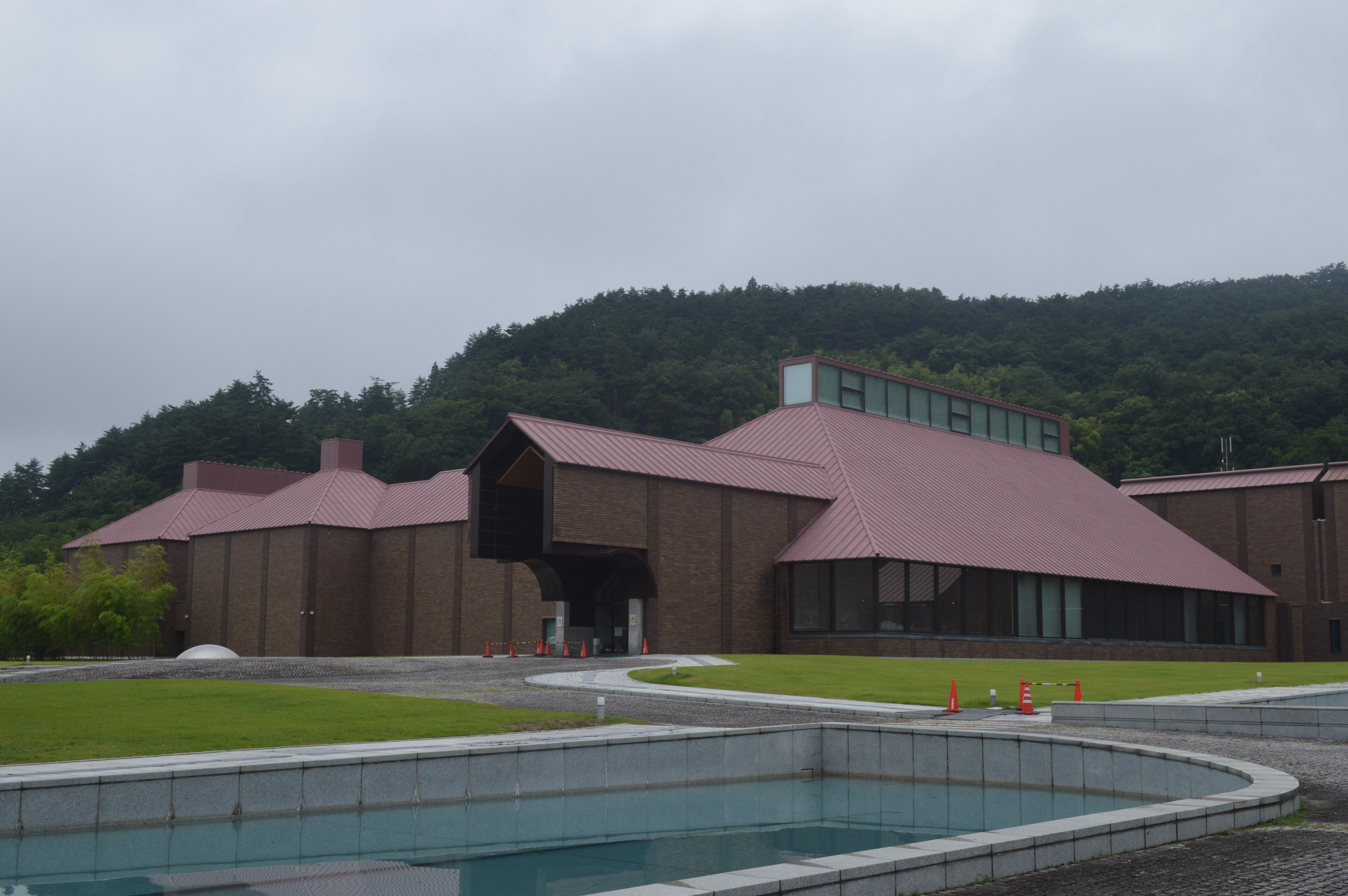
Fukushima Prefectural Museum of Art: From Nuclear Fallout to Impressionist Masterworks
The first artwork purchased for a museum that did not yet exist was an Andrew Wyeth painting called "Pine Baron." The year was 1980, the building was still four years from completion, and the citizens of Fukushima Prefecture had spent three years debating whether they even needed an art museum. They did. When it finally opened on July 22, 1984, nestled at the base of Mount Shinobu on a 60,000-square-meter campus shared with the prefectural library, the Fukushima Prefectural Museum of Art became something unexpected: a place where French Impressionism meets nuclear history, where Monet hangs near paintings born from radioactive fallout, and where a prefecture better known for rice and hot springs proved it could hold its own in the world of fine art.
The Lucky Dragon in the Gallery
Among nearly 4,000 works in the collection, the most emotionally charged may be Ben Shahn's Lucky Dragon series. The American social realist painter created these works in response to the Daigo Fukuryu Maru incident of 1954, when a Japanese tuna fishing boat was caught in the radioactive fallout from the Castle Bravo hydrogen bomb test at Bikini Atoll. The crew of twenty-three suffered acute radiation sickness; the radio operator, Aikichi Kuboyama, died six months later. Shahn -- a Lithuanian-born American artist known for art as political witness -- transformed the tragedy into a series of paintings that became among the most powerful anti-nuclear artworks of the twentieth century. That Fukushima Prefecture owns a significant portion of this series carries a weight that deepened immeasurably after 2011.
Impressionists at the Foot of a Mountain
The collection spans continents and centuries. French Impressionist works by Claude Monet and Paul Gauguin share space with modern Japanese paintings by Sekine Shoji and Kishida Ryusei, two artists who helped define Japan's own modernist movements. Twentieth-century American realism is well represented, alongside traditional Japanese woodblock prints, earthenware, ceramic art, and textiles. Before the museum even opened, the printmaker Kiyoshi Saito donated 227 of his own works to the prefecture -- an act of generosity that helped anchor the permanent collection. The breadth is deliberate: this was designed as a museum for an entire prefecture, not a single niche, and its range reflects the ambition of the citizens' committee that planned it.
Built by Committee, Beloved by Millions
The museum's origin story is a study in Japanese civic deliberation. In May 1977, citizens gathered to "consider matters of culture." Surveys followed. Reports were delivered to the governor in 1978 and 1979. A ten-member investigative committee was formed in June 1979. Funding regulations were established. A site was selected -- the former Fukushima College Economics Department campus -- and construction began in July 1982. The process took seven years from first meeting to opening day, a pace that might seem glacial but produced something built to last. The museum surpassed one million visitors by June 1995 and two million by May 2006. By May 2011, three million people had walked through its doors.
Blockbusters in Tohoku
The museum's special exhibitions have drawn staggering crowds for a regional institution. A Picasso exhibition in April 1998 brought 67,125 visitors. An "Art of Star Wars" show in July 2004 drew 77,601. A Studio Ghibli exhibition in February 2011 attracted 74,378 people. But the true blockbusters have been the shows dedicated to Ito Jakuchu, the eccentric eighteenth-century Japanese painter whose hyper-detailed roosters and nature scenes have experienced a dramatic revival in popularity. A September 2013 Jakuchu exhibition drew 155,592 visitors -- a record -- and a return engagement in April 2019 brought 116,344 more. A Vermeer and Rembrandt show in April 2016 pulled 104,510, proving that Fukushima audiences are as hungry for Dutch Golden Age masters as they are for Japanese classics.
Closed by Earthquake, Reopened by Resolve
On March 11, 2011, the Great Tohoku Earthquake and tsunami struck northeastern Japan. The museum closed the following day and remained shut until April 15. The closure was mercifully brief -- just over a month -- but the earthquake's broader impact on Fukushima Prefecture, with the Fukushima Daiichi nuclear disaster unfolding simultaneously, cast a long shadow over every institution in the region. That the museum reopened quickly and reached its three-million-visitor milestone just two months later, in May 2011, spoke to the role cultural institutions play in recovery. Art does not fix damaged reactors or clean contaminated soil, but a museum at the foot of a mountain, with Monet on the walls and Shahn's Lucky Dragon in the gallery, offers something that recovery plans cannot: continuity, beauty, and the reminder that Fukushima is far more than its worst day.
From the Air
Located at 37.77°N, 140.46°E at the base of Mount Shinobu in northwestern Fukushima City. The museum shares a large campus with the Fukushima Prefectural Library, visible as a cleared institutional area against the forested lower slopes of Mount Shinobu. The Abukuma River flows through the city to the east. Fukushima Airport (RJSF) lies approximately 35 nautical miles to the south. Best viewed at 2,000-4,000 feet AGL when approaching from the east, with Mount Shinobu providing a natural backdrop to the museum campus.