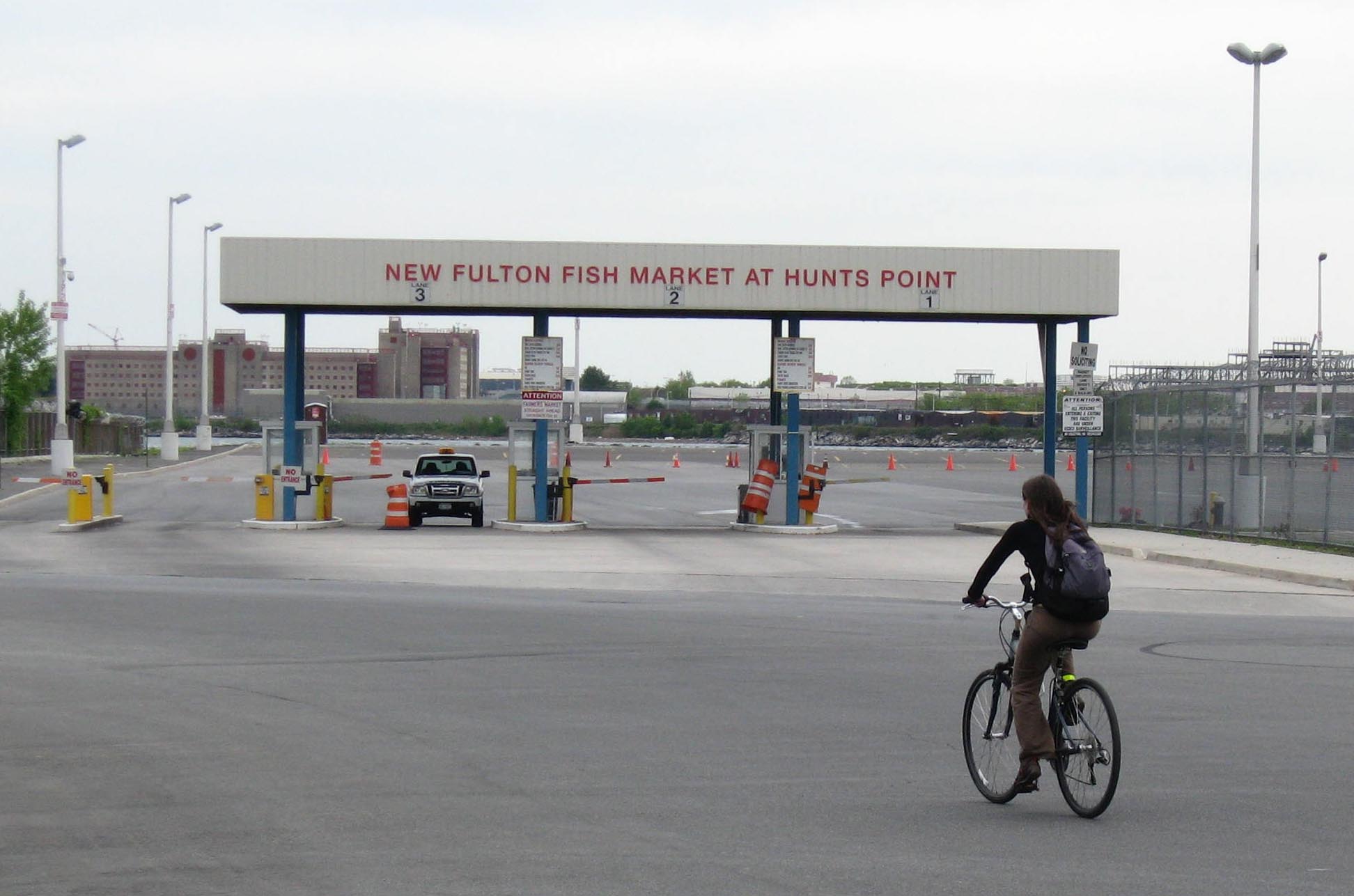
Fulton Fish Market
At two in the morning, while most of New York sleeps, the Fulton Fish Market comes alive. Forklifts beep through refrigerated warehouse corridors, buyers haggle over swordfish and snapper under fluorescent lights, and trucks idle in lines that stretch through the Hunts Point section of the Bronx. The market handles some 200 million pounds of seafood annually, generating over a billion dollars in revenue -- second in volume only to Tokyo's Toyosu Market. But for 183 years before it moved to this modern facility in 2005, the Fulton Fish Market occupied a stretch of Manhattan waterfront at the South Street Seaport, where the smell of brine and commerce mingled in open air and the line between legitimate business and organized crime was seldom clear.
Salt Water and Cobblestones
The market opened in 1822 as a wing of the broader Fulton Market, a public marketplace established to sell foodstuffs near the East River docks. In those early decades, fishing boats sailed directly to the stalls from across the Atlantic, and housekeepers from Manhattan and Brooklyn came to buy the day's catch. By 1850, the market's character had shifted: wholesale buyers replaced retail shoppers as the primary customers, and the Fulton Fish Market grew into the most important seafood distribution hub on the East Coast. It survived fires in 1835, 1845, 1918, and 1995 -- each time rebuilding in roughly the same spot near Fulton Street. The U.S. government tracked and reported its prices as a benchmark for the national seafood trade. Writer Joseph Mitchell immortalized its mid-century atmosphere in Old Mr. Flood, capturing a world of rubber boots, ice chips, and characters who measured their lives in bushels.
The Five Families' Cut
For most of the twentieth century, the Fulton Fish Market operated under the shadow of New York's Mafia families. Control of the unloading process -- who moved fish from truck to stall, and at what price -- gave organized crime a chokehold on every transaction. In 1988, the U.S. Attorney's Office filed a federal racketeering suit and installed a court-appointed trustee to oversee operations, but the trustee's ability to dislodge entrenched criminal influence proved limited. A single company held a ten-year monopoly on deliveries within the market, a stranglehold that persisted even as the market prepared to relocate. It was not until 2001 that the City of New York's Business Integrity Commission took over regulatory authority, making a serious attempt to sever the ties between the fish trade and the families who had profited from it for generations.
The Move to Hunts Point
On November 14, 2005, nearly four years after construction began on an $85 million facility, the Fulton Fish Market left Manhattan for good. The reasons were pragmatic: the South Street Seaport location was cramped, lacked climate control, and sat on some of the most valuable real estate in the city. Developers eyed the waterfront for retail and residential towers. The move brought 650 workers to the Bronx and added 5,500 diesel truck trips per week through Hunts Point, raising the neighborhood's weekly total to 60,000. The new 400,000-square-foot facility offered temperature-controlled warehouses and direct highway access via the Bruckner Expressway. For the vendors who had spent their careers on cobblestoned Manhattan streets, the transition was efficient but emotional. The New York Times reported "tough guys and moist eyes" on the market's last day downtown.
What the Numbers Revealed
Economists have studied the Fulton Fish Market as a case study in imperfect competition. Using 1992 transaction data, economist Kathryn Graddy found that third-degree price discrimination operated in the market: Asian buyers, who typically resold fish whole to retail shops in poorer neighborhoods or to Chinatown's fiercely competitive restaurant sector, were quoted prices averaging 6.3 cents per pound less than white buyers. Graddy attributed this not to racial bias but to market logic -- Asian buyers had less ability to pass costs on to their own customers, making them more price-sensitive. The finding illustrated how even in a centralized market with well-informed participants, pricing could diverge along predictable lines. The market's data has also been used to advance methods in econometric research, turning barrels of fish into lessons about how real markets actually work.
From the Air
The current Fulton Fish Market facility is at 40.805N, 73.878W in Hunts Point, the Bronx, near the Bruckner Expressway interchange. The original location was at the South Street Seaport in Lower Manhattan (40.707N, 74.003W). Nearby airports include LaGuardia (KLGA, 4 nm northeast) and JFK (KJFK, 12 nm southeast). Best viewed at 2,000-3,000 ft AGL to see the Hunts Point industrial district along the East River.