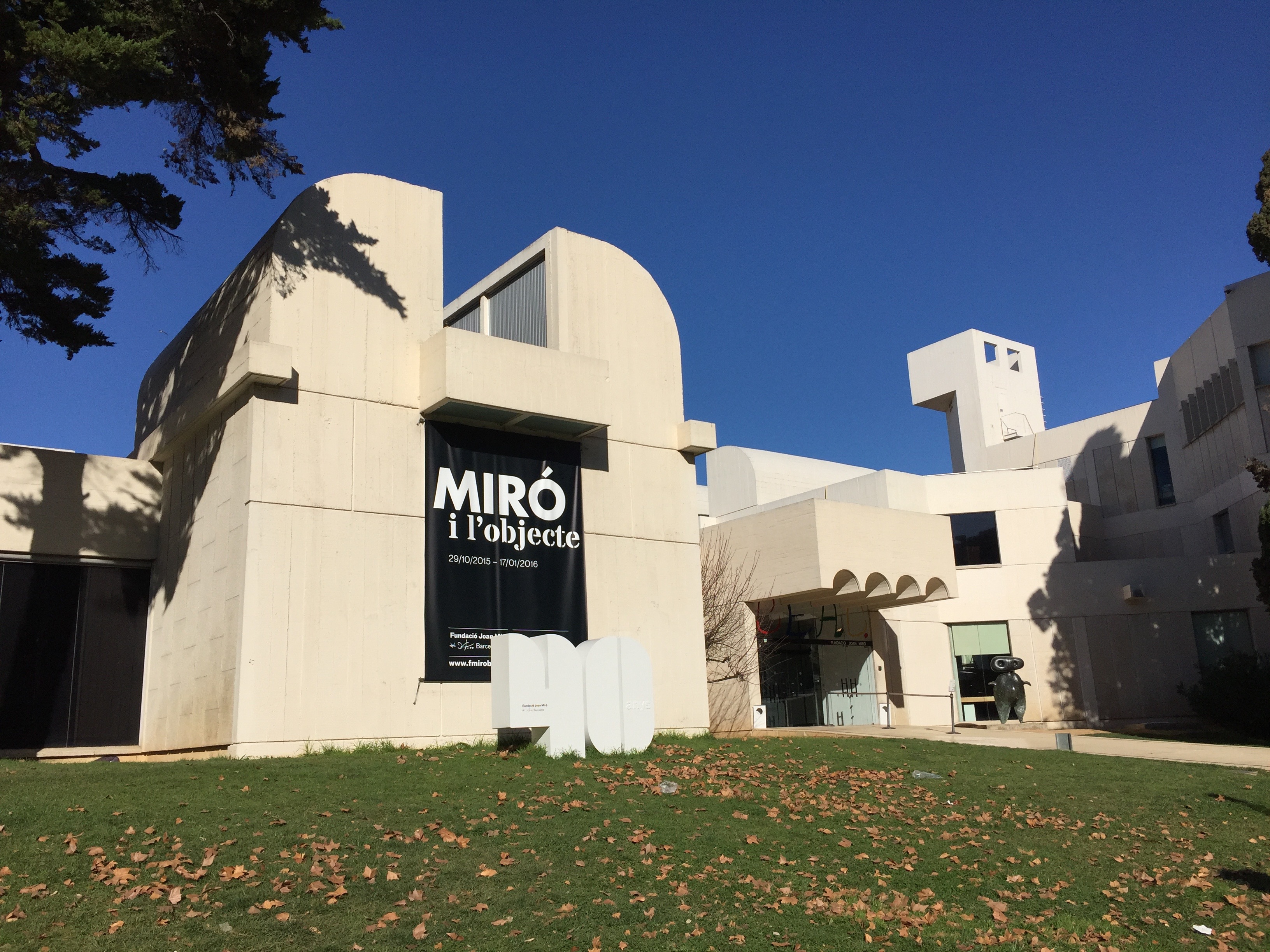
Fundacio Joan Miro
One of the most unusual objects in the Fundacio Joan Miro is a fountain made of mercury. Alexander Calder's Mercury Fountain, created for the Spanish Republic's pavilion at the 1937 Paris World's Fair, sits behind glass because its medium is lethally poisonous. Liquid mercury flows in silver arcs that catch the light, beautiful and dangerous, a material that cannot be touched yet commands attention. It belongs in a museum that Miro conceived not as a mausoleum for finished careers but as a living space where art could be, like mercury, fluid and unpredictable.
A Museum Against Museums
Joan Miro proposed the foundation in 1968, when he was 75 years old and one of the most celebrated artists alive. He could have built a conventional retrospective, a building full of his greatest hits arranged chronologically. Instead, working with his lifelong friend Joan Prats, he imagined something different: a space that would show his own work but also champion young experimental artists, a museum that was also a laboratory. The building he commissioned from architect Josep Lluis Sert, another close friend, opened on 10 June 1975 on the hill of Montjuic. Sert designed it with courtyards and terraces that blur the line between inside and outside, creating a path through the galleries that feels less like a tour and more like a walk through a Mediterranean garden that happens to contain art. The first president was photographer Joaquim Gomis, yet another member of Miro's circle. The foundation was, from the start, a collaboration among friends who shared a vision of what art could do.
The Work Within
Miro donated many of the works himself. The collection spans his career from early realist paintings like Hermitage of San Juan Huerta (1917) and Street Pedralbes (1917) through the surrealist breakthrough of Painting (the white gloves) in 1925, to the politically charged works of the Civil War era. Man and Woman in Front of a Pile of Excrement (1935) captures the anxiety of a Spain sliding toward catastrophe. His 1944 Barcelona Series, a set of fifty lithographs, records the city under Franco. Later works like The Gold of the Azure (1967) and the monumental Tapestry of the Fundacio (1979) show an artist who never stopped experimenting, pushing further into abstraction and scale even in his eighties. The breadth is remarkable: six decades of constant reinvention, from delicate drawings to massive tapestries, from paintings to sculpture to ceramics.
Espai 13 and the Next Generation
True to Miro's founding vision, the foundation maintains Espai 13, a dedicated space for young and experimental artists. The program has been led by a succession of curators including Frederic Montornes, Monica Regas, and Ferran Barenblit, who later became director of MACBA. Espai 13 has served as a launching pad for emerging artists working in forms Miro could not have anticipated but would have recognized: installation, video, performance, digital media. The foundation also holds work by Calder, Magritte, Rothko, Tapies, and Chillida, placing Miro in dialogue with his contemporaries and successors. Since 2007, the Joan Miro Prize has been awarded biennially to a contemporary artist, with recipients including Olafur Eliasson, Pipilotti Rist, Mona Hatoum, and Kader Attia. The prize carries 70,000 euros and the weight of Miro's name, a combination that keeps the foundation connected to the living edge of art practice.
Light on the Mountain
Sert's building is inseparable from its setting. Montjuic's elevation catches Barcelona's Mediterranean light, and Sert engineered the galleries to use it. Skylights filter natural illumination into the exhibition spaces, so the quality of light shifts through the day, changing how the paintings read in morning versus afternoon. The terraces open to views of the city below, and Calder's 4 Wings, a large-scale mobile, turns in the garden, its movement powered by the same breezes that carry the smell of pine from the hillside. A 1986 expansion added an auditorium and a library housing some of the foundation's 10,000 items. The building has aged gracefully, its white walls and clean geometries harmonizing with the Catalan landscape rather than competing with it. Miro wanted a museum that would feel alive. Sert built him one that breathes.
From the Air
The Fundacio Joan Miro (41.37°N, 2.16°E) sits on the northern slope of Montjuic hill, its white modernist form visible against the green hillside. Barcelona-El Prat (LEBL) is 10km southwest. The building is on the same hill as the Olympic stadium and Montjuic Castle, accessible from the city by cable car. From the air, the foundation's rooftop terraces and courtyards are distinguishable among Montjuic's gardens and cultural venues.