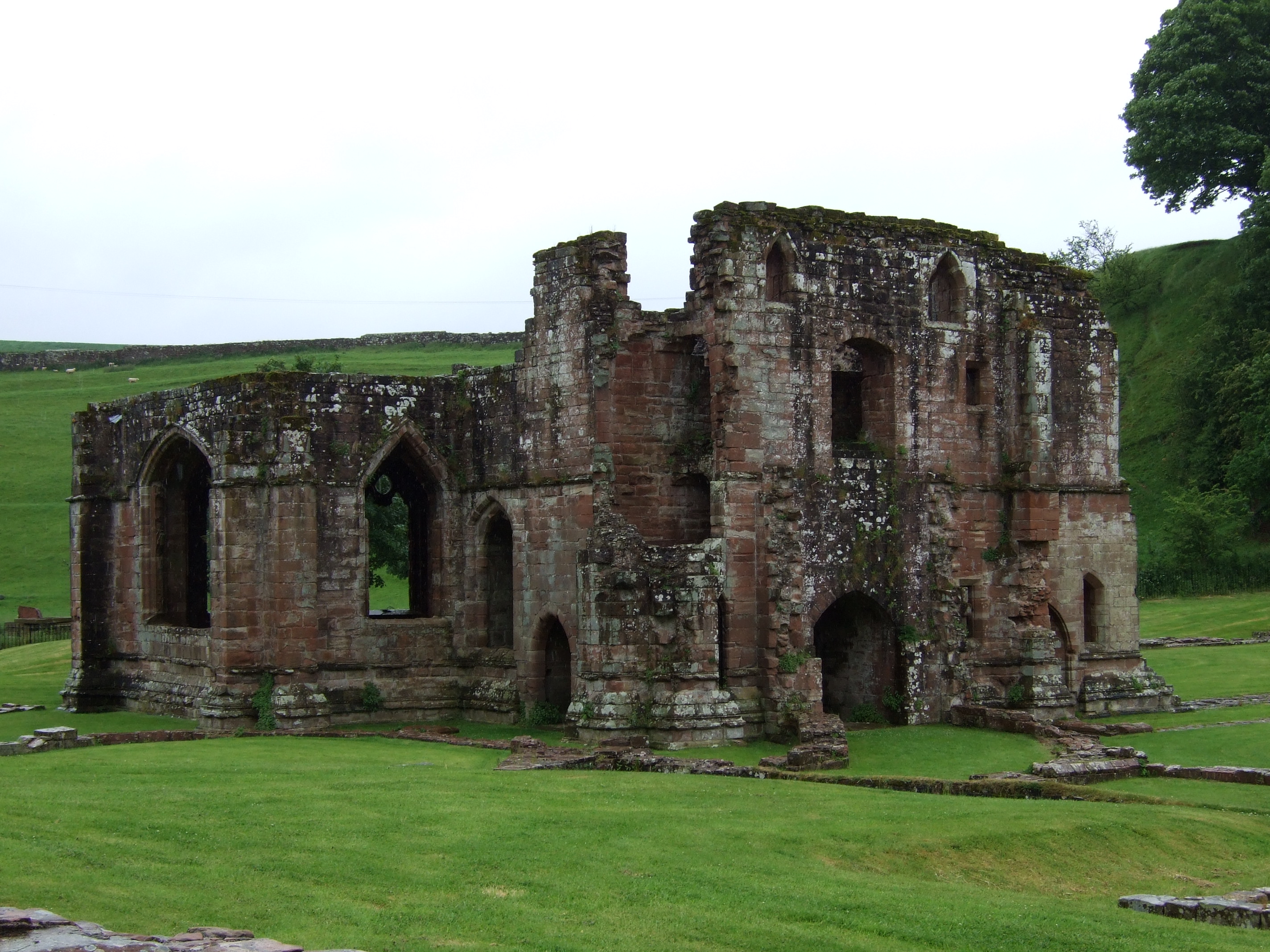
Furness Abbey
When Robert the Bruce invaded northern England during the Great Raid of 1322, the abbot of Furness Abbey chose pragmatism over principle. He paid to lodge and feed the Scottish king rather than see four centuries of accumulated wealth and power destroyed. It was a calculated move by a monastery that understood power as well as prayer. Furness Abbey, set in the Vale of Nightshade south of Dalton-in-Furness in Cumbria, was by the 15th century the second-richest Cistercian house in England -- behind only the great Fountains Abbey in Yorkshire. Its monks were landowners, mine operators, and political players whose influence stretched from the Furness Peninsula across the Irish Sea to the Isle of Man.
From the Ribble to the Vale of Nightshade
The abbey was founded in 1123 by Stephen, Count of Boulogne -- later King Stephen of England -- at Tulketh on the banks of the River Ribble. After three years, the monks judged the site unsuitable and moved to Furness, where they settled in a sheltered valley built entirely from local red sandstone. In 1147, the community joined the Cistercian order, and over the following centuries they enlarged and rebuilt the original church. The ruins visible today -- soaring arches, fragments of the chapter house, the tracery of great windows now open to the sky -- date primarily from the 12th and 13th centuries, though remodelling continued until the abbey reached its peak of grandeur in the 1400s.
Lords of the Irish Sea
Furness Abbey's power extended far beyond its valley. The monks were the dominant force in a remote border territory, wielding influence across the Irish Sea. They built Rushen Abbey on land they owned on the Isle of Man and operated mines on the island. They constructed Piel Castle to control trade between the Furness Peninsula and the Isle of Man. Kings of Mann and the Isles and Bishops of Sodor and Man were buried within the abbey's walls. Sitting roughly seventy miles south of the Scottish border, the monks navigated the dangerous space between warring English and Scots -- sometimes paying tribute, sometimes suffering raids, always surviving.
Famous Visitors to the Ruins
Henry VIII's commissioners dissolved the abbey in 1537, and its stones began their long decline into ruin. But the ruins attracted their own kind of pilgrims. William Wordsworth visited several times and wrote about Furness in his 1805 autobiographical poem The Prelude. J. M. W. Turner produced numerous etchings of the crumbling arches. Queen Victoria came in 1848 with her lady-in-waiting Augusta Stanley. In 1869, the young Theodore Roosevelt and his siblings played freely on the unroped ruins during their family's European tour -- a childhood adventure that would have horrified modern health and safety officials. In 1896, the Chinese statesman Li Hongzhang visited during a tour of industrial northern England, staying so long that his schedule had to be rearranged.
Red Sandstone and Ghost Stories
The abbey's sandstone ruins still hold their shape with remarkable clarity -- arches, pillars, and window tracery standing open to the Cumbrian weather. English Heritage operates a visitor centre housing stone carvings and effigies recovered from the site. The abbey's folklore is as layered as its architecture: a monk's ghost is said to climb a vanished staircase and walk toward the gatehouse before disappearing into a wall. A squire's daughter, who used to meet her lover among the ruins after the Reformation, supposedly still waits there for a sailor who never returned from the sea. The abbey hosted large-scale mystery plays from 1958 through the 1960s, and a revival in 1988 that author Melvyn Bragg attended. Today, the Vale of Nightshade is quieter -- a place where red sandstone columns frame pieces of sky, and eight centuries of history settle into moss and silence.
From the Air
Furness Abbey sits at 54.14N, 3.20W in the Vale of Nightshade north of Barrow-in-Furness, Cumbria. The red sandstone ruins are visible from low altitude nestled in a wooded valley. The Furness Line railway runs adjacent. Nearest airport: Barrow/Walney Island (EGNL, 4nm southwest). The Furness Peninsula and Walney Island are distinctive landmarks from altitude. The abbey is inland from the coast, about a mile east of the main Barrow urban area.