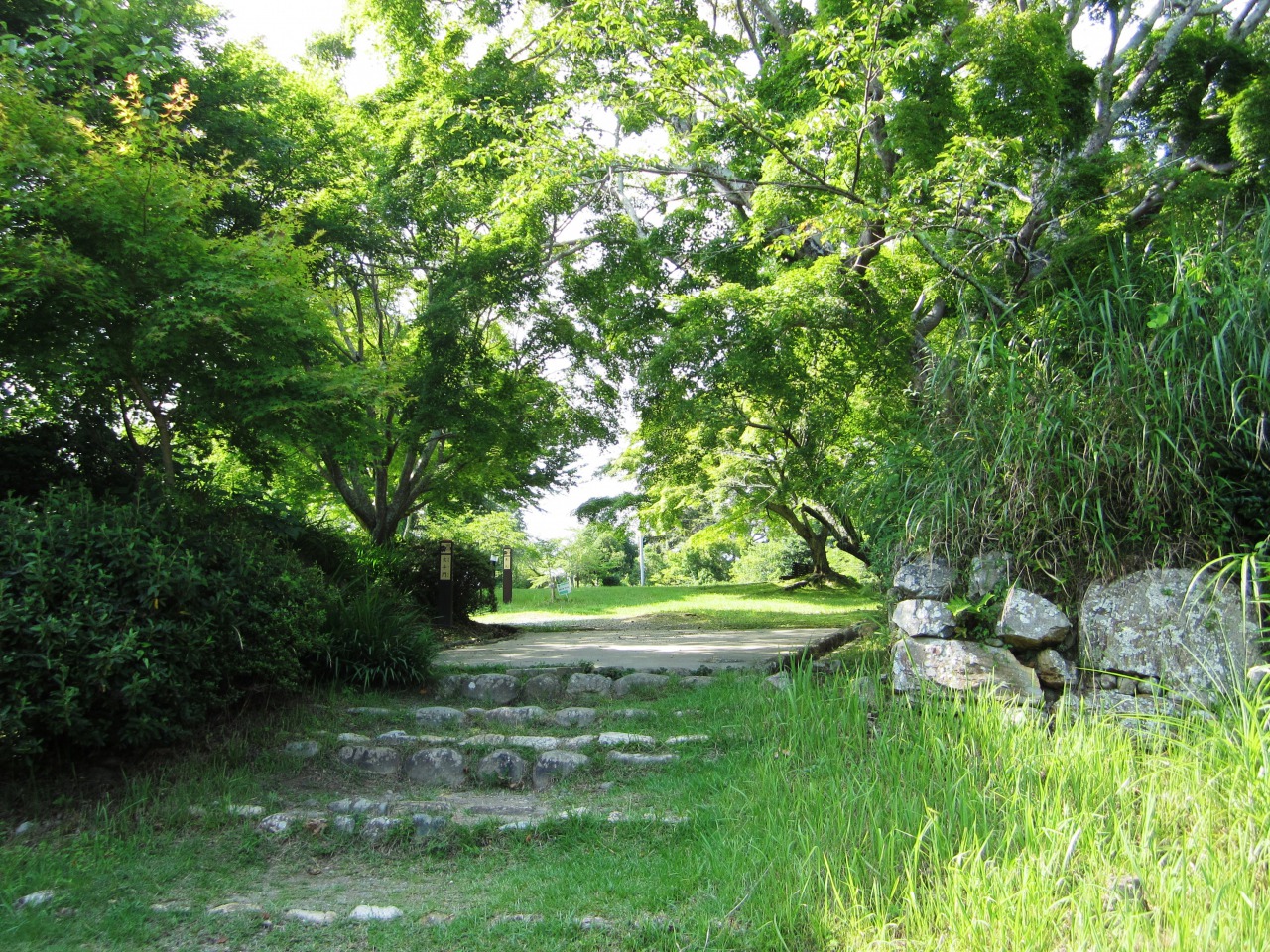
Futamata Castle
In 1579, Tokugawa Ieyasu ordered his eldest son and heir to relocate from Hamamatsu to a remote hilltop fortress at the confluence of two rivers. Within months, that son was dead by his own hand, forced to commit seppuku on his father's command. The fortress was Futamata Castle, and the story of what happened within its walls reveals the brutal calculus of power during Japan's most violent century. Perched on a narrow ridge where the Tenryu River meets the smaller Futamata River, with water guarding three of its four sides, this natural stronghold in what is now Hamamatsu, Shizuoka Prefecture, spent decades passing between warring clans like a chess piece in a game no single player could win.
Where Rivers Draw the Battle Lines
The geography tells you everything about why this castle mattered. Sitting at the confluence of the Tenryu and Futamata rivers, the hilltop site was a natural fortress -- water on three sides, steep terrain on the fourth. But position alone did not make it valuable. Futamata Castle controlled the gateway into southern Shinano Province, making it a critical chokepoint for any army moving through Totomi Province. The Imagawa clan recognized this in 1503 when they first built the castle and placed their Matsui clan vassals in charge. For over half a century, controlling Futamata meant controlling the roads that connected provinces and the armies that marched along them.
A Castle That Changed Hands Like a Coin
The castle's history reads like a ledger of shifting loyalties. When Imagawa Yoshimoto fell at the Battle of Okehazama in 1560, his castellan at Futamata died alongside him. The weakened Imagawa could not hold the fortress, and by 1569, Tokugawa Ieyasu seized both Futamata and nearby Hamamatsu Castle. Ieyasu assigned Futamata to an ally, then quickly replaced him with a more loyal vassal when he sensed wavering commitment. In October 1572, Takeda Shingen launched a massive invasion of Totomi Province and captured Futamata after a month-long siege. His forces went on to defeat Ieyasu at the Battle of Mikatagahara. But Shingen's sudden death in 1573 collapsed the entire invasion. Takeda Katsuyori inherited the fight, lost catastrophically at the Battle of Nagashino in 1575, and after six more months of siege, Futamata finally returned to Tokugawa hands.
A Father's Terrible Order
The darkest chapter at Futamata Castle has nothing to do with sieges or battles between rival clans. In 1579, Ieyasu commanded his son and heir, Matsudaira Nobuyasu, to leave Hamamatsu and take up residence at Futamata. It was effectively exile. Months later came the order for Nobuyasu to commit seppuku. His mother, Lady Tsukiyama -- Ieyasu's official wife -- was executed as well. The official charge was conspiracy with the Takeda clan, but the true reasons remain debated by historians. Oda Nobunaga, Ieyasu's powerful ally, feared that the talented Nobuyasu posed a future threat to his own son, Oda Nobutada. Lady Tsukiyama had blood ties to both the fallen Imagawa and the enemy Takeda. Whether Ieyasu sacrificed his family to preserve his alliance with Nobunaga, or genuinely believed the conspiracy charges, the event stained Futamata Castle with a tragedy that outlasted all its military engagements.
Stone Walls and Second Lives
After Toyotomi Hideyoshi ordered the Tokugawa to relocate east to the Kanto region in 1590, he gave Futamata to his general Horio Yoshiharu. Yoshiharu transformed the fortress, adding stone walls and a proper main keep. He also expanded onto the neighboring hill across the Futamata River, building Tobayama Castle as a residential annex because the original site was too narrow for a grand residence. The inner bailey of Tobayama was a 100-meter-square space ringed by stone walls with a masugata composite gate. Yoshiharu operated the two castles as one integrated complex -- until he was transferred to distant Izumo Province in 1600, and both castles were abandoned. Today, half-broken stone walls still stand at Tobayama, silent witnesses to the brief ambition of turning a battlefield into a home.
Memory Written in Stone and Shrine
Abandonment did not mean forgetting. In 1896, a Shinto shrine was erected on the northern enclosure of Futamata Castle, dedicated to the war dead of the First Sino-Japanese War. It was later rededicated to honor those lost in the Russo-Japanese War and the Pacific War. The ruins themselves received recognition in 2018 as a National Historic Site, jointly with the adjacent Tobayama Castle ruins. The designation acknowledged what the rivers and ridgelines had always made clear: this place shaped the fate of armies and families across some of the most consequential decades in Japanese history.
From the Air
Futamata Castle sits at 34.862N, 137.809E on a narrow ridge at the confluence of the Tenryu and Futamata rivers in Hamamatsu, Shizuoka Prefecture. From the air, the river junction is clearly visible -- look for the Y-shaped waterway pattern with forested hilltops between the channels. Best viewed at 2,000-3,000 feet AGL. The nearest airport is RJNS (Hamamatsu Air Base), approximately 15 nm to the south. Shizuoka Airport (RJNS) is also within range. The Tenryu River valley provides an excellent visual corridor for navigation in this mountainous region.