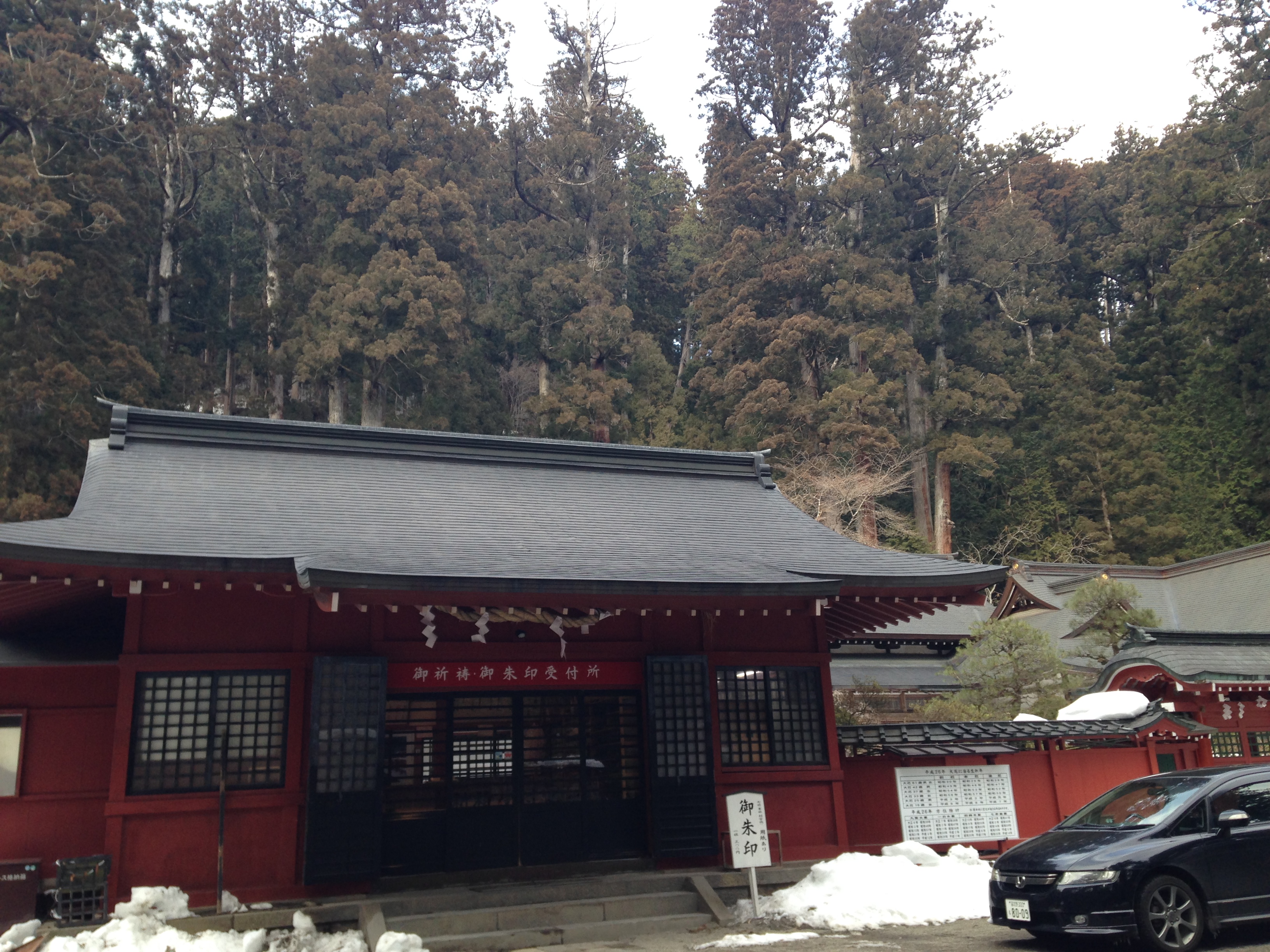
Futarasan Shrine
In the year 766, according to legend, a Buddhist priest named Shodo Shonin stood on the bank of the fast-flowing Daiya River and could not cross. He prayed. A god ten feet tall appeared, snakes coiled around one arm. The god released the serpents -- one blue, one red -- and they transformed into a rainbow-colored bridge covered in sedge, strong enough to carry Shodo and his followers across the torrent and up toward Mount Nantai. That bridge, the Shinkyo, still spans the Daiya today. Rebuilt many times but following the same vermilion-lacquered design since 1636, it stands 10.6 meters above the river, 28 meters long and 7.4 meters wide, recognized as one of the three most beautiful bridges in Japan. It was reserved exclusively for Imperial messengers until 1973, when the public was finally allowed to cross. The shrine that Shodo founded on the far side -- Futarasan Shrine -- has been guarding these mountains for over 1,250 years.
One Shrine, Three Sacred Places
Futarasan is not a single building but a sprawling spiritual geography. The main shrine sits in Nikko's sacred precinct, tucked between the famous Toshogu mausoleum and the Taiyu-in, surrounded by the ancient cryptomeria forests that make this valley feel permanently dusk. The middle shrine stands on the shore of Lake Chuzenji, a crater lake formed by the eruptions of Mount Nantai. It was built in 1096 and its current buildings date to a 1699 reconstruction. The innermost shrine, the Oku-no-miya, perches at the summit of Mount Nantai itself -- the volcano that dominates the Nikko skyline at 2,486 meters. It was founded in 782. Archaeologists excavating the summit have recovered ritual instruments from the Nara period, confirming that people have been climbing this mountain to pray for over 1,200 years. Together, the shrine's precincts encompass 3,400 hectares, including eight mountain peaks and the thundering Kegon Falls -- an area second in size only to the Ise Grand Shrine.
The Mountain That Gave Life
Long before Shodo Shonin arrived, Mount Nantai was already sacred. The mountain had been worshipped since at least the Yayoi period as a shintaizan -- a mountain that serves as a yorishiro, a vessel housing a kami, a divine spirit. The reason was practical as much as spiritual: Nantai's snowmelt and rainfall fed the streams that watered the plains below, where people grew rice and sustained their families. The mountain gave life, and so the mountain was divine. This ancient mountain cult eventually merged with Shugendo, a syncretic tradition blending Shinto animism with esoteric Buddhism, creating a practice of mountain asceticism that treated the physical act of climbing as a form of prayer. Shodo's founding of Futarasan Shrine in 767 formalized this worship. The kami enshrined there govern nation-building, agriculture, medicine, and thunder -- domains that trace directly back to the mountain's role as the source of water and therefore survival.
Seized, Restored, and Enshrined Forever
The shrine's history tracks the turbulence of Japan itself. During the Sengoku period, the era of warring states, powerful clans stripped Futarasan of its landed estates. The Late Hojo clan seized its properties, and Toyotomi Hideyoshi took what remained. But the Tokugawa shoguns, who chose Nikko as their spiritual capital, rebuilt everything. Tokugawa Hidetada reconstructed the shrine in 1617, and the buildings standing today date from that restoration. Powerful daimyo and members of the nobility poured support into the shrine, tying its fortunes to the shogunate's prestige. When the Meiji government reorganized Shinto into a state system in 1871, Futarasan received one of the highest rankings. In 1998, its grounds were designated a National Historic Site as part of the Shrines and Temples of Nikko. The following year, 1999, that designation expanded to UNESCO World Heritage status. The shrine possesses two swords classified as National Treasures of Japan, and dozens of buildings and artifacts carry Important Cultural Property designations.
The Ghost Lantern and the Sacred Bridge
Futarasan's grounds hold artifacts that blur the line between devotion and folklore. Among them is the Bake-doro, the so-called Ghost Lantern -- a Chinese-style bronze lantern in the shrine precinct that, according to tradition, was slashed by a samurai guard who mistook its flickering light for a supernatural apparition. The cuts in the metal are still visible. The Shinkyo bridge at the shrine's entrance remains the most photographed structure in Nikko. Its vermilion lacquer glows against the dark green of the river gorge, and on clear days the reflection doubles the arch into a perfect circle on the water's surface. The bridge was registered as a World Heritage structure in December 1999. Standing on it, with the sound of the Daiya rushing below and the cedar canopy closing overhead, you are standing where legend says two serpents became a rainbow. Futarasan specializes in that kind of moment -- where the physical world and the mythic one become briefly indistinguishable.
From the Air
Located at 36.76N, 139.60E in the mountain valley of Nikko, Tochigi Prefecture. The main shrine is part of the Nikko temple complex visible as a cluster of traditional rooftops within dense cryptomeria forest. The middle shrine sits on the southern shore of Lake Chuzenji, clearly visible from above. The summit shrine is atop Mount Nantai (8,169 ft / 2,486 m), the dominant volcanic peak in the area. Best viewed at 3,000-6,000 feet AGL for the valley complex; higher altitudes needed to see all three shrine locations in relation to each other. Nearest airport: RJTU (Utsunomiya Airport) approximately 22nm south. The Shinkyo bridge is identifiable as a vermilion span over the Daiya River gorge at the entrance to the shrine complex. Mountain weather is variable; expect fog in the valleys and cloud buildup against the higher peaks, especially in afternoon.