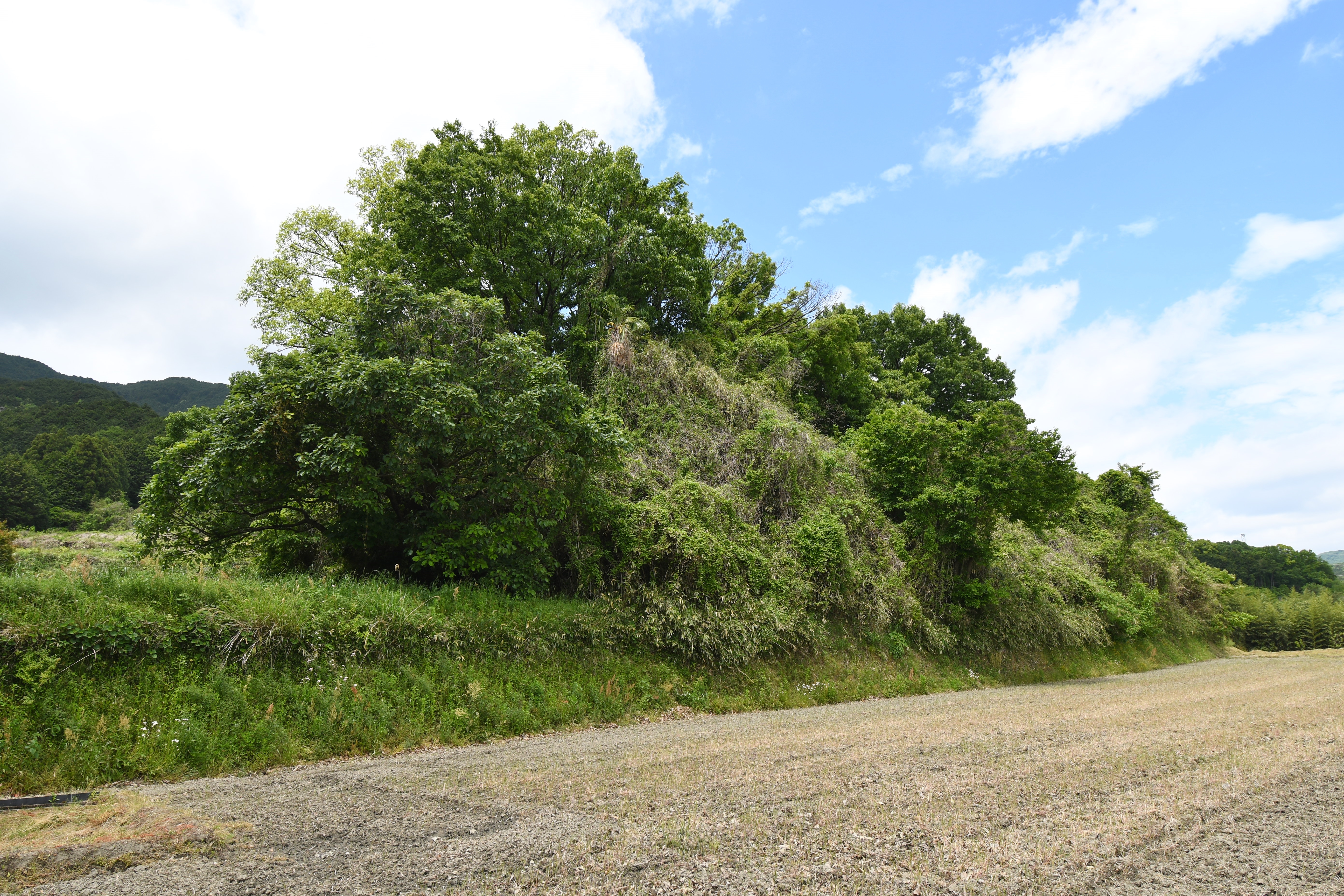
Futazuka Kofun: The Tomb That Carved Into a Mountain
Most kofun sit on flat ground, mounds of earth raised above the plains. The builders of Futazuka Kofun did something different. They carved into the high slope of Mount Katsuragi itself, excavating the sides of their tomb directly from the mountainside at an elevation of about 200 meters. The result is a keyhole-shaped mound that looks, at first glance, like two circular tombs pressed together -- both the front and rear portions rise over 10 meters, giving the structure a squat, muscular silhouette against the Yamato Basin stretching eastward below. Designated a National Historic Site of Japan in 1972, this late Kofun period tomb from the early to mid-6th century held a secret that looters missed for 1,500 years: a western side chamber crammed with 118 grave goods, sealed and untouched until archaeologists opened it in 1958.
Keyhole on a Mountainside
The Futazuka Kofun measures 60 meters in total length, with the posterior circular portion spanning 36 meters in diameter and the anterior rectangular portion stretching 41 meters wide. Both sections reach over 10 meters in height, an unusual proportion that gives the mound its distinctive two-humped appearance. A projection juts from the west side of the narrow neck connecting the two main portions. Deep moats flank the east side, with shallower moats to the west. No haniwa -- the terracotta figures that typically adorn kofun -- have been found here, but fukiishi roofing stones were laid in key areas. The tomb's most striking feature is its relationship to the terrain: rather than being built up from level ground, its flanks were carved from the mountain slope, merging architecture with geology.
Three Chambers, Three Stories
The existence of a stone burial chamber in the circular rear mound had been known since ancient times, its entrance long since breached. But the 1958 archaeological excavation revealed two additional chambers -- one in the front portion and one in the western projection. The rear chamber is the largest: 16.7 meters long including its passageway, with the burial chamber proper measuring 6.73 meters long, 2.98 meters wide, and 4.1 meters high. A drainage ditch runs through the passageway, which is built from stacked natural stones. A tuff sarcophagus once held the principal burial, but it was destroyed long ago. Despite centuries of exposure, excavators still found gilt bronze flower-shaped seating brackets, horse equipment, iron weapons, farming tools, and beads scattered within.
The Sealed Chamber
The western projection chamber is the find that sets Futazuka apart. Built in a style also found on the Korean peninsula, this chamber descends one step -- about 0.9 meters -- from its antechamber to the burial space below, an unusual architectural choice. The burial chamber proper measures 4.48 meters long, 1.35 meters wide, and 1.26 meters high. Because this chamber had never been looted, archaeologists found 118 grave goods packed tightly together: amber beads, straight iron swords, iron knives, horse equipment, iron arrowheads, iron axes, iron sickles, iron spades, and a large quantity of Sue ware pottery. The density of objects initially suggested this was a dedicated storage chamber for burial offerings. But a gap of about two meters between the artifact clusters indicated that a wooden coffin had once occupied the space -- it had simply rotted away over the centuries, leaving only the goods that surrounded it.
A View Across the Yamato Basin
The front burial chamber, 9 meters long with its passageway, held what remained of a tuff composite sarcophagus -- only the bottom portion survived. Horse equipment, farming tools, and gold and silver hollow beads were recovered. The variety of grave goods across all three chambers -- weapons alongside farming implements, precious beads beside utilitarian pottery -- paints a picture of a burial culture that equipped its dead for many roles in the afterlife. The excavated artifacts now reside at the Nara National Museum. Standing at the mound's elevation of 200 meters, the panoramic view east across the Yamato Basin explains the choice of location: this was a commanding resting place, a tomb with a view that stretched across the heartland of ancient Japan. The site is a 30-minute walk from Kintetsu Shinjo Station on the Kintetsu Railway Gose Line.
From the Air
Located at 34.49°N, 135.70°E at the foot of Mount Katsuragi in the city of Katsuragi, Nara Prefecture. The mound sits at approximately 200 meters elevation on the mountainside, with the Yamato Basin (Nara Basin) stretching to the east. The keyhole shape may be discernible from 2,000-3,000 feet AGL in good conditions, though tree cover may obscure it. Mount Katsuragi (959 meters) provides a prominent landmark to the west. Osaka Itami Airport (RJOO) lies approximately 25 nautical miles to the northwest. Nara city is approximately 15 nautical miles to the northeast. The terrain transitions from flat basin to mountainous terrain near the site.