Future of Life Institute
In March 2023, the Future of Life Institute published an open letter asking every AI lab on Earth to pause training systems more powerful than GPT-4 for at least six months. Within weeks, more than 30,000 people signed, including Elon Musk, Steve Wozniak, and Yoshua Bengio. The letter did not produce a pause. What it produced was something its authors may have wanted even more: a global argument about whether humanity was building something it could not control.
Cosmologists Worrying About Tomorrow
The Future of Life Institute was founded in March 2014 by five people who spent their careers thinking about very large scales of space and time. MIT cosmologist Max Tegmark and UC Santa Cruz physicist Anthony Aguirre study the structure of the universe. Skype co-founder Jaan Tallinn had made his fortune connecting people across the globe and then turned his attention to what might disconnect civilization permanently. DeepMind research scientist Viktoriya Krakovna and Tufts postdoctoral scholar Meia Chita-Tegmark rounded out the founding team. Their advisory board reads like a guest list for the most anxious dinner party imaginable: Stephen Hawking before his death in 2018, Stuart Russell, George Church, Frank Wilczek, Elon Musk, and actors Alan Alda and Morgan Freeman. The institute's mission is broad by design. It targets existential risk from artificial general intelligence but also works on biotechnology threats, nuclear weapons policy, and climate change.
Ten Million Dollars and a Question
FLI's research grant program launched in 2015 with a $10 million donation from Elon Musk, of which $7 million went to 37 projects studying how to keep advanced AI safe and beneficial. In 2021, Ethereum creator Vitalik Buterin funded a new $25 million round. The grants have supported technical AI safety research across dozens of universities and labs. But FLI's influence extends well beyond grant checks. In 2017, the institute convened what The New York Times called a gathering of the "heavy hitters of A.I." at Asilomar, California, where researchers including Yann LeCun and Yoshua Bengio drafted principles for responsible AI development. Those Asilomar AI Principles helped shape the OECD's own framework and contributed to the regulatory conversation that eventually produced the European Union's Artificial Intelligence Act.
Letters, Films, and Killer Robots
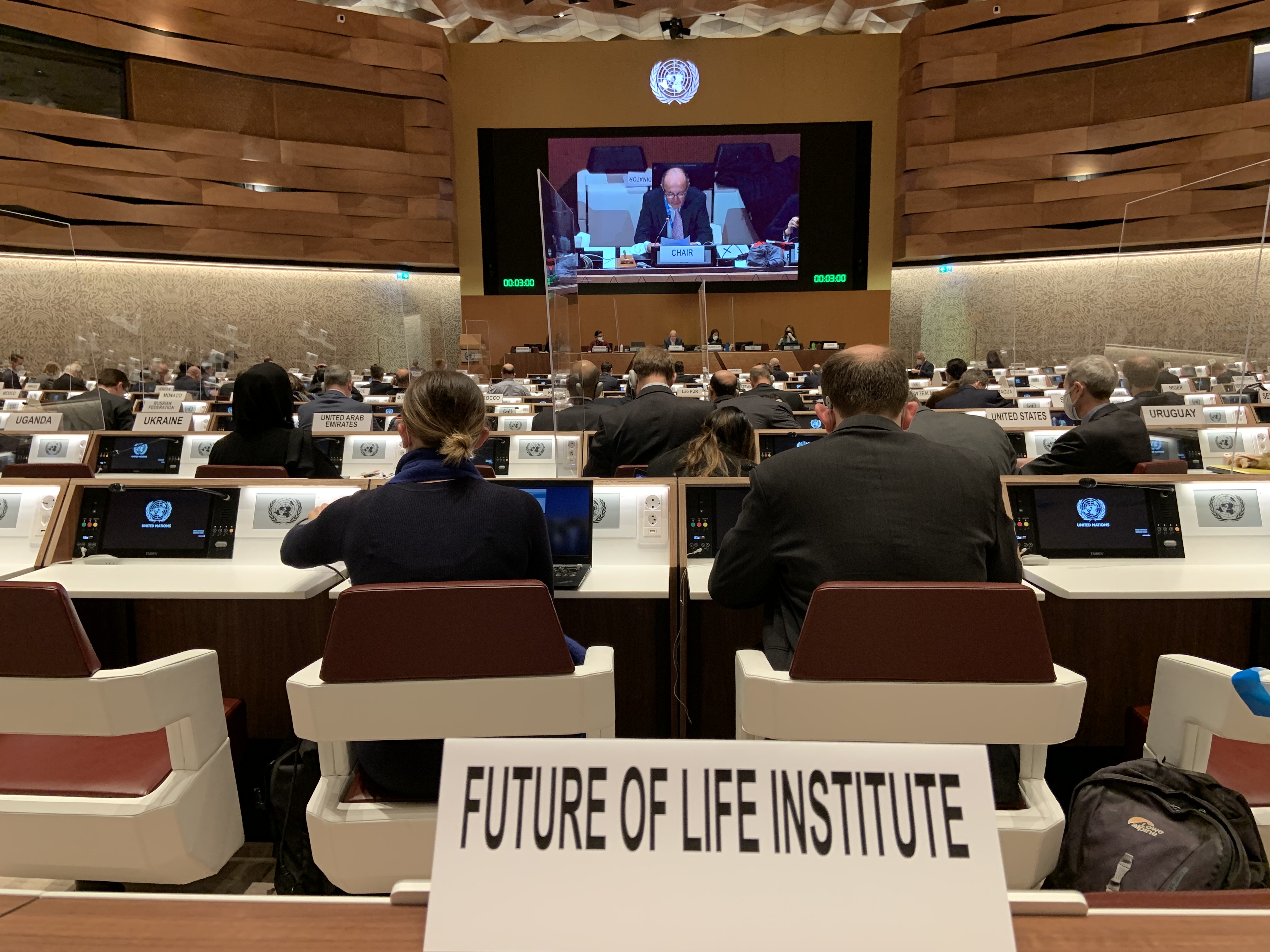
FLI has a flair for public communication that most nonprofits envy. In 2017, the institute released Slaughterbots, a short film depicting a future where palm-sized autonomous drones assassinate targets using facial recognition. The film went viral and a sequel followed in 2021. In 2018, FLI drafted an open letter calling for laws against lethal autonomous weapons, signed by Demis Hassabis, Shane Legg, and Mustafa Suleyman of DeepMind alongside Musk. At the United Nations, FLI has advocated for a treaty banning autonomous weapons and coordinated scientific support for the Treaty on the Prohibition of Nuclear Weapons. The institute operates at the intersection of technical research and political advocacy, translating academic concerns about catastrophic risk into language that lawmakers and the public can act on.
The Pause That Was Not a Pause
The March 2023 open letter remains FLI's most visible moment. It warned of "a profound change in the history of life on Earth" and called for a six-month moratorium on training AI systems beyond GPT-4's capabilities. The signatories were eclectic: alongside AI researchers and tech executives were politician Andrew Yang, author Yuval Noah Harari, and rapper Will.i.am. Not everyone who signed agreed on the reasons. Musk cited fears of existential risk from artificial general intelligence. Gary Marcus signed over concerns about AI-generated propaganda and called the letter imperfect but right in spirit. Critics pushed back sharply. Emily Bender, Timnit Gebru, and Margaret Mitchell, authors of a paper the letter itself cited, argued that FLI's framing privileged speculative future risks over present harms already affecting marginalized communities. FLI director Anthony Aguirre was blunt about the stakes: "Whether it's soon or it takes a while, after we develop superintelligence, the machines are going to be in charge." No lab paused. But the letter forced a public reckoning with the speed of AI development that governments and regulators could no longer ignore.
From the Air
Located at 37.29N, 121.94W in the San Jose, California area, in the southern San Francisco Bay region. The institute's offices are situated within the broader Silicon Valley tech corridor. From the air, the area appears as a mix of suburban development and tech campus architecture south of downtown San Jose. Nearest airports: San Jose International (KSJC, 5nm N), Reid-Hillview (KRHV, 6nm NE), Moffett Federal Airfield (KNUQ, 12nm NW). Best viewed at 3,000-5,000 feet AGL for context of the surrounding tech landscape.