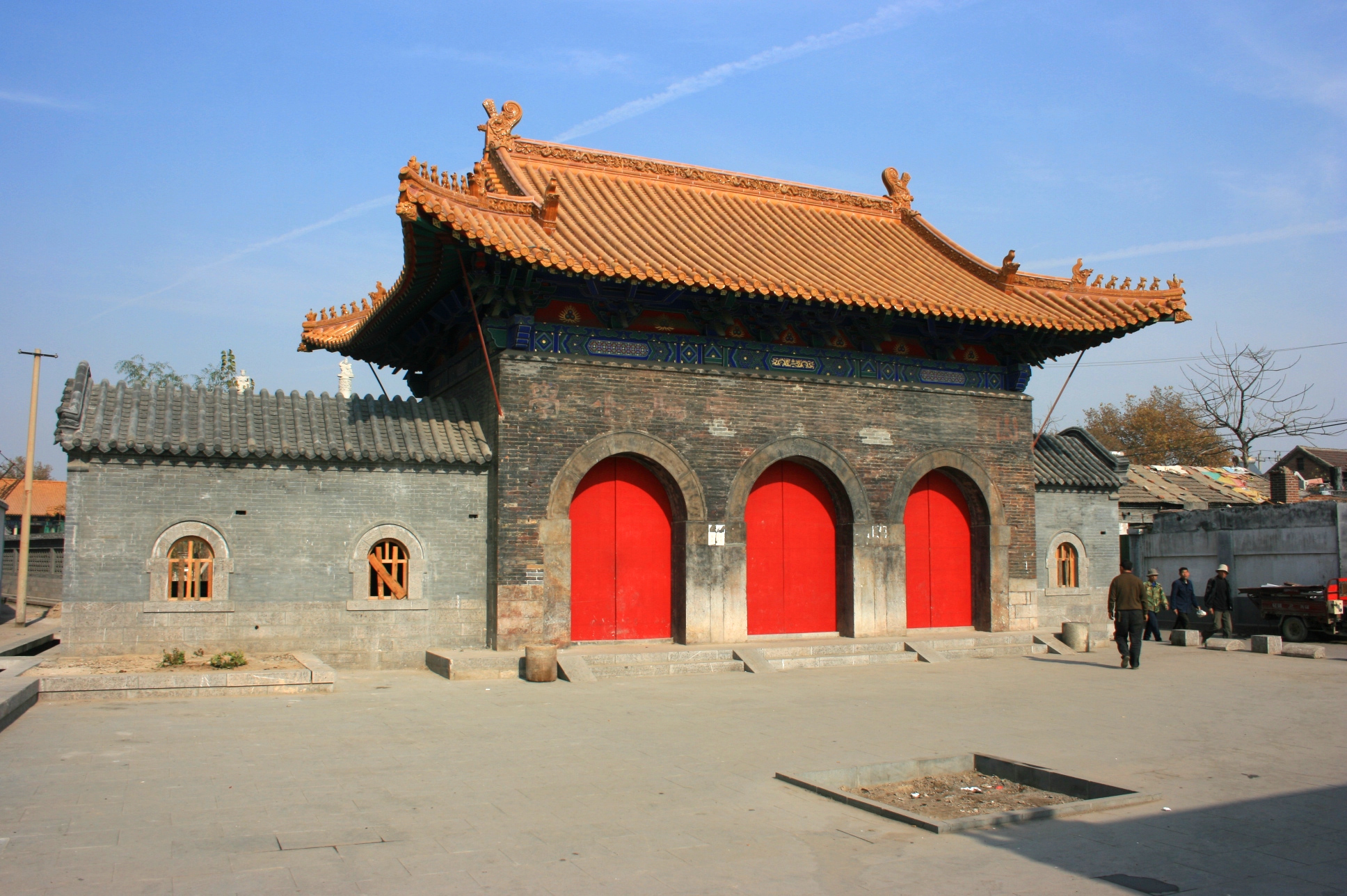
Fuxue Confucian Temple
Engineers call the technique "dismantling and raising." You take apart a building piece by piece, number every beam and bracket, raise the foundation, and reassemble it using as many original materials as possible. When Jinan's Fuxue Confucian Temple underwent its "Millennium Restoration" beginning in 2005, that is exactly what they did to the Dacheng Hall -- lifting the entire structure 1.5 meters to restore the commanding height it had lost over nearly a thousand years of settling, neglect, and the vandalism of the Cultural Revolution, when workers smashed the ridge beasts from its roof.
A Thousand Years of Building and Breaking
The temple was first constructed during the Xining period of the Northern Song dynasty, between 1068 and 1077, modeled on the great Temple of Confucius in Qufu. War destroyed it during the Jin period, and by the end of the Yuan dynasty it was in ruins. The Ming Hongwu Emperor ordered it rebuilt in 1369, and over the next five centuries it was expanded and renovated more than thirty times. The complex faces north and sits south, following the strict axial layout prescribed for Confucian temples: Dacheng Gate, Lingxing Gate, the semicircular Pan Reservoir with its arched stone bridge, the grand Dacheng Hall, Minglun Hall for lectures, and the Zunjing Pavilion for scripture storage. By the Republic of China era, it was one of the most complete Confucian temple complexes in Shandong.
When the Temple Became a School
In 1946, the Second Experimental Primary School of Shandong Province moved into the temple grounds. After the founding of the People's Republic, it was renamed Furong Street Primary School. In 1964, the school demolished Minglun Hall to build a three-story office and teaching building. The surrounding streets still bear the temple's imprint -- Dong and Xi Huazhengzi Streets take their name from the decorative brick patterns on the temple walls, while Xiangmen Lane sits beside its eastern gate and Panbi Street runs along its outer wall. The Cultural Revolution destroyed most of the 27 Ming and Qing stone steles that had survived within the complex. By 1982, only a handful remained, including a Tongzhi-era reconstruction record and a Daoguang-period inscription about teaching regulations.
The Millennium Restoration
The push to restore the temple began in 2003, when Cui Dayong of the Municipal Bureau of Culture proposed relocating the primary school. Nine museum employees jointly wrote to provincial leaders that September, urging action. Planning began in 2004, and construction started on September 10, 2005. The Dacheng Hall restoration was completed in October 2006. By June 2007, the buildings south of the hall opened to the public for a single day. The Zunjing Pavilion's wooden structure was finished in February 2009. During the Dacheng Hall reconstruction, workers unearthed two stone steles in front of the building, and in 1991, repairs at the former primary school had already turned up the "Portrait of the Venerated Sage" stele -- an intaglio carving of Confucius teaching, inscribed with a note that it imitated the brushwork of the Tang dynasty master Wu Daozi. That stele now resides in the Jinan Museum. A new statue of Confucius, 2.72 meters tall, was completed in September 2009, and statues of the Four Sages and twelve sages were reinstalled in the corridors.
The Streets Remember
The temple's influence extends beyond its walls into the very street names of old Jinan. The surrounding lanes form a web of references: Huazhengzi Streets named for the brick patterns, Xiangmen Lane for the side gate, Panbi Street for the outer wall. South of the temple, Furong Street stretches toward Quancheng Street, preserving the old commercial axis that the temple once anchored. The restoration plan envisions further rebuilding to the north -- Qisheng Temple, Wenchang Temple, Kuixing Tower -- and to the west, the reconstruction of Minghuan and Xiangxian Temples to form a parallel axis. Whether all this is completed remains uncertain, but the ambition is clear: to reassemble a thousand-year-old center of learning and worship from the fragments that wars, revolutions, and school construction left behind.
From the Air
Located at 36.67N, 117.02E in the old city district of Jinan, south of Daming Lake. Jinan Yaoqiang International Airport (ZSJN) is approximately 30 km northeast. The temple complex sits between Daming Lake to the north and Furong Street to the south. From the air, it is part of the dense historic quarter visible between the lake and modern Quancheng Street.