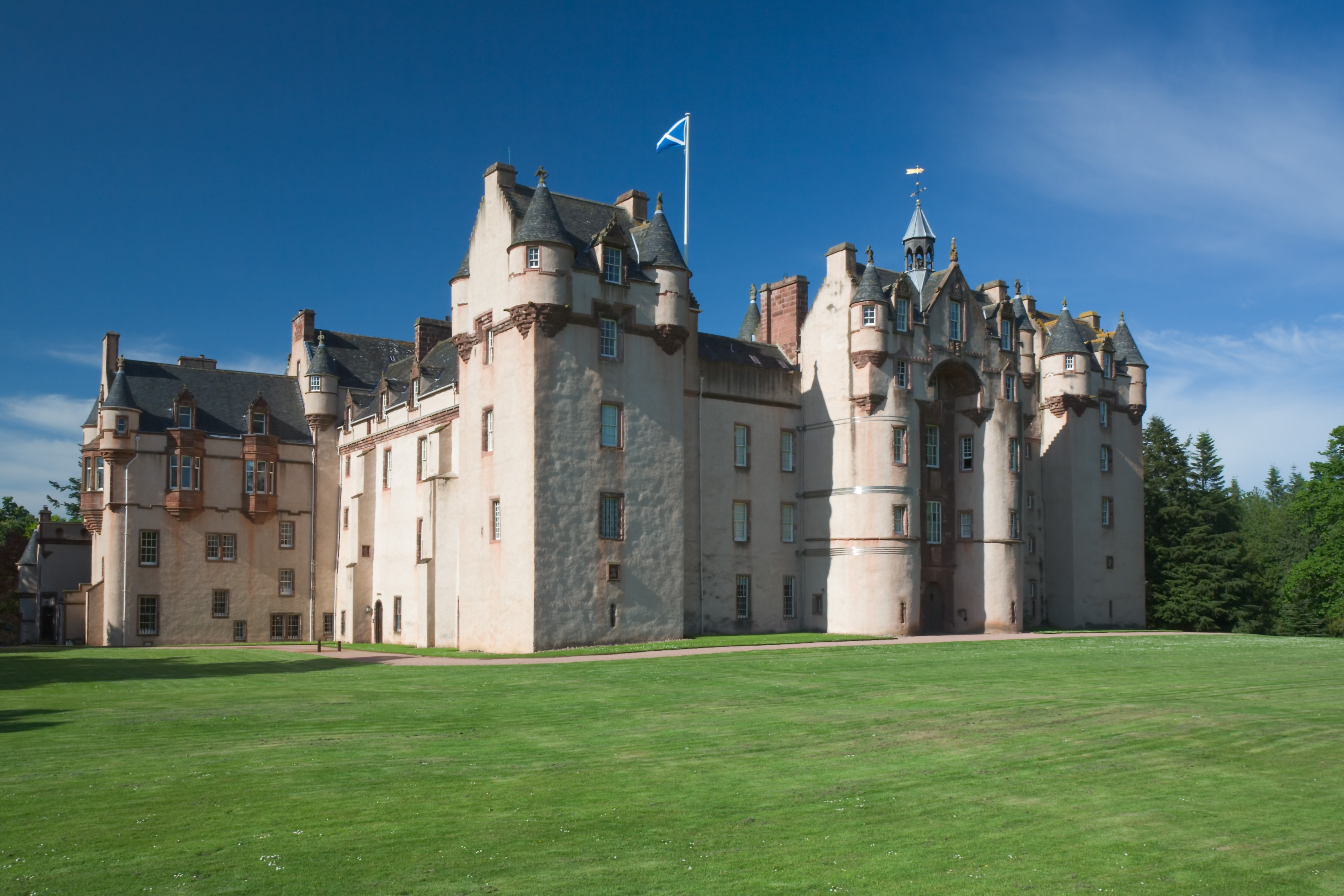
Fyvie Castle
Her name is still there, carved into the stone windowsill of the room that was supposed to be hers. Dame Lilias Drummond died in 1601, wasted away - some said from grief, others from neglect - while her husband Alexander Seton was already courting his second wife. Within months of Lilias's death, Seton married Grizel Leslie and brought her to Fyvie Castle. On their wedding night, the newlyweds found the name 'D LILIAS DRUMMOND' gouged into the windowsill of the bridal chamber, on the exterior face of the wall, fifty feet above the ground. No one has ever explained how it got there. Lilias, now the Green Lady, has never left.
Five Families, Five Towers
Fyvie Castle is structured around a principle that no architect planned but that history imposed: five towers, each built by a different family that held the castle in succession. The Preston Tower is the oldest, dating to the thirteenth century. The Meldrum Tower followed. The Seton Tower, the grandest, was added by Alexander Seton - the same man who may or may not have driven his first wife to her grave - around 1600. The Gordon Tower came next, when the Gordons acquired Fyvie in the late seventeenth century. The Forbes-Leith Tower, added in the nineteenth century, completed the sequence. The castle is thus an architectural timeline, each tower reflecting the wealth, taste, and ambitions of its builder. Walking through Fyvie is walking through eight centuries of Aberdeenshire power.
Thomas the Rhymer's Curse
According to legend, Thomas the Rhymer - the thirteenth-century poet and prophet whose predictions pervade Scottish folklore - passed through Fyvie and pronounced a curse. The castle would never descend through more than two generations of the same family, he said, unless three stones known as the 'weeping stones' were found and kept within its walls. The stones, whose origin and nature are unclear, have been lost and found repeatedly over the centuries, and the curse has proved remarkably accurate: the castle has passed from Prestons to Meldrums to Setons to Gordons to Forbes-Leiths, none holding it for more than a few generations before circumstances forced a transfer. Whether the curse shaped events or merely described a pattern is a question Fyvie's long history declines to answer.
A Gallery of Portraits
The Forbes-Leith family, who acquired Fyvie in 1889 and restored it extensively with money from American steel interests, filled the castle with one of the finest private portrait collections in Scotland. Works by Raeburn, Batoni, Gainsborough, and other major artists hang in rooms that blend medieval architecture with Edwardian opulence. The collection includes portraits of the families who held Fyvie, creating a visual record that complements the architectural one. Alexander Forbes-Leith, later Lord Leith of Fyvie, spent lavishly on both the collection and the building, restoring the great wheel stair, renovating the interiors, and establishing Fyvie as a showpiece of the Aberdeenshire castle circuit. His investment saved a building that might otherwise have declined into ruin.
Montrose at the Gates
Fyvie saw military action during the Scottish Civil War when the Marquess of Montrose fought the Battle of Fyvie in October 1644. Montrose, leading his Royalist force through Aberdeenshire, was pursued by a Covenanter army under Argyll. The two sides clashed in the grounds of the castle, with Montrose using the walls of the estate as defensive positions. The engagement was indecisive - neither side could claim a clear victory - but Montrose's ability to stand and fight with an outnumbered force reinforced his growing reputation as a commander. The castle itself survived the battle largely undamaged, its thick walls and elevated position discouraging any serious attempt at assault. The Covenanter musket balls embedded in the castle walls have long since been pointed out to visitors, though which are genuine and which are later additions is anyone's guess.
The Green Lady's Castle
The National Trust for Scotland took ownership of Fyvie in 1984, and the castle is now open to visitors who can trace the five-tower sequence and search for the carved name on the windowsill. The Green Lady remains Fyvie's most famous resident - staff and visitors report sightings, cold spots, and the scent of roses in the room associated with Dame Lilias. During renovations behind the great fireplace in one of the towers, workers discovered a concealed skeleton, lending the ghost stories a material dimension that makes them harder to dismiss. The castle grounds include a loch, woodland walks, and a walled garden that has been restored to its Edwardian layout. Fyvie's beauty is undeniable, but it carries an undertone of unease - too many stories of premature death, curses fulfilled, and names carved by invisible hands for the atmosphere to be entirely comfortable.
From the Air
Fyvie Castle is located at approximately 57.443°N, 2.395°W near the village of Fyvie in Aberdeenshire, about 25 miles north of Aberdeen. The castle is visible from the air within its wooded estate, with Fyvie Loch to the east. The five towers, though not individually distinguishable from altitude, give the castle a complex and substantial profile. Nearest airport is Aberdeen Airport (EGPD), approximately 25 miles south. The A947 road passes through Fyvie village. Best viewed at 1,000-2,000 feet.