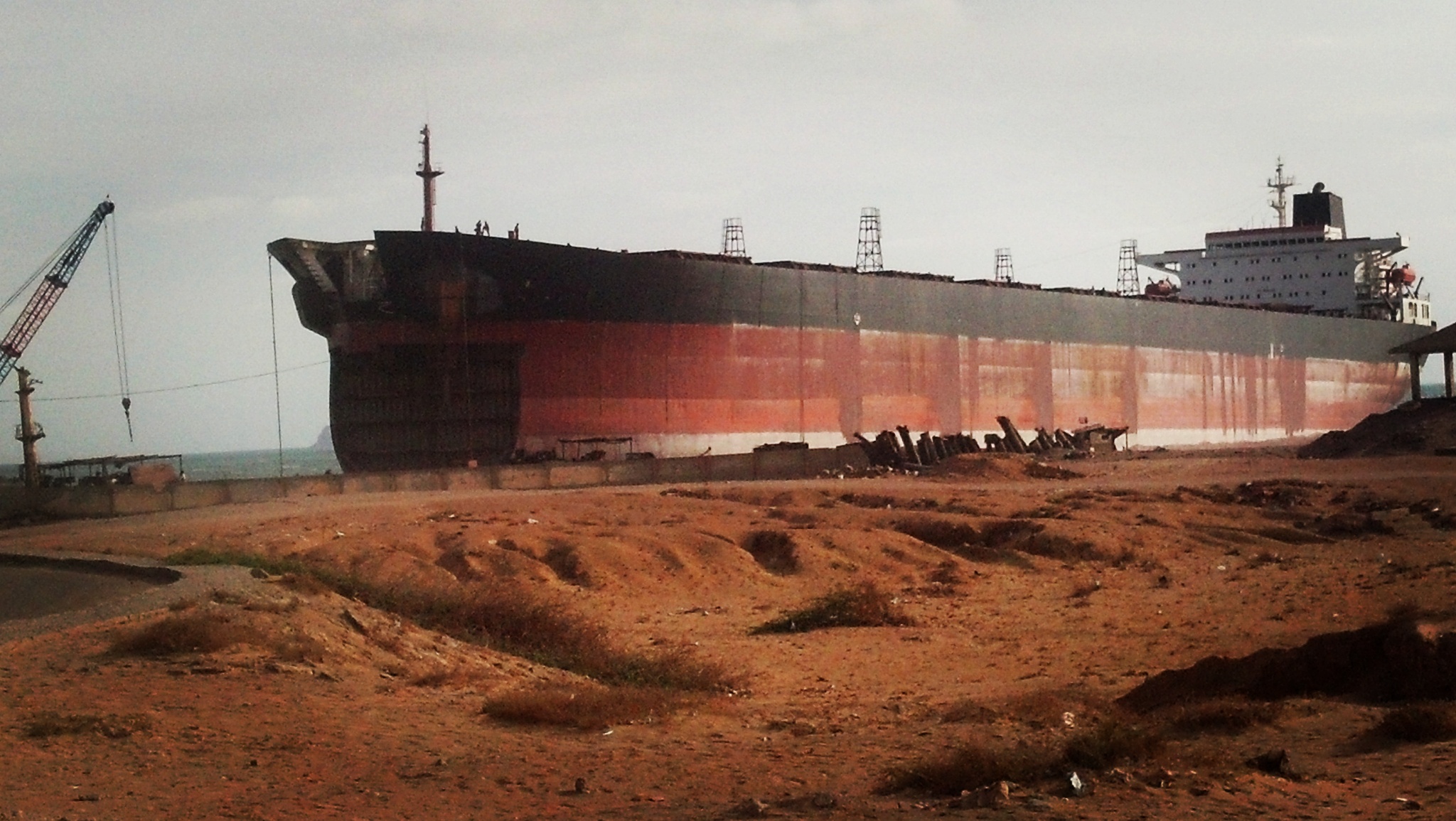
Gadani Ship Breaking Yard
From above, the beach at Gadani looks wrong. A ten-kilometer stretch of sand is lined not with umbrellas but with the rusting hulls of cargo ships, oil tankers, and container vessels, their bows driven into the shore like beached whales. Tiny figures swarm over them with cutting torches. This is the world's third-largest ship-breaking yard, a place where the global shipping industry's retirement plan meets some of Pakistan's most dangerous labor.
The Biggest Yard on Earth
In the 1980s, Gadani held the title of the largest ship-breaking operation in the world, employing more than 30,000 workers across 132 breaking plots. Ships from every ocean came here to die -- tankers, bulk carriers, even military vessels -- and Gadani's workers stripped them down to raw steel with remarkable speed. A ship with 5,000 light displacement tons can be broken at Gadani in 30 to 45 days, compared to six months or more at rival yards in Alang, India, or Chittagong, Bangladesh. That efficiency is a product of experience, low overhead, and the willingness of workers to do backbreaking, hazardous labor for wages that started low and stayed there.
Decline and the Long Slide
Competition from newer facilities in India and Bangladesh, combined with relatively high Pakistani import duties on decommissioned vessels, eroded Gadani's dominance through the 1990s and 2000s. Output fell to less than one-fifth of its 1980s peak. The workforce shrank from 30,000 to roughly 6,000. But the yard never closed. More than one million tons of steel are still salvaged annually, much of it sold to domestic steel mills. A reduction in scrap metal taxes brought a modest resurgence. The beach remains lined with ships in various stages of dismemberment -- some freshly arrived with paint still bright, others reduced to skeletal ribs being carted away on trucks.
The Human Cost of Steel
Workers at Gadani earn as little as twelve dollars a day and face dangers that would shut down operations in most countries: asbestos exposure from old insulation, toxic fumes from paint and cargo residue, falling steel, and the ever-present risk of explosion from fuel remnants in tanker hulls. On November 1, 2016, gas cylinder explosions aboard the oil tanker Aces -- a floating production storage vessel built in 1982 as the Mobil Flinders -- killed at least 26 workers and wounded 58. More than 100 people had been dismantling the ship when it erupted. Thirty others were reported missing. A year later, when breaking resumed on the same vessel, fire broke out again on the first day because the oil residue inside had never been removed. The workers who died at Gadani were doing the work that keeps global shipping affordable -- recycling steel from ships that richer nations no longer want.
Where Ships Go to Die
Viewed from the air, Gadani's scale becomes surreal. Ships that once carried grain across the Pacific or crude oil from the Persian Gulf sit nose-to-tail along the beach, each one a small city being taken apart room by room. The steel recovered here becomes rebar for Pakistani construction, kitchen utensils, and automobile parts. Furniture, fittings, and salvageable equipment are sold in nearby markets. The environmental toll is significant: heavy metals, oil residue, and asbestos contaminate the beach and the adjacent waters of the Arabian Sea. There is no separation between the breaking plots and the ocean. Yet the yard persists because the economics are irresistible -- a worn-out supertanker contains more steel than a small mine produces in a year, and someone has to take it apart.
From the Air
Located at 25.064°N, 66.711°E on the Balochistan coast, approximately 50 km northwest of Karachi. From altitude, the ship-breaking yard is unmistakable -- a line of large vessel hulls beached along the shore. The nearest airport is Karachi's Jinnah International (OPKC). The coastline here is arid with minimal vegetation. Ships in various stages of demolition are visible from several thousand feet.