Gaineswood
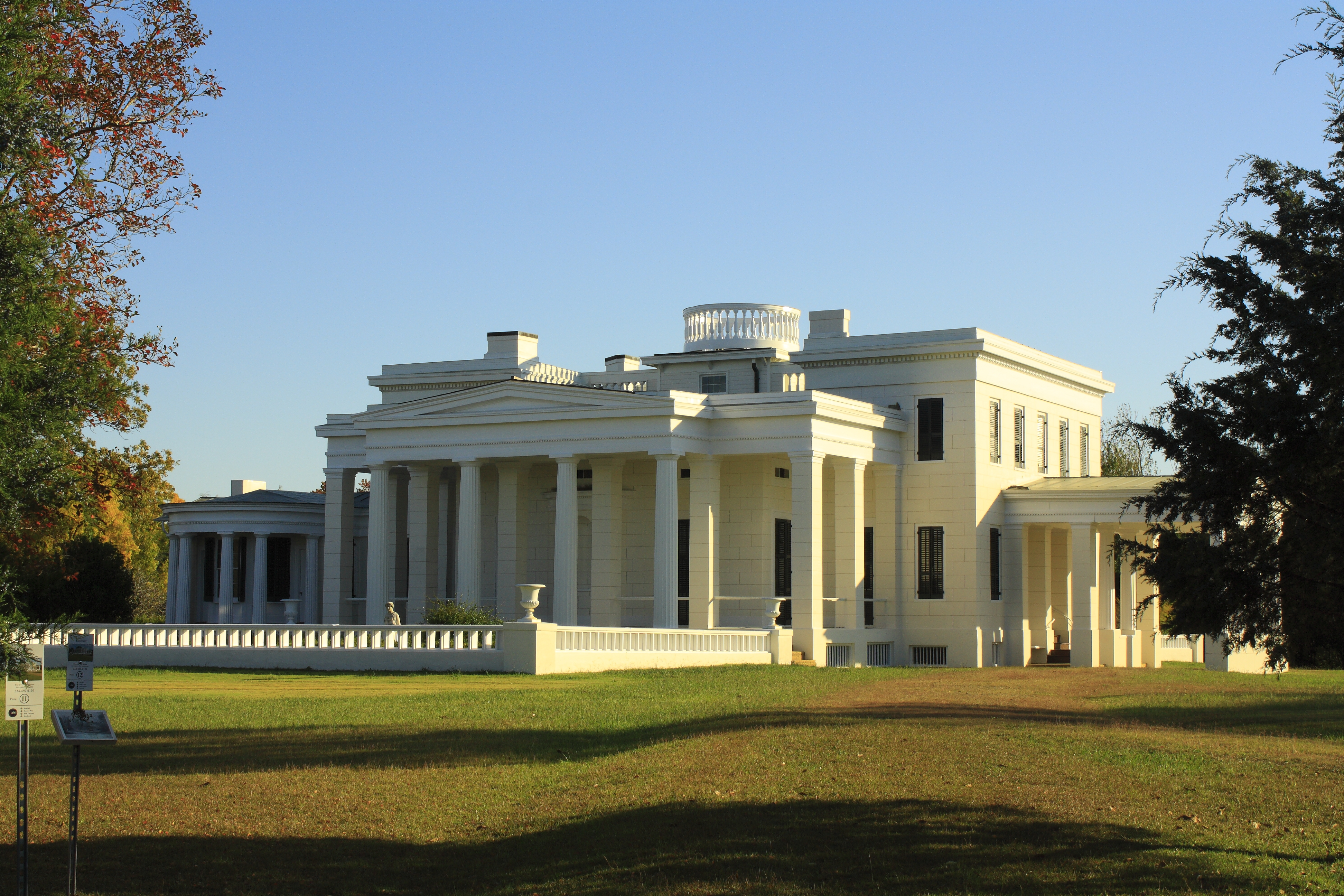
It started as a dogtrot cabin, the kind of rough-hewn log dwelling that dotted Alabama's frontier in the 1840s. By the time General Nathan Bryan Whitfield finished with it eighteen years later, the structure had become Gaineswood, a Greek Revival mansion so architecturally ambitious that it employed all three classical orders, Doric, Ionic, and Corinthian, under a single roof. Whitfield had no formal training. He taught himself from pattern books by James Stuart, Minard Lafever, and Nicholas Revett, and then directed the construction himself. The result stands today in Demopolis, Alabama, a National Historic Landmark that speaks to the contradictions of the antebellum South: extraordinary beauty built on the labor of enslaved people.
A Self-Taught Architect's Obsession
Nathan Bryan Whitfield moved from North Carolina to Marengo County, Alabama in 1834, drawn by the rich soil of the Black Belt. In 1842 he purchased the property from George Strother Gaines, a former U.S. Indian Agent whose brother Edmund P. Gaines was a noted Army general. Whitfield began building the following year. What started as a modest expansion quickly became something far more elaborate. He pored over architectural pattern books, sketching and adapting designs meant for public buildings and grand European estates. The exterior showcases eighteen fluted Doric columns and fourteen square pillars supporting three porches. Step inside and the style shifts: fluted Ionic columns line the entrance hall, while the ballroom features four fluted Corinthian columns and twenty-four Corinthian pilasters framing vis-a-vis mirrors beneath a coffered ceiling. Whitfield originally named the property Marlmont in 1843, then renamed it Gaineswood in 1856 to honor George Gaines.
The Pushmataha Oak
Before Whitfield ever set foot on the property, the grounds witnessed a pivotal moment in Choctaw history. When George Gaines served as U.S. Indian Agent, he met beneath an old post oak tree on the estate with Pushmataha, the renowned chief of the Choctaw Nation. They negotiated terms of a treaty that would eventually force the Choctaw from their ancestral homeland to Indian Territory. The tree became known as the Pushmataha Oak, a living witness to the dispossession of an entire people. That the same ground would later become a plantation worked by 235 enslaved people producing nearly 600 bales of cotton annually adds a grim symmetry. By 1860 Whitfield controlled as many as 7,200 acres across the region. The mansion itself was built with the profits of forced labor, and much of the actual construction was performed by enslaved workers whose names have largely been lost to history.
Domed Ceilings and Pattern Book Dreams
Gaineswood's interior is its greatest surprise. The library and dining room both feature elaborate domed ceilings with central skylights, bathing the rooms in natural light that shifts throughout the day. The plasterwork throughout the main floor is extraordinarily detailed, the kind of ornament usually found in civic buildings or churches rather than private homes. Whitfield achieved all of this in rural Alabama, far from the architects and craftsmen of Charleston or New Orleans. He sold the completed house to his son, Dr. Bryan Watkins Whitfield, in 1861, just as the Civil War was about to reshape the world that had made such extravagance possible. The second generation maintained Gaineswood as a residence. Nearby, Mary Foscue Whitfield inherited the Foscue-Whitfield House in 1861 and used it as a companion residence.
Preserved in Place
Gaineswood was placed on the National Register of Historic Places and designated a National Historic Landmark in 1973, recognizing it as one of the most significant remaining examples of Greek Revival architecture in Alabama. The estate is now owned by the state of Alabama and administered by the Alabama Historical Commission as a historic house museum. Walking through its rooms today, you can trace Whitfield's evolving ambition from one wing to the next, seeing exactly where a planter's practical needs gave way to an architect's unrestrained vision. The columns still stand, the domes still curve overhead, and the grounds still carry the memory of the oak tree where a nation's fate was negotiated.
From the Air
Gaineswood is located at 32.508N, 87.834W in Demopolis, Alabama. The nearest airport is Demopolis Regional Airport (KDYA), approximately 3 miles south. Approach from the east along the Tombigbee River for best orientation. The white-columned mansion is visible at lower altitudes (below 2,000 feet AGL) in clear conditions, set among mature trees in a residential area on the north side of Demopolis. Tuscaloosa National Airport (KTCL) is about 50 nm to the northeast.