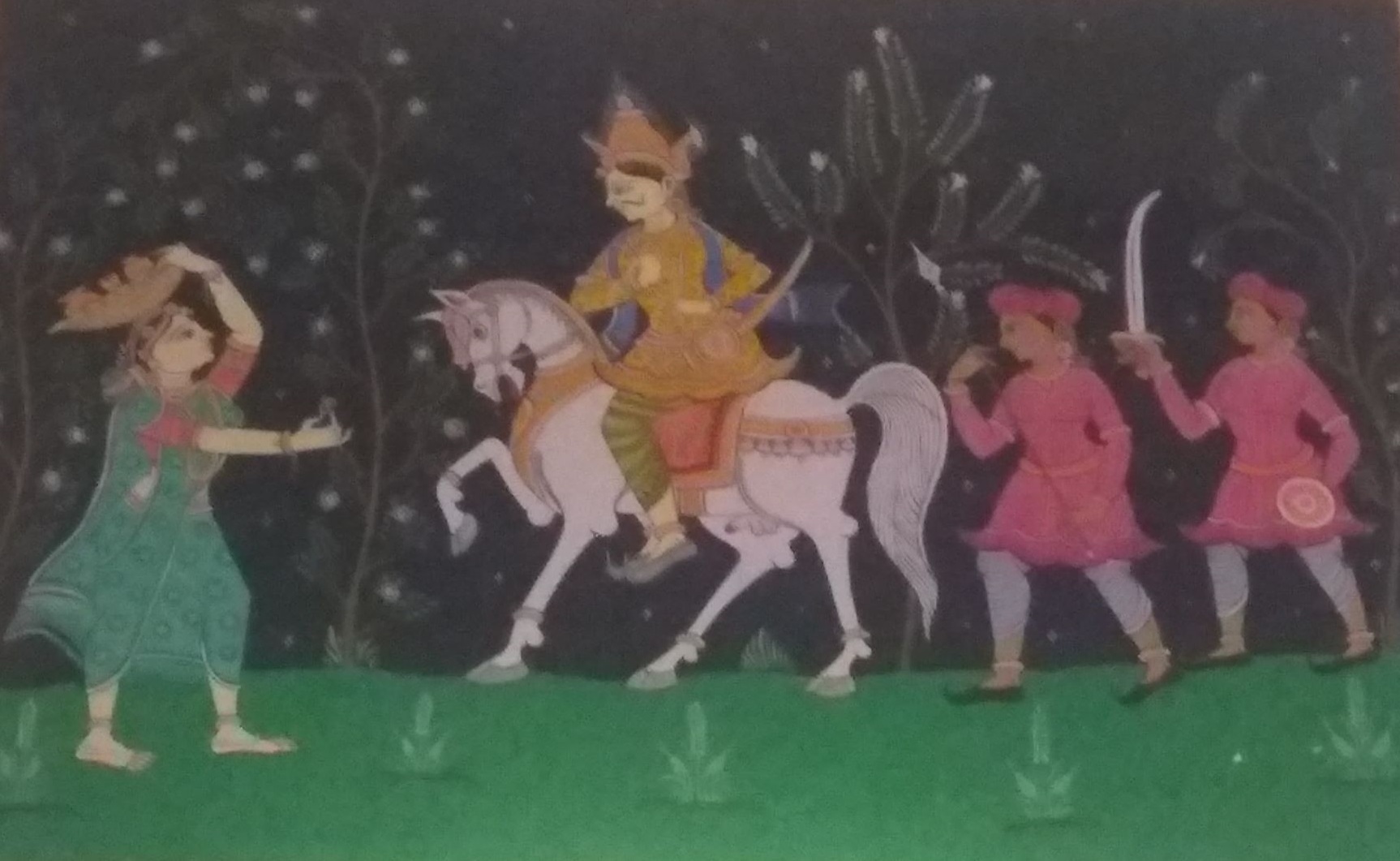
Gajapati Empire
In the royal vocabulary of pre-colonial India, four titles divided the subcontinent's rulers by the strength of their armies. The Aswapati commanded horses, the Narapati led men, the Chhatrapati held an umbrella of sovereignty. And the Gajapati -- the Master of Elephants -- commanded the most fearsome weapon of medieval Indian warfare. From their capital at Cuttack, the Gajapati dynasty turned that title into an empire that stretched, at its peak, from Bengal in the north to Tiruchirappalli in the deep south of Tamil Nadu, rivaling the mighty Vijayanagara Empire for dominance over the Deccan.
From the Ashes of the Gangas
The Gajapati Empire was born from succession, not revolution. When Bhanu Deva IV, the last ruler of the Eastern Ganga dynasty, died around 1434, a general named Kapilendra Deva of the Suryavamsa lineage seized the throne. The Eastern Gangas had already built the foundations -- they had shifted their capital from Kalinga-nagara (modern Mukhalingam near Srikakulam) to Cuttack in the 13th century, constructed the Sun Temple at Konark under Narasingha Deva I, and renovated the great Jagannath Temple at Puri under the influence of the philosopher Ramanujacharya. Kapilendra Deva inherited this infrastructure and turned it into the launchpad for expansion. The title Gajapati itself predated his dynasty -- the first recorded use appears in a 1246 CE inscription at the Kapilash Temple -- but it was Kapilendra who made it synonymous with imperial power.
An Army of Elephants and Engineers
The Gajapati military machine was organized with a sophistication that surprises modern readers. At the front marched the Hantakaru Dala, an engineering division responsible for forward scouting, clearing jungle, and marking roads -- functions identical to the combat engineers of modern armies. Behind them came the Aguani Thata, the advance units who led the charge. The main body, the Pradhana Vala, concentrated the army's greatest strength: Dhenkiya warriors wielding sword and shield, Banua marksmen with composite bows and poison-tipped arrows, Phadikara close-combat fighters in leather armor, cavalry, and the legendary elephant corps that gave the dynasty its name. Even the non-combatants had a role. The Itakara division carried musical instruments and performed war dances with the Ghumura drum, keeping morale high under the command of an officer called the Bahubalendra.
The Saint Who Unmade Warriors
The Gajapati Empire's decline began not with a military defeat but with a spiritual conversion. Chaitanya Mahaprabhu, the Bengali saint who founded the devotional movement centered on the worship of Krishna, arrived in the empire during the reign of Emperor Prataparudra and stayed for eighteen years at Puri. His influence was transformative. Prataparudra, deeply moved by Chaitanya's teachings of bhakti -- devotion through love rather than conquest -- gradually abandoned the military traditions that had sustained Kalinga's emperors for centuries. The emperor eventually retired to the life of an ascetic, leaving the empire's future uncertain and its borders undefended. Historians have pointed to this shift as one cause of the decline in militarism among the Odia population, a fateful turn that left the empire vulnerable to its rivals.
Betrayal and the End of a Dynasty
With Prataparudra withdrawn into religious contemplation, a minister named Govinda Vidyadhara saw his opportunity. He assassinated the emperor's sons and usurped the throne, ending the direct Gajapati line. The empire that had once projected power from Bengal to Tamil Nadu contracted rapidly. The Vijayanagara Empire pressed from the south, the Golconda Sultanate encroached from the west, and by 1541 the Gajapati era was over. But the dynasty's cultural legacy proved more durable than its political one. The Jagannath Temple at Puri, which the Gajapatis had expanded and made the spiritual center of their realm, endured as one of Hinduism's holiest sites. Kapilendra Deva's Narendra Tank, built within the temple precinct, still hosts the annual Chandan Yatra festival of Lord Jagannath.
Temples as Testimony
What the Gajapatis built outlasted everything they conquered. As devout Vaishnavites, they patronized art, architecture, and literature with a fervor that scholars describe as an efflorescence. The Jagannath Temple became a center for Odissi dance and dramatic performance. In Bhubaneswar, Kapilendra Deva commissioned the Shaivite Kapilesvara Temple, demonstrating a tolerance that extended beyond sectarian boundaries. Across their domain, from the Barabati Fort in Cuttack to the Kurumbera and Udayagiri forts, the Gajapatis left a chain of architectural witnesses to their century of power. Copper-plate land grants from the 15th century, inscriptions at the Lingaraj Temple, and the ornate carvings of Ekamra Kshetra in old Bhubaneswar all testify to a dynasty that understood monuments outlast armies.
From the Air
The Gajapati Empire was centered at Cuttack (20.52N, 85.79E). Key visible landmarks include the Barabati Fort ruins in Cuttack and the Jagannath Temple complex at Puri (19.81N, 85.83E), about 60 km to the south. Biju Patnaik International Airport (VEBS) in Bhubaneswar is the nearest major airport. From altitude, the coastal plain of Odisha stretching from Cuttack to Puri represents the empire's heartland. The Sun Temple at Konark (19.89N, 86.09E) is visible along the coast.