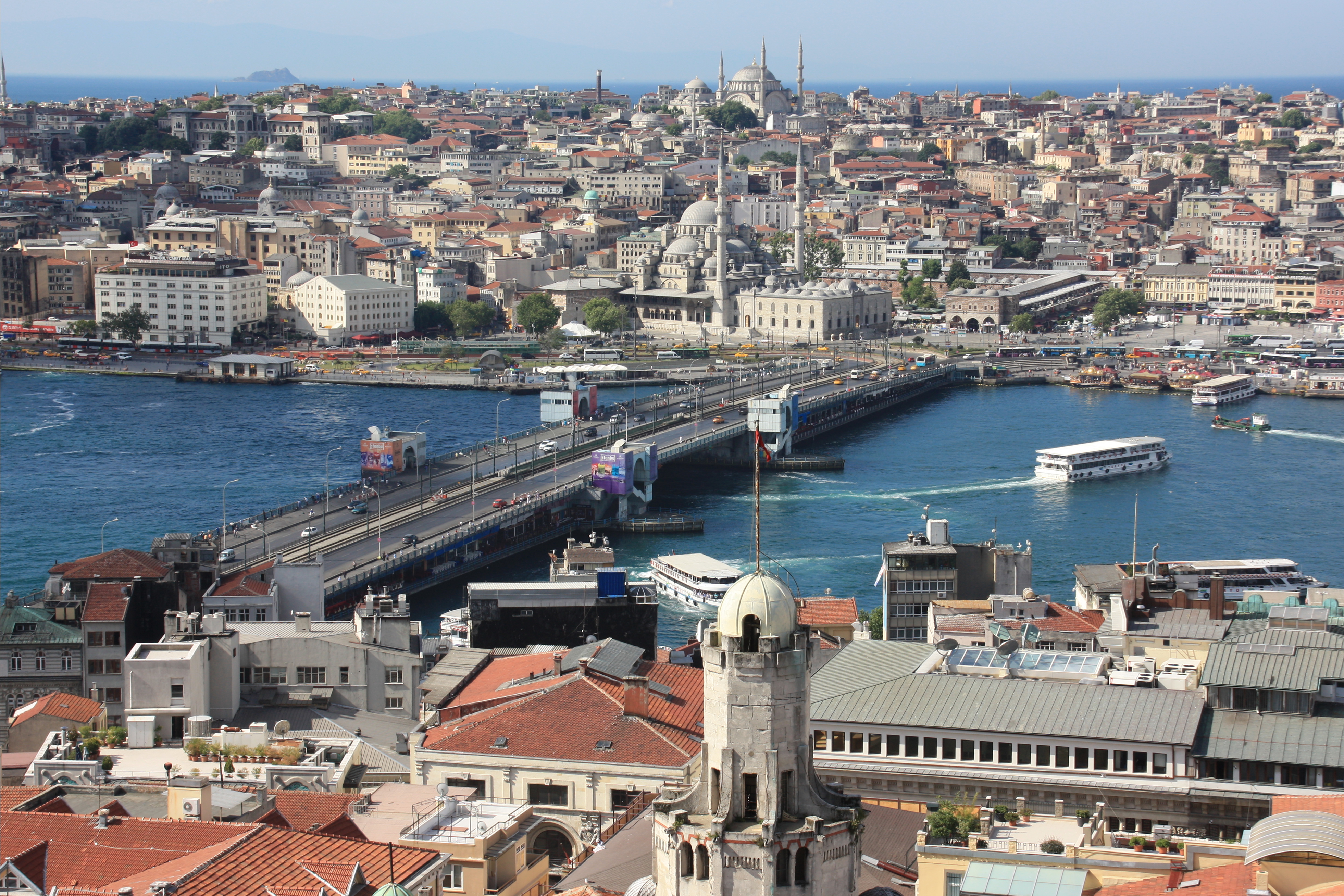
Galata Bridge
In 1502, an Italian engineer in his fifties sent the Sultan of the Ottoman Empire a sketch. Leonardo da Vinci proposed bridging the Golden Horn in a single sweeping arc - a span longer than anything ever built, supported by a pressed-bow geometry he had derived from first principles. Sultan Bayezid II said no. So did Michelangelo, when offered the same commission. The Golden Horn waited another three centuries for a bridge, and when one finally came it was wood, then iron, then more iron, then steel, in a succession of five structures across two hundred years. The current Galata Bridge, completed in December 1994, is just the latest. The fishermen leaning over its railings have been there, in one form or another, since 1845.
Leonardo's Lost Bridge
The 1502 design was, by any measure, audacious. Leonardo proposed a single masonry arch some 240 meters long, using a pressed-bow shape, parabolic curve, and keystone arch principles to distribute the load. Had it been built, it would have been the longest bridge span on Earth by a wide margin and would have remained so for centuries. Bayezid II had recently sponsored the construction of new mosques and palaces; he was no enemy of ambition. But Leonardo's bridge required techniques no one in the Mediterranean had ever attempted, and the Sultan declined. The sketch sat in a notebook. In 2001, the Norwegian artist Vebjørn Sand built a small-scale pedestrian version of Leonardo's design near Oslo - the first civil engineering project ever based on a Leonardo sketch to actually be constructed. Five hundred years late, the bridge finally got built. Just not over the Golden Horn.
Five Bridges, One Crossing
Wooden bridges came first. In 1845, the Valide Sultan - mother of Abdülmecid I - paid for a wooden span at the mouth of the Golden Horn, called the New Bridge to distinguish it from an older one further upstream. For three days, crossing was free. After that, an officer in white uniform stood at each end and collected tolls based on what you were carrying: five para if you were a pedestrian, ten if you had a backpack, twenty if you led a pack animal, a hundred if you came in a horse carriage. The system ran, more or less unchanged, until 31 May 1930. The wooden bridge was replaced in 1863 by another wooden bridge, replaced in 1875 by an iron one built by a British firm, replaced in 1912 by a German floating steel one that became famous for the bars and music venues hidden underneath. That fourth bridge burned in 1992. The current fifth bridge, a bascule structure built by the Turkish firm STFA, opened a few meters away in late 1994.
Underneath the Steel
Walk down the stairs at either end of the modern bridge and you find a string of fish restaurants tucked under the deck. They were added in 2003, deliberately imitating the ramshackle bars and meyhanes that had clung to the underside of the old fourth bridge - a place so important to Turkish music that bands like Duman, MFÖ, Şebnem Ferah, and Teoman count their formative years as time spent in the bar Kemancı under the old Galata. Above your head, trams of the T1 line clatter across, running from Bağcılar in the western suburbs all the way to Kabataş, just below Dolmabahçe Palace. Above the trams, the bridge railing is occupied, almost without break, by men with telescoping rods. They have been catching small bluefish and mackerel here for as long as anyone can remember.
The Line Between Two Cities
The Galata Bridge is more than a piece of infrastructure. For a thousand years it has been the symbolic seam between two Istanbuls. South of the Golden Horn lies Fatih - the old peninsula of mosques, the imperial palaces, the seat of religious and secular power. North across the bridge lies Beyoğlu and what was once Pera, the European quarter where ambassadors lived, where merchants from Genoa and Venice traded, where Greek and Armenian and Jewish communities clustered, where signs hung in five languages. The Turkish writer Peyami Safa captured the feeling in his novel Fatih-Harbiye: walk across the bridge and you change civilizations. The Italian traveler Edmondo De Amicis, in his nineteenth-century book Constantinople, described the procession of faces and costumes on it as something from a fevered dream. The bridge gave Istanbul its hyphen.
What the Card Game Was Named After
Here is one charming legend: the card game called bridge may take its name from this place. The story holds that British soldiers stationed in Constantinople during the late nineteenth century, on their way to favorite coffeehouses in Pera, would cross the Galata Bridge so often that the route gave the game its name when they brought it home. Etymologists are skeptical. But standing on the bridge at sunset - the New Mosque silhouetted to the south, ferries thrashing the Golden Horn into copper foam, fishermen pulling up silver flashes from below - it does feel like the kind of place that ought to have spawned a card game, a film, a novel, a whole genre of melancholy songs. It has, in fact, spawned all of these. Geert Mak's book The Bridge, published in 2008, devotes itself entirely to the people who make a living here. There are a lot of them. There always have been.
From the Air
The Galata Bridge crosses the Golden Horn at 41.02°N, 28.97°E in the heart of Istanbul, connecting Eminönü on the Old City peninsula (south) to Karaköy in Beyoğlu (north). From the air it is a thin black line across the brown-blue water of the Horn, slightly arched at the center where the bascule sections raise. Look for the New Mosque (Yeni Cami) just south of the southern end and the Galata Tower rising about 400m north. Istanbul Airport (LTFM) is about 30 km west; Sabiha Gökçen (LTFJ) about 25 km southeast. The Bosphorus opens to the east, the Sea of Marmara to the south.