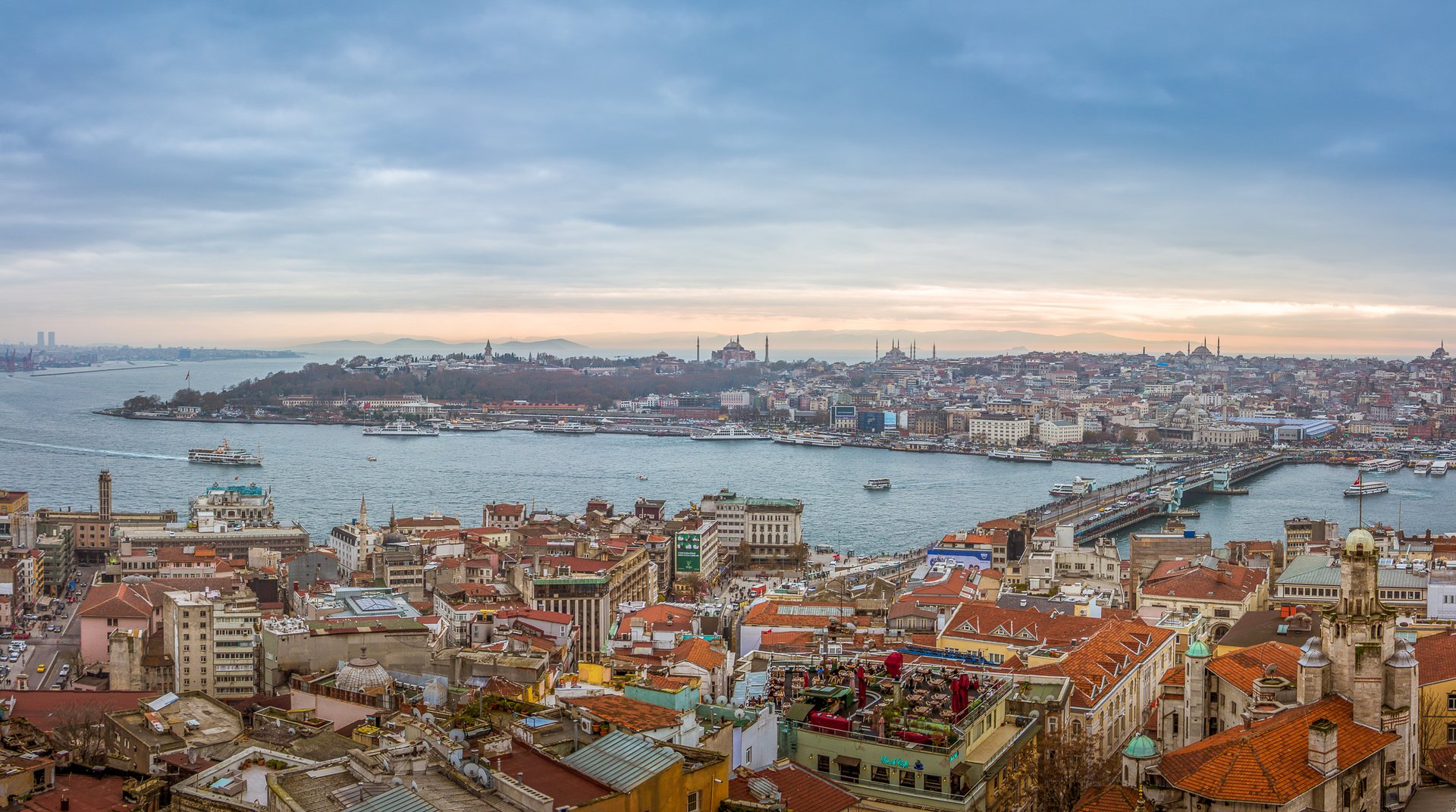
Galata
The Greeks called it Peran en Sykais, the Fig Field on the Other Side. They meant the other side from the city of Constantinople - across the Golden Horn, opposite the great peninsula of palaces and patriarchs, on a hill that everyone agreed was outside the real city. For most of the medieval period, that geographic insult turned out to be a privilege. Galata was where you went if you were from somewhere else. Genoese merchants, Venetian traders, Greek and Armenian Christians, Sephardic Jews fleeing the Spanish Inquisition, Spanish Moriscos expelled in 1609, Catholic monks, Levantine bankers - all of them washed up here, on the wrong side of the water, and built a city of their own.
A Tower at the Top
The skyline gives Galata away from kilometers off. The Galata Tower, built by the Genoese in 1348 at the highest point of their citadel walls, is still the most recognizable structure on the European side of Istanbul. The Genoese were granted this hill in 1267 by the Byzantine Emperor Michael VIII Palaiologos, under the Treaty of Nymphaeum, in gratitude for help retaking Constantinople from the Latin crusaders. The original treaty barred them from fortifying the colony. The Genoese ignored that, building higher and thicker walls each generation, until the tower crowned the lot. Today only fragments of the medieval walls survive in the streets immediately around the tower. The hill itself remains the same - steep, cobbled, and best climbed slowly.
The Conquest That Spared Them
When Mehmed II's army breached the walls of Constantinople in May 1453, the Genoese of Galata had to make a fast political calculation. They had stayed officially neutral during the siege, neither helping the Sultan nor openly opposing him. As the city fell, accounts diverge - one historian, Halil İnalcık, estimates that around eight percent of Galata's population fled by ship. Of those who remained, most surrendered. Some sources say the Genoese mayor handed the keys to the Ottoman commander Zagan Pasha before the fleet had even arrived. Sultan Mehmed accepted the surrender and largely left Galata's residents alone. Property of those who fled was confiscated, but, by some accounts, restored to anyone who returned within three months. The eyewitness Leonard of Chios remembered something darker: women separated from children in the panic, valuables abandoned, swimmers drowning in the Golden Horn. Both accounts are probably true.
The Refuge
The Ottoman conquest did not end Galata as a Christian quarter; it changed how it worked. Sultan Bayezid II later gave the old Dominican church of San Domenico to Spanish Moors who fled the Spanish Inquisition of 1492 - the building has been the Arap Camii, the Arab Mosque, ever since. More Spanish Moriscos arrived between 1609 and 1620 after their expulsion from Spain, intermarrying with the locals. Sephardic Jewish communities established synagogues that still stand today, including the Italian Synagogue and the Neve Shalom. Greek and Armenian Catholic and Orthodox churches kept their congregations. By the early twentieth century, the historian Matthew Ghazarian wrote, Galata was "a bastion of diversity" - the Brooklyn, in his phrase, to the Old City's Manhattan. Shop signs hung in Ottoman Turkish, French, Greek, and Armenian, sometimes all four on the same building.
The Banks Street
Walk down Bankalar Caddesi - Banks Street - and you walk through the financial center of the late Ottoman Empire. The Imperial Ottoman Bank, opened in 1892, anchors the street; today it is the Ottoman Bank Museum. Beside it stand a row of nineteenth-century bank buildings, several decorated with carved stone ornaments salvaged from the medieval Genoese Palace - the Palazzo del Comune, built by Galata's Genoese podestà Montano De Marini in 1314. The palace itself still stands further up the street, though its front facade was rebuilt in the 1880s and locals know it now by another name, Bereket Han. Nearby, the famous Camondo Stairs curve up the hillside in a graceful neo-baroque double helix, built around 1870 by the Ottoman-Venetian Jewish banker Abraham Salomon Camondo. The Camondo family financed the Sultan; their later descendants were murdered at Auschwitz. The stairs remember them by name.
The Saray That Named a Football Club
Up the hill from the tower, on the avenue today called İstiklal, stood the Mekteb-i Sultani - the Imperial Lyceum, founded in 1481 by Bayezid II in a garden of red and yellow roses. The school's name in popular usage was Galata Sarayı, Galata Palace, and the district around it gradually became known by that name too. In 1905, in classroom 5B, a group of students founded a football club. They called it Galatasaray, after their school, after their neighborhood. Today the club fills 50,000-seat stadiums in red and yellow - the colors of the original rose garden - and Galata Palace as a name now belongs more to football than to anything imperial. The roses are gone. The schoolyard remains. So does the tower at the top of the hill, watching over a quarter that has spent eight centuries being everyone else's first home in the city.
From the Air
Galata sits at 41.02°N, 28.97°E on the north shore of the Golden Horn, opposite Istanbul's Old City peninsula and just south of the bend where the Golden Horn meets the Bosphorus. From the air the Galata Tower is a small dark cylinder at the top of a steep hill, with the dense streets of Karaköy spilling down toward the water. The Galata Bridge crosses to Eminönü directly south. Istanbul Airport (LTFM) is about 30 km west; Sabiha Gökçen (LTFJ) about 25 km southeast on the Asian side. Best viewed at low altitude in clear morning light, when the Bosphorus is calm and the tower throws a long shadow over the slope below.