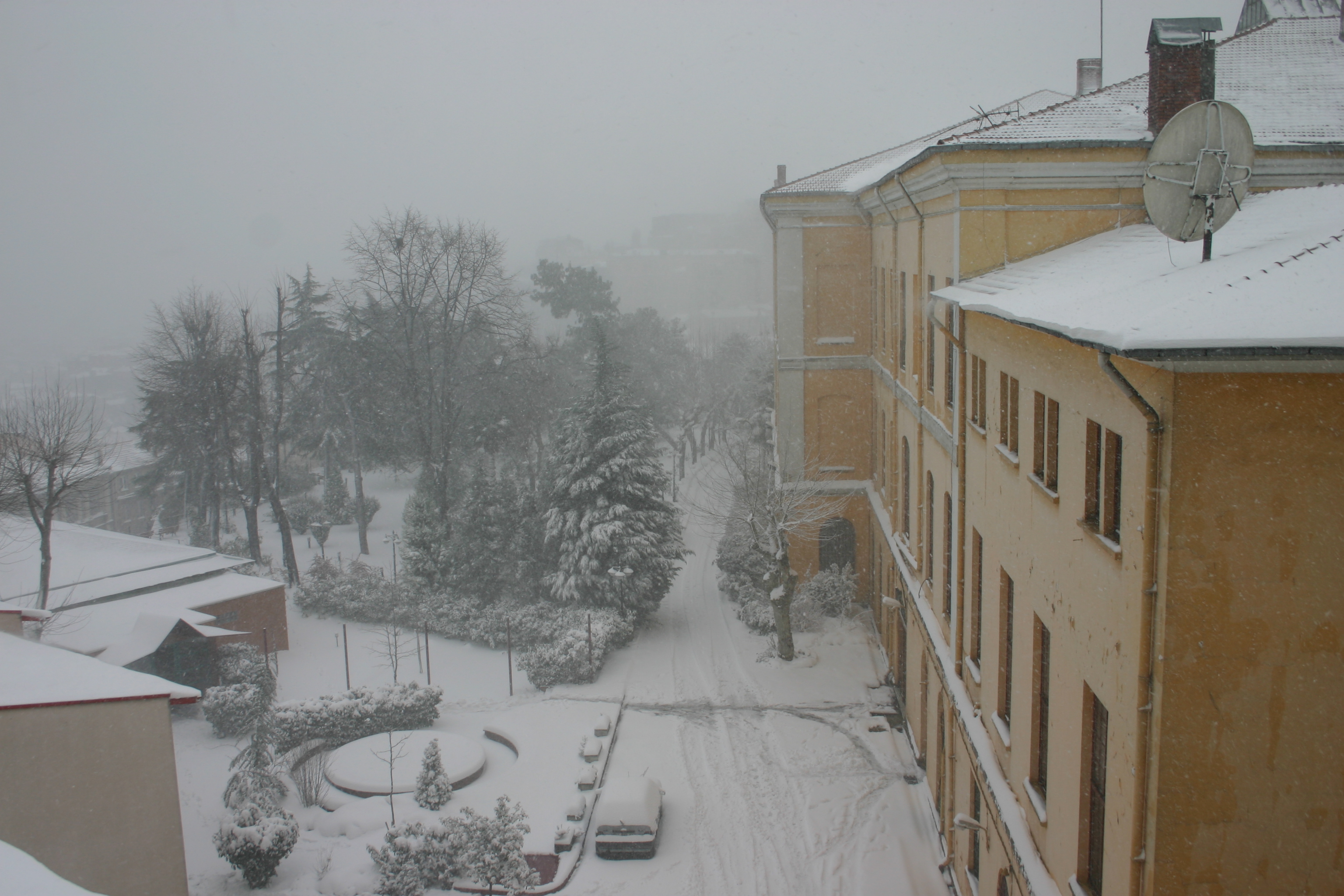
Galatasaray High School
Bayezid II liked to walk Istanbul incognito. The story goes that one of these wanders, in a Galata garden filled with red and yellow roses, brought him to a Bektashi dervish named Gül Baba - Father Rose. The Sultan asked the wise man how the empire could be improved. Gül Baba said the empire needed a school where students of every background could be educated together, and that he would gladly serve as its first teacher. Bayezid took him at his word. In 1481, the Sultan returned to that rose garden with an imperial edict establishing the Galata Sarayı Enderun-u Hümayunu - the Galata Palace Imperial School - in the grounds beside it, with Gül Baba as headmaster. Five hundred and forty-five years later, the school is still there, on the same street, in roughly the same spot.
Older Than the Republic
Galatasaray High School is the oldest high school in Turkey, and the second-oldest Turkish educational institution after Istanbul University, which was founded in 1453 - the year Constantinople fell. It predates the Republic of Turkey by 442 years. It predates Galileo, Shakespeare, and Newton. It survived the abolition of the sultanate, the Tanzimat reforms, the proclamation of the Republic, the secularization of education, two world wars, and the introduction of mixed schooling in 1965. Admission today is by national entrance exam, and successful candidates represent roughly the top 0.03 percent of all test-takers in Turkey. About a hundred children are admitted to the high school each year. The exam is one of the most competitive in the country.
The French Pivot
For three and a half centuries the school taught in Ottoman Turkish along classical Islamic lines. Then Sultan Abdülaziz, the first Ottoman sultan to visit Europe, came back from a trip to France in the 1860s impressed by the lycée system. In September 1868 he reopened the school as the Lycée Impérial Ottoman de Galata-Sérai - in Turkish, Galatasaray Mekteb-i Sultanisi - with French as the main language of instruction, European teachers, and an open enrollment policy that admitted students from every religious and ethnic community of the empire. From 1868 to 1878, most students were non-Muslims, including a substantial Bulgarian contingent. The lycée model has held for more than 150 years now. Courses on Turkish literature, history, and geography are taught in Turkish; French Literature, philosophy, mathematics, and science are taught in French; English, Italian, and Latin round out the languages. Graduates of Galatasaray hold a diploma equivalent to the French Baccalaureate and are admitted to French universities without further examination.
Fire in 1907
In 1907 a fire broke out in the wooden school buildings on İstiklal Avenue and burned them to the ground. The library, the museum, the archive - all of it lost, with only some of the external stones surviving. The students were temporarily moved across the Bosphorus to Beylerbeyi while a new stone building rose on the same site. By 1909 they were back. The current main building, with its high yellow facade and tall iron gates opening onto the bustle of İstiklal Avenue, dates from that reconstruction. A red-and-white nostalgic tram still passes the gates several times an hour. Inside, the courtyard is shaded by old plane trees, and the bell that summons students between classes is the same kind that has summoned students since the Ottoman period.
An Alumni List That Runs the Country
Three Turkish prime ministers - including Nihat Erim - graduated from Galatasaray. So did the foreign ministers Fatin Rüştü Zorlu and Feridun Cemal Erkin. Tevfik Fikret, the late-Ottoman poet who all but invented modern Turkish lyric verse, taught here. So did the painter Şevket Dağ. The Turkish-American economist Daron Acemoğlu, who won the 2024 Nobel Memorial Prize in Economic Sciences for his work on the institutional roots of national prosperity, is a Galatasaray graduate. The physicist Feza Gürsey, whose work on group theory shaped a generation of theoretical physics, sat in these classrooms. So did Ali Sami Yen, who in 1905 founded the Galatasaray Sports Club in classroom 5B with a few friends and named it after the school. The club became one of the most successful football organizations in Turkey, and the district around the school took the name too. Today everyone knows Galatasaray as the football club. The football club exists because of this school.
Still Recruiting
After the 1992 Turkish-French Bilateral Agreement, the lycée added a sister institution - Galatasaray University - which now reserves 25 percent of its enrollment for graduates of the high school. The high school itself became co-educational in 1965, and female students now make up at least 40 percent of pupils. There is one year of French preparation, then four years of senior high, all conducted in two languages with deep European cultural literacy expected. Many graduates spend the rest of their lives reading novels in two languages and arguing politics in three. Atatürk visited the school three times - on 2 December 1930, 28 January 1932, and 1 July 1933 - and the visits are still commemorated. The roses Gül Baba tended in 1481 are long gone. The school he founded is still recruiting.
From the Air
Galatasaray High School sits at 41.03°N, 28.98°E on İstiklal Avenue in Beyoğlu, roughly a kilometer north of the Galata Tower and the Golden Horn. From the air it is hard to pick out individually - the Beyoğlu district is densely built - but İstiklal Avenue itself shows as a long pedestrian thoroughfare running roughly north-south through the European quarter, terminating at Taksim Square to the north. Istanbul Airport (LTFM) is about 30 km west; Sabiha Gökçen (LTFJ) about 25 km southeast across the Bosphorus. Best appreciated at street level rather than from the air.