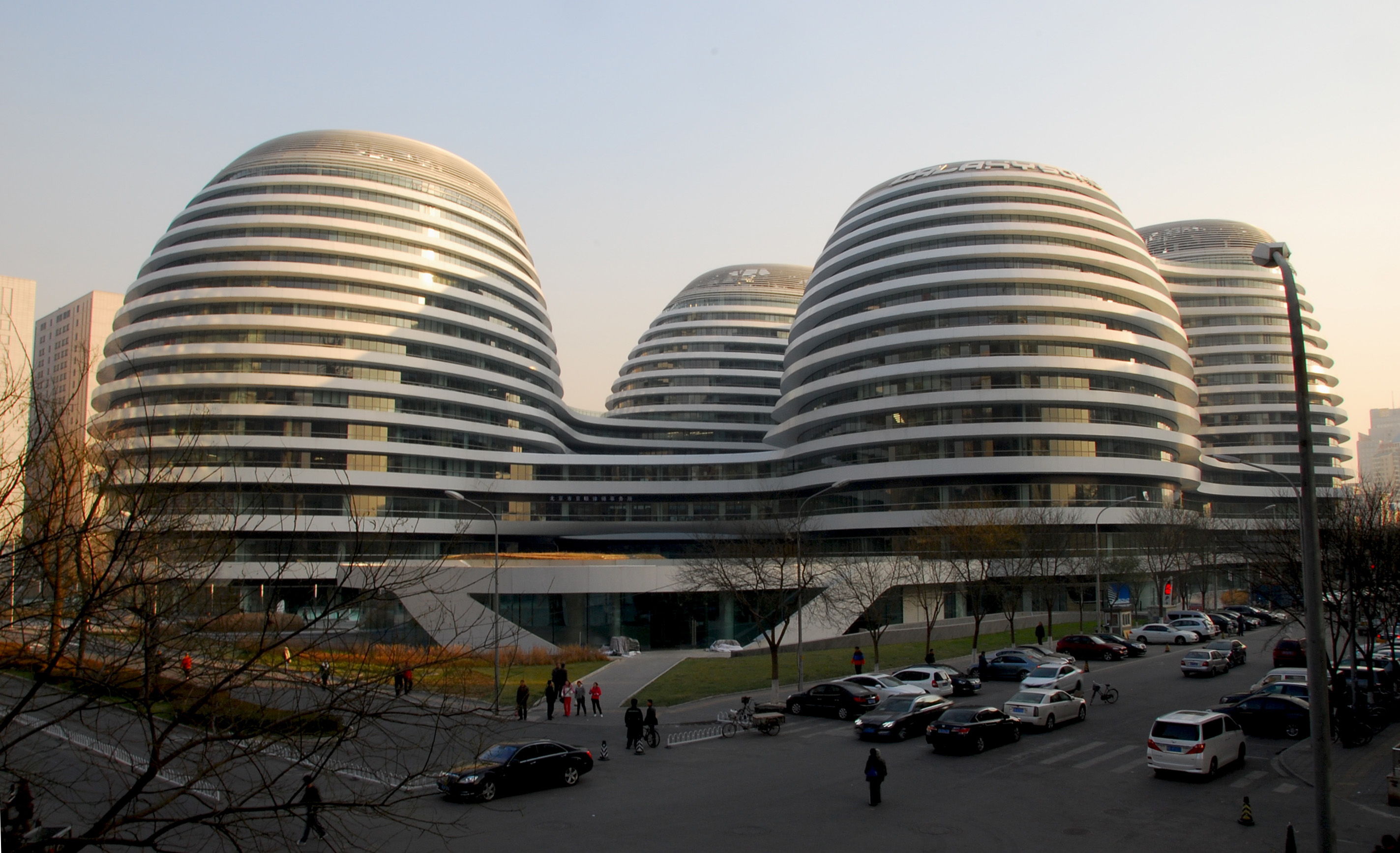
Galaxy SOHO
Nothing else in Beijing looks like this. Four enormous domed structures bulge and merge near the southwest corner of Chaoyangmen Bridge, their smooth aluminum-and-stone skin curving in ways that seem to defy the right angles surrounding them. Galaxy SOHO, completed in 2012, was the first of three Beijing buildings designed by Iraqi-British architect Zaha Hadid, and from the moment it opened, it divided opinion as sharply as its curves divided the skyline. Hadid called it a reinvention of the classical Chinese courtyard. Heritage advocates called it an act of destruction.
Courtyards Without Corners
The design emerged from Hadid's fascination with parametric architecture -- buildings generated through mathematical relationships rather than drawn by hand. Four asymmetric structures flow into one another through bridges and platforms, creating interior courtyards and a central canyon that echo the spatial logic of a traditional siheyuan, the courtyard houses that defined old Beijing, but rendered in a vocabulary of continuous curves. The exterior cladding of aluminum and stone gives way inside to glass, terrazzo, stainless steel, and glass-reinforced gypsum. Across 330,000 square meters and eighteen floors, the complex distributes retail and entertainment on the lower three levels, office space from the fourth through fifteenth floors, and restaurants, bars, and cafes on the top three stories, where diners look out across the city through walls that never quite become ceilings.
The Price of the New
When the Royal Institute of British Architects nominated Galaxy SOHO for the Lubetkin Prize in 2013, the Beijing Cultural Heritage Protection Centre responded with a sharp public rebuke. The development, the Centre stated, had caused great damage to the preservation of the old Beijing streetscape, the original urban plan, traditional hutong neighborhoods, courtyard houses, and the vernacular architecture that gave the city its character. The criticism touched a nerve that runs through modern Beijing: a city racing to build its future while watching its past vanish block by block. Whatever one thinks of the architecture, the hutongs that once occupied this site are gone, replaced by curves that generate their own kind of urban life but bear no trace of what came before.
Living Inside the Future
For the people who work and shop inside Galaxy SOHO, the controversy is largely abstract. The complex functions as a self-contained urban ecosystem along Beijing's Second Ring Road, where the cooled roofing system manages microclimates created by the building's own geometry. The flowing floor plates create unexpected sightlines and gathering spaces that feel more like landscape than architecture. Hadid went on to design two more Beijing buildings for SOHO China -- Wangjing SOHO and Leeza SOHO -- but Galaxy remains the most provocative, the one that announced most loudly that Beijing's architectural ambitions had no interest in staying inside the box. Whether that ambition honored or betrayed the city's identity depends on where you stand, and from the air, the building's four domes look like nothing so much as bubbles rising from the flat grid of the old city.
From the Air
Located at 39.9192N, 116.4268E near the Chaoyangmen interchange on Beijing's Second Ring Road. The four distinctive white-gray domed structures are easily identifiable from the air, contrasting sharply with the rectangular grid of surrounding buildings. Beijing Capital International Airport (ZBAA) is approximately 25 km northeast. Best viewed at 2,000-4,000 ft AGL to appreciate the flowing parametric form.