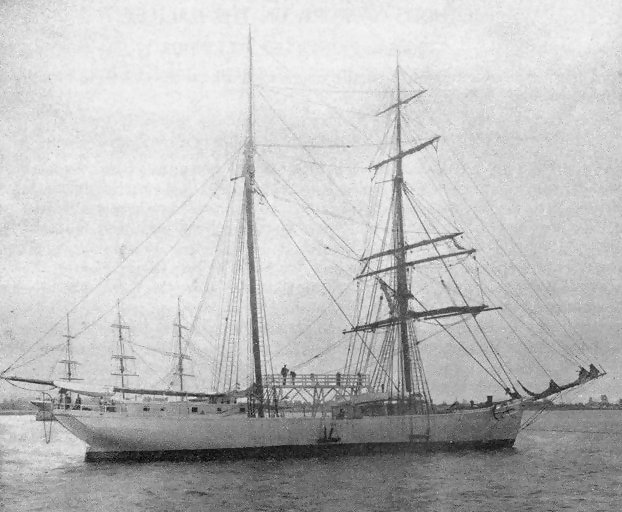
Galilee (ship)
The brigantine Galilee was built for speed. Designed by Matthew Turner in 1891, she began her career on the packet line between San Francisco and Tahiti, earning a reputation as one of the fastest sailing vessels on the route. But her second career was stranger and more consequential: in 1905, the Carnegie Institution chartered her, stripped out every piece of iron that could be removed without sinking her, and converted her into a floating magnetic observatory. For three years, she crisscrossed the Pacific measuring the Earth's magnetic field -- work that would help calibrate nautical compasses and advance the understanding of terrestrial magnetism.
Turner's Design
Matthew Turner was one of the most prolific shipbuilders on the Pacific Coast, and the Galilee was among his finest designs. As a brigantine -- a two-masted vessel with a square-rigged foremast and a fore-and-aft rigged mainmast -- she combined the speed of square sails for downwind passages with the maneuverability of gaff rigging for working in harbors and coastal waters. The San Francisco-to-Tahiti packet run demanded both: fast ocean passages across open water, followed by careful navigation through reef-lined approaches. Galilee delivered, and her reputation for speed made her an attractive choice when the Carnegie Institution went looking for a vessel to convert into a research platform.
A Ship Made of Wood and Brass
The challenge of measuring the Earth's magnetic field from a ship is that ships themselves are magnetic. Iron hulls, iron fittings, even iron nails in the planking distort compass readings and interfere with magnetometers. To solve this, the Carnegie Institution's Department of Terrestrial Magnetism oversaw a conversion that replaced every possible iron component on the Galilee with non-magnetic materials -- brass, copper, and wood. The transformation turned a working trading vessel into a precision scientific instrument. Between 1905 and 1908, the Galilee made three extended cruises across the Pacific, taking systematic measurements of magnetic declination, inclination, and intensity at points across thousands of miles of ocean.
Charting the Invisible
The data collected by the Galilee helped fill enormous gaps in the global magnetic chart. At the turn of the twentieth century, much of the Pacific was still poorly surveyed magnetically, meaning that navigators crossing those waters relied on compass corrections that were based on incomplete information. The Galilee's cruises provided the observations needed to improve magnetic charts used by every vessel navigating the Pacific. The work was unglamorous -- long passages between measurement stations, painstaking instrument readings, careful record-keeping in all weather conditions -- but it was foundational. The Carnegie Institution would later build a purpose-designed non-magnetic research vessel, the Carnegie, to continue this work, but the Galilee proved the concept.
After the Science
The Galilee's scientific career ended after the third Pacific cruise in 1908. She returned to commercial service and eventually made her way back to the San Francisco waterfront, where she joined the community of aging sailing vessels that clustered around the city's piers in the early twentieth century. Her legacy lives in the magnetic charts she helped create -- charts that made navigation safer for every ship that followed her across the Pacific. The Carnegie, her more famous successor, was destroyed by a gasoline explosion in Samoa in 1929, making the Galilee's surviving contribution to terrestrial magnetism research all the more significant.
From the Air
The Galilee was based out of San Francisco and conducted research cruises across the Pacific Ocean. San Francisco Bay coordinates approximately 37.81N, 122.42W. The brigantine's home port was along the San Francisco waterfront. Nearby airports: KSFO (11nm S), KOAK (8nm E).