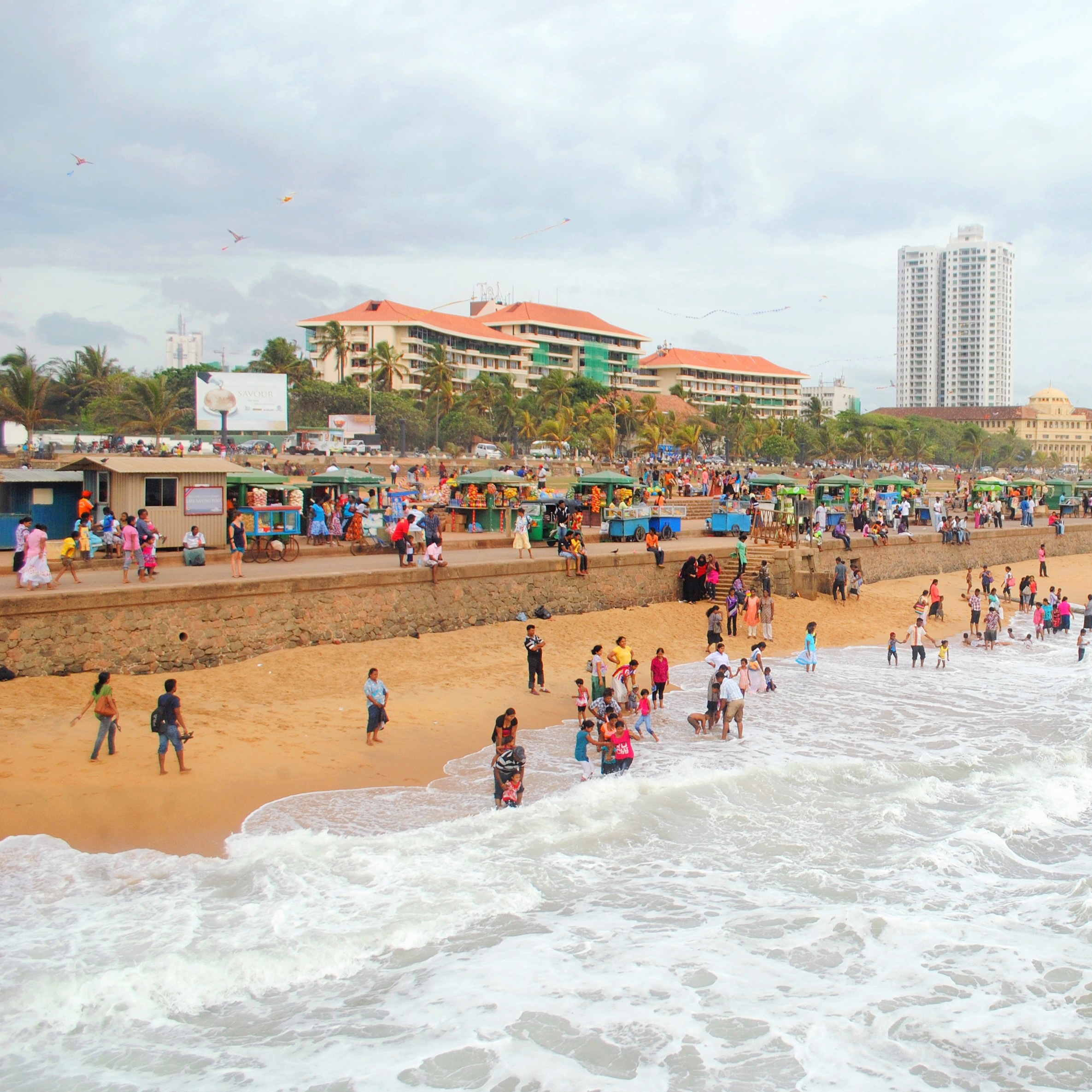
Galle Face Green
The Dutch cleared this land to kill people. They needed an unobstructed line of fire from their fort cannons toward the Portuguese positions, and so they levelled the scrub along Colombo's western shoreline into an open field. Three centuries later, families spread blankets on that same ground, children chase kites into the Indian Ocean wind, and vendors sell sliced mango dusted with pepper and salt. Galle Face Green has been many things to many rulers, but it has always belonged, in practice, to whoever showed up.
A Name That Faces South
Even the name carries the sediment of colonial occupation. One theory traces it to the Dutch fortification's gateway, the Gal Gate, which faced south toward the port city of Galle. In Dutch, faas means front, so Galle Face literally described the front of the fort that looked toward Galle. A competing etymology draws from the Sinhalese word gal, meaning rock, referring to the rocky shoreline the Dutch found when they arrived. The original Green extended far beyond its current five hectares, bounded by Beira Lake to the north, the Indian Ocean to the west, and St. Peter's Church to the east. By the time Governor Sir Henry George Ward authorized a one-mile promenade along the oceanside in 1856, designed for ladies and children to saunter and "take in the air," the space was already shrinking. The promenade was completed in 1859, and the Green has been contracting ever since as Colombo grew around it.
Where Sri Lanka Learned to Play
In the early 1820s, British Governor Sir Edward Barnes filled and levelled the marshy esplanade in front of the fort for a purpose the Dutch never envisioned: horse racing. The Colpetty Race Course stretched approximately one and a half miles, and a thatched cadjan-roofed pavilion rose at the green's highest point for spectators. That pavilion evolved over decades into a brick building, then a grandstand, and ultimately the Race Bungalow, which became the Colombo Club in 1871. The building still stands, now the Crystal Ballroom of the Taj Samudra Hotel. Racing moved to the Colombo Racecourse in 1893, but by then the Green had spawned an entire sporting culture. In a single remarkable year, 1879, British expatriates inaugurated the Colombo Golf Club on the Green without a clubhouse or proper course, the first official rugby match in Ceylon was played between the Colombo Football Club and a rest-of-the-world team, and Royal College and S. Thomas' College played the inaugural Royal-Thomian cricket match. Legend has it the two cricket teams rowed across Beira Lake in boats to reach the grounds.
Colombo's Living Room
Today the Green is a five-hectare strip between Galle Road and the Indian Ocean, the largest open space in Colombo. On weekend evenings it transforms into something between a food market and a festival, with vendors selling cooked crabs and prawns alongside the mango slices. Kite flyers stake out their patches of sky. Lovers walk along the promenade that Governor Ward built for Victorian propriety but that now serves a more democratic purpose. The Galle Face Hotel, established in 1864, anchors the southern end with its colonial verandahs. Radio Ceylon, the oldest radio station in South Asia, once recorded programs here during outside broadcasts in the 1950s and 1960s. On 25 December 2016, the Green hosted what was recorded as the world's tallest artificial Christmas tree. Every February 4th, Sri Lanka's national day celebrations fill the space with flags and ceremony.
The Ground Pushed Back
In April 2022, as Sri Lanka's economic crisis deepened under President Gotabaya Rajapaksa, the Green became something it had not been since the Dutch cleared it for warfare: contested ground. Protesters occupied the park on April 9th and built a camp complete with food, water, toilets, medical facilities, and a lending library. They called it Occupy Galle Face. The camp became a symbol of democratic resistance, a tent city pitched beside Colombo's seat of power. On Black Monday, pro-Rajapaksa partisans attacked the protest camp. At least eight protesters died and over a hundred were injured. The violence did not end the movement. Rajapaksa eventually fled the country. The Green, which had absorbed horse races, cricket matches, and Christmas trees with equal indifference, absorbed this too. It remains what it has always been: whatever Colombo needs it to be.
From the Air
Galle Face Green sits at 6.927N, 79.844E along Colombo's western coastline, a narrow strip of green clearly visible between the dense urban development and the Indian Ocean. Best viewed from the west at 1,500-3,000 feet AGL, where the contrast between the park and surrounding city is most dramatic. The nearest major airport is Bandaranaike International (VCBI), approximately 18 nautical miles north. Ratmalana Airport (VCCC) is closer at about 5 nautical miles south. The Galle Face Hotel and adjacent high-rise developments provide orientation landmarks along the coast.