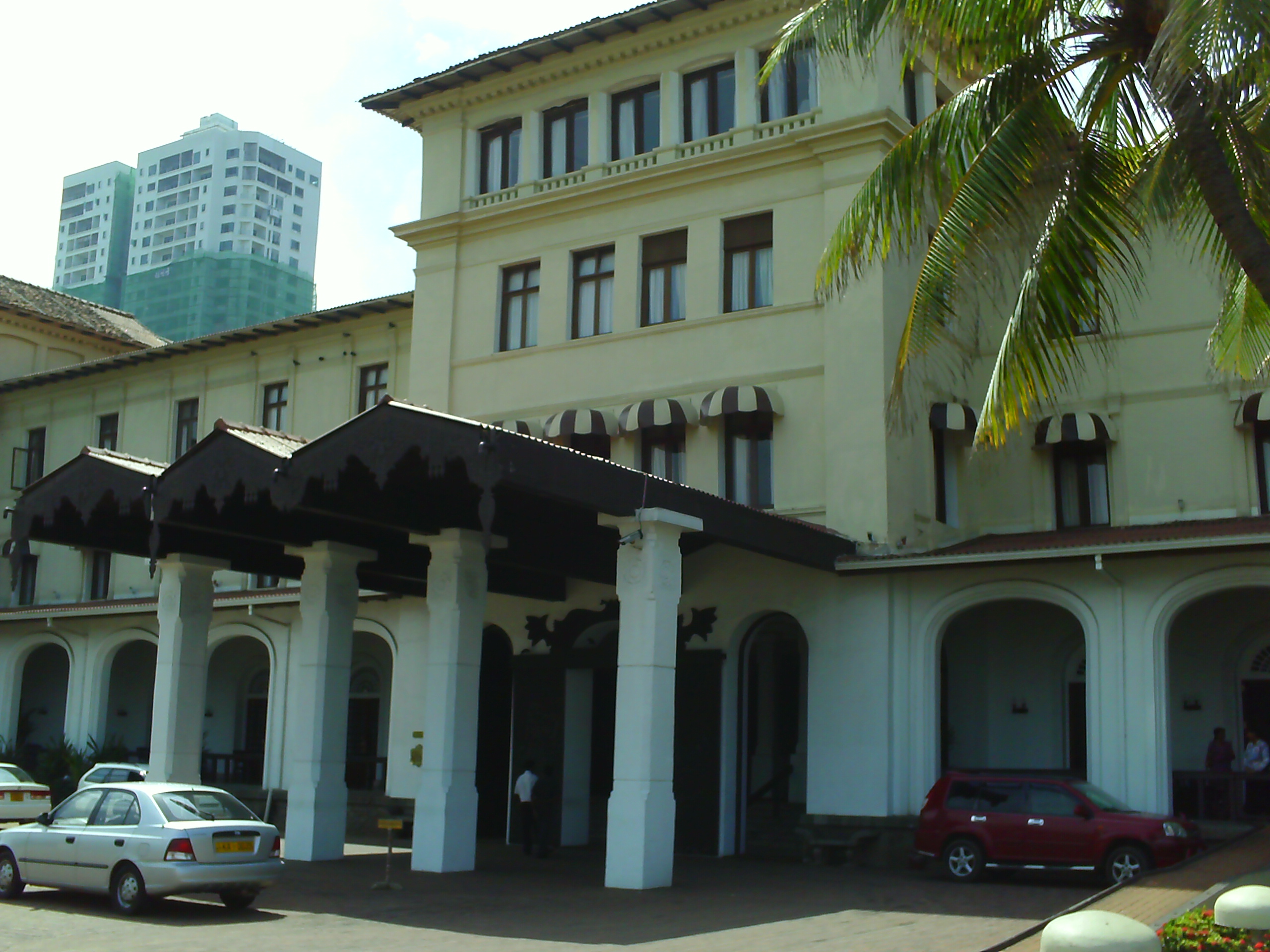
Galle Face Hotel
In 1840, a British artillery cannon misfired during a practice session on the Galle Face Green. The cannonball crashed through the roof of the Galle Face Boarding House and landed on a drawing room floor. Rather than demolish the embarrassment, subsequent owners preserved the cannonball, placed it on a pedestal, and eventually turned the mishap into an annual commemorative race. That instinct -- to absorb history rather than erase it -- defines the Galle Face Hotel, which has stood on this stretch of Colombo coastline since 1864, collecting stories the way other buildings collect dust.
From Dutch Villa to Grand Hotel
The building began as a Dutch villa called Galle Face House. Four British entrepreneurs converted it into a hotel in 1864, naming it after the stretch of green lawn it overlooked. Land for expansion was purchased between 1870 and 1894, and in 1894 architect Edward Skinner completed the design of the south wing that still defines the property's silhouette. The hotel has been extensively restored but never fundamentally altered, a rarity among colonial-era properties in South Asia. It is listed in the book 1000 Places to See Before You Die, won the first-ever PATA award for Best International Heritage Hotel in 2012, and remains the only hotel in Colombo with genuine beachfront access, a geographic accident of its 19th-century origins that no amount of modern development can replicate.
The Guest Register
The hotel's guest list reads like a catalog of the 20th century's most consequential figures. Princess Alexandra of Denmark, Jawaharlal Nehru, Indira Gandhi, Richard Nixon, Prince Philip, Admiral Louis Mountbatten, Emperor Hirohito while still a prince, the cricketer Sir Donald Bradman, and cosmonaut Yuri Gagarin all stayed here. The literary connections run equally deep. Mark Twain, Anton Chekhov, and Arthur Conan Doyle used the premises while writing, and Arthur C. Clarke wrote the final chapters of 3001: The Final Odyssey within its walls. In the 1950s and 1960s, Radio Ceylon broadcast New Year's Eve dances from the hotel, and the Coconut Grove nightclub hosted Mignonne Fernando and The Jetliners, whose performances became a fixture of Colombo nightlife.
Kuttan at the Door
K.C. Kuttan joined the Galle Face Hotel as a bell boy and waiter in 1942. He never left. Over the decades he became the hotel's doorman, greeting guests with a consistency that outlasted the British Empire, Sri Lankan independence, a civil war, and the hotel's own renovation. When international media discovered him, he was recognized as the world's oldest hospitality industry veteran. He continued serving until his death on November 18, 2014, having worked at the same establishment for seventy-two years. His story captures something essential about the Galle Face Hotel: it is a place where time accumulates rather than passes, where the staff become as much a part of the architecture as the columns and verandahs.
Cannonballs and Saltwater
The hotel's eccentricities are part of its charm. The museum in the Regency Wing houses Prince Philip's first car and a gallery of famous guests. The Chequerboard, a black-and-white tiled terrace near the King of the Mambo Cuban restaurant, serves as a sunset-watching platform. The swimming pool is filled with salt water, the only one of its kind in Colombo, positioned so close to the Indian Ocean that the distinction between pool and sea feels almost philosophical. And then there is the Cannonball Run, the annual commemorative race from the cannon at the Fort end of the Green to the preserved cannonball inside the hotel, typically run by members of Colombo's diplomatic community. The last recorded run was in 2016, but the cannonball remains on its pedestal in the south wing, a monument to the productive absurdity of turning a military accident into a tradition.
From the Air
The Galle Face Hotel sits at 6.920N, 79.846E on Colombo's western coastline, immediately south of the Galle Face Green. The colonial-era building with its distinctive south wing is identifiable from the air along the coastal strip. Best viewed from the west at 1,000-2,500 feet AGL. Bandaranaike International Airport (VCBI) is approximately 18 nautical miles to the north. Ratmalana Airport (VCCC) lies about 5 nautical miles south. The hotel sits between modern high-rises and the green strip, making it a useful orientation landmark along Colombo's waterfront.