Galleria Borghese
In 1644, the English diarist John Evelyn visited the Villa Borghese and called it "an Elysium of delight," marveling at its fountains, groves, and a vivarium housing ostriches, peacocks, and "divers strange Beasts." Nearly four centuries later, the villa still earns the superlative. The Galleria Borghese holds one of the most concentrated collections of masterpieces in existence: six paintings by Caravaggio, some of Bernini's most important marble sculptures, Raphael's Entombment of Christ, Titian's Sacred and Profane Love, and Canova's Venus Victrix. It fits into twenty rooms across two floors. There is no filler.
A Cardinal Who Collected Like a Predator
Cardinal Scipione Borghese, nephew of Pope Paul V, was the kind of collector who did not take no for an answer. He amassed paintings and sculptures with the appetite and methods of a man who understood that papal power was temporary and art was permanent. He was an early patron of the young Bernini and an avid collector of Caravaggio, acquiring works that other patrons rejected as too dark or too scandalous. The villa that housed his collection was built by architect Flaminio Ponzio from Scipione's own sketches, erected outside the walls of Rome near the Porta del Popolo. The main building, designed by Flemish architect Giovanni Vasanzio, used spolia from the Arch of Claudius on the Via Flaminia in its portico. The original grounds covered an area with a circumference of nearly three miles.
Bernini's Theater of Marble
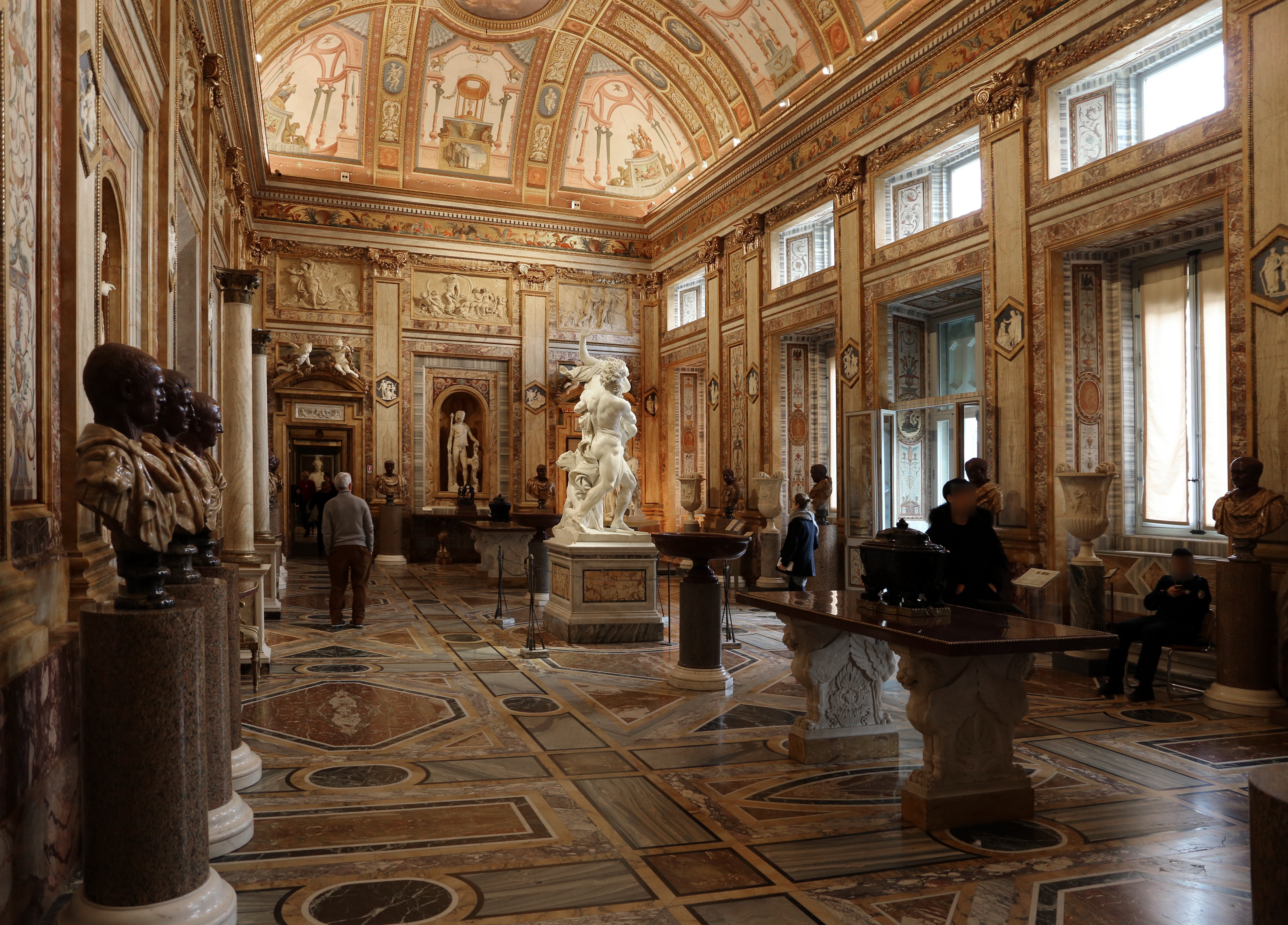
The Galleria Borghese is where Bernini grew up as an artist, and many of his sculptures remain in the rooms for which they were conceived. The progression tells the story of a prodigy becoming a master. The early Goat Amalthea with Infant Jupiter and Faun dates to 1615, when Bernini was just seventeen. By 1618, he was carving Aeneas, Anchises, and Ascanius, a three-figure group of virtuosic ambition. Then came the works that redefined what marble could do: the Rape of Proserpine in 1621, where Pluto's fingers sink into Proserpine's thigh with an illusion of yielding flesh; Apollo and Daphne between 1622 and 1625, capturing the moment of metamorphosis as bark climbs Daphne's legs and leaves sprout from her fingertips; and David in 1623, coiled mid-throw with an intensity that makes Michelangelo's serene David look like he is waiting for a bus.
Six Caravaggios in One Room
Hall VIII, called Silenus's Hall, contains six paintings by Caravaggio, a concentration unmatched anywhere else. Boy with a Basket of Fruit and Young Sick Bacchus date from around 1593, when Caravaggio was young, hungry, and painting himself as models because he could not afford to hire them. The later works deepen into shadow: Saint Jerome Writing, from around 1606, and the extraordinary Madonna and Child with Saint Anne, commissioned for Saint Peter's and then rejected by the clergy who found it indecorous. David and the Head of Goliath is among Caravaggio's most haunting works; the severed head of Goliath is widely believed to be a self-portrait, painted during the artist's exile from Rome after he killed a man in a brawl. The room itself was decorated by Antonio Asprucci in the 18th century with frescoes of Silenus on the ceiling.
What Napoleon Took
In 1808, Prince Camillo Borghese, who had married Napoleon's sister Pauline, was forced to sell the family's Roman sculptures and antiquities to his brother-in-law. The Borghese Gladiator, admired since the 1620s as the single most celebrated sculpture in the villa, went to the Louvre, where it remains. The Borghese Hermaphroditus followed. What stayed behind was still extraordinary, but the loss reminds visitors that the collection was once even richer. Pauline herself left a different kind of mark. Antonio Canova sculpted her as Venus Victrix between 1805 and 1808, reclining semi-nude on a marble chaise. When asked whether she felt uncomfortable posing, Pauline reportedly replied that the studio was heated. The sculpture remains in Hall I, scandalous and beautiful.
Twenty Rooms, No Wasted Space
The Galleria spans twenty named halls, each themed and decorated as a total environment. The Salone's ceiling fresco by Mariano Rossi uses foreshortening so extreme it appears three-dimensional, depicting Marcus Furius Camillus breaking the Gallic siege of the Capitoline Hill. The Egyptian Hall VII mixes archaeological artifacts with exotic decorations inspired by the 18th-century craze for all things pharaonic. Hall XX, the Hall of Psyche, is devoted to the great Venetian masters: Titian's Sacred and Profane Love from 1514, Giorgione, Veronese, Carpaccio, Giovanni Bellini, and Antonello da Messina's Portrait of a Man from 1475. The Borghese villa was sold to the Italian government in 1902 along with the surrounding gardens and parkland. Today, visitors must reserve timed tickets for two-hour windows, a restriction that keeps the crowds manageable and the experience intimate, a rare thing in Rome.
From the Air
The Galleria Borghese (41.91N, 12.49E) sits within the Villa Borghese gardens on the Pincian Hill in central Rome. The villa is visible from altitude as a symmetrical building surrounded by the large green expanse of the Borghese park. Rome Fiumicino (LIRF) is 30km southwest; Ciampino (LIRA) is 15km southeast. The gardens are one of the most recognizable green spaces in central Rome from the air, bordered by the Aurelian Walls to the east.