Gallia Belgica
Caesar gave the name. In the Commentarii de Bello Gallico, written to justify a brutal eight-year campaign of conquest, he praised the Belgae as the bravest of all the peoples of Gaul - and then proceeded to break them. The compliment was strategic. By the time Caesar's army marched north from the Seine in 57 BC, the Belgic tribes had massed a confederation he claimed numbered 288,000 warriors under King Galba of the Suessiones, the largest force he would face in Gaul. He avoided a pitched battle. Instead, he picked the tribes apart one by one, using cavalry to harass and isolate, then crushing them in detail. The Belgae fell piecemeal. Out of that broken landscape, Augustus would later draw the borders of a province called Gallia Belgica - and from those borders, two thousand years later, the modern country of Belgium would eventually take its name.
Caesar's Province
The official province was created in 22 BC by Marcus Agrippa, working from Augustus's restructuring of conquered Gaul. It stretched from the Seine and Marne north to the Rhine, from the English Channel deep into what is now Luxembourg and the German Moselle valley. Reims served as the first capital, before the honor shifted to Trier - Augusta Treverorum - which would eventually become one of the four great capitals of the late Roman Empire. The Romans organized their conquest the way they always did: by drawing the territory into civitates that corresponded loosely to the old tribal lands, then subdividing those into pagi, smaller units whose name survives in the French word pays. Roman roads laced the province together. The Via Belgica, running from Boulogne to Cologne, became the spine of Belgic Gaul for nearly four hundred years.
What the Conquest Cost
The conquest was not clean. The Eburones, a tribe in what is now eastern Belgium and Limburg, rose against Caesar in 54 BC under their chieftain Ambiorix. They wiped out a full Roman legion under Sabinus and Cotta - one of the worst defeats Caesar would suffer in Gaul. Caesar's response was annihilation. He returned with the legions, declared the Eburones beyond his protection, and invited neighboring tribes to plunder them at will. The historical record suggests the tribe was effectively destroyed as a people. The Bellovaci tried again in 52 BC, in the great revolt that followed Vercingetorix at Alesia. Their ambush of Caesar's legions failed, and Caesar slaughtered the rebels. Ambiorix himself slipped across the Rhine and disappeared from history. He would be rediscovered centuries later by a young Belgian nation hunting for founding heroes, and a bronze statue of him still stands today in Tongeren, his sword raised, his people long since dust.
Trier in Gold
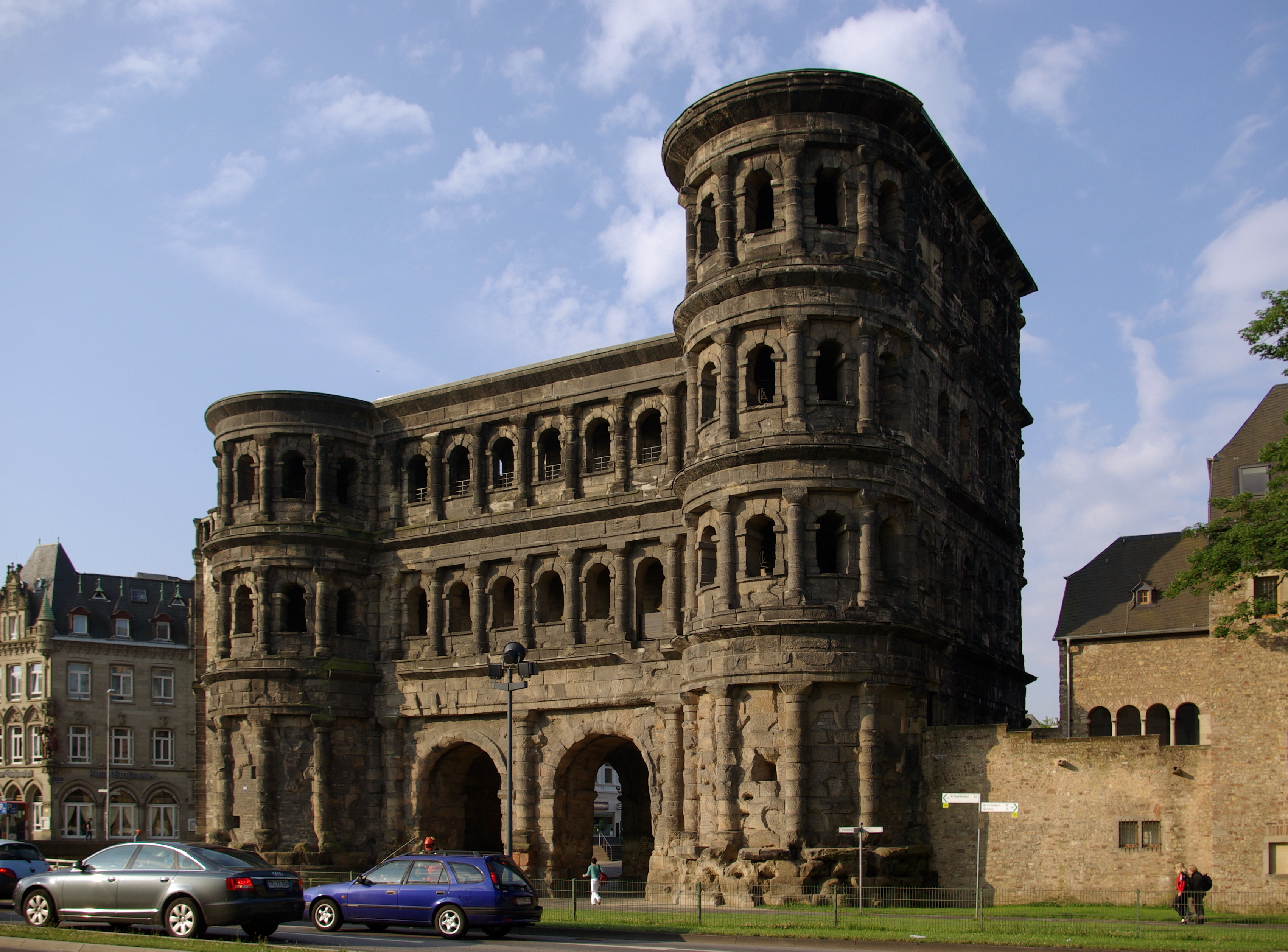
By the fourth century, the eastern half of the province had become one of the wealthiest corners of the Roman world. The Moselle valley filled with villas. Vineyards climbed the slate slopes that produce wine to this day. Trier briefly served as the capital of the Western Roman Empire, and the city the Romans built there - including the Porta Nigra, a black sandstone gate that still towers over the modern town - remains one of the most complete Roman cityscapes north of the Alps. The poet Ausonius wrote his Mosella in this period, a long Latin praise-poem to the river and its fish and the play of light on its water. It is the closest thing we have to a tourist brochure from late Roman Belgica, and it reads, surprisingly, like one - a man in love with a landscape, certain it would last forever.
The Long Unraveling
It did not last. The Crisis of the Third Century broke Roman control over the north. In 260, the Gallic Empire briefly split off under the emperor Postumus, who held the Franks at bay along the Rhine; when Aurelian crushed the breakaway state in 274, the Roman armies never returned to the river border, and the Salian Franks slipped across to settle Flanders, Brabant, and Limburg. Diocletian reorganized what remained around 300, splitting the province into Belgica Prima in the east, with its capital at Trier, and Belgica Secunda in the west, between the Channel and the upper Meuse. Then came the catastrophic Rhine crossing of 406, when a coalition of Vandals, Alans, and Suebi - pushed west by the Huns - poured into the Moselle valley and laid waste to much of the province. Roman power in the north never recovered. By the time Attila reached the Catalaunian Fields in 452, the cities of Belgica had already been plundered. Only Paris escaped.
The Name That Survived
Empires die; names persist. When the Franks built their Merovingian kingdom over the ruins of Belgica Secunda, the Latin name Belgica stayed behind, drifting into the vocabulary of educated Europeans as the name for the Low Countries as a whole. In the sixteenth century, when the Habsburg-ruled south split politically from the rebellious Dutch north, scholars distinguished Belgica Regia from Belgica Foederata - royal Belgica and federal Belgica, two halves of the same Latin abstraction. Even the United Kingdom of the Netherlands, created in 1815, was sometimes called the Royaume des Belgiques. It took the revolution of 1831 to fix the word in its modern, narrower sense: the new country that broke away from the Dutch claimed the name Belgique for itself, and the older, larger meaning slowly fell out of use. The province Caesar had named for a confederation of warriors he could not defeat in open battle had finally given its name to a country.
From the Air
The historical heartland of Gallia Belgica is centered on the Brussels region at approximately 50.85 degrees N, 4.35 degrees E, but the province sprawled from the English Channel coast east to the Rhine and south to the Marne. Key Roman cities visible from cruising altitude include Trier (Augusta Treverorum, the late capital) in the Moselle valley, Reims (the early capital), and Tongeren, the oldest town in modern Belgium. From a normal cruising altitude of 35,000 feet, the entire former province fits within a single visual frame on a clear day. Major airports include Brussels (EBBR), Luxembourg (ELLX), and Cologne/Bonn (EDDK). The Via Belgica corridor between Boulogne and Cologne still loosely follows modern road networks.