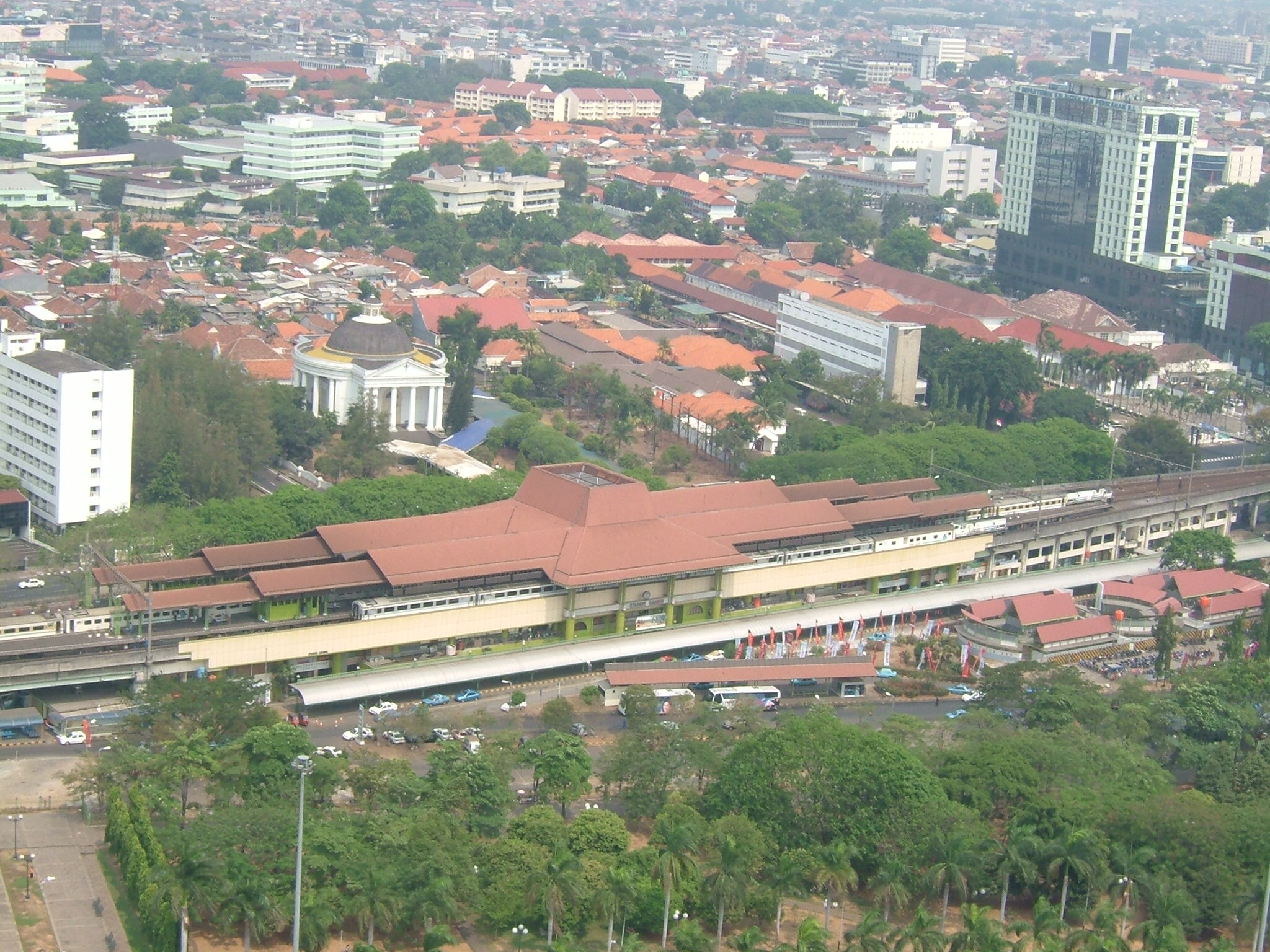
Gambir Railway Station
The architect who designed it is forgotten, but Weltevreden Station opened its doors on October 4, 1884, serving passengers of the Nederlandsch-Indische Spoorweg Maatschappij -- the private Dutch railway company that had been threading tracks across Java since the 1860s. Today that station is called Gambir, and it sits on the eastern edge of Merdeka Square in Central Jakarta, one of the busiest intercity rail terminals on the island of Java. It has been rebuilt twice, renamed three times, and elevated off the ground entirely, yet it still occupies the same plot of land where Dutch colonial engineers first laid rail beside what was then the Koningsplein.
From Halte to Hub
Before the permanent station existed, there was just a halte -- a small railway stop called Koningsplein -- inaugurated on September 16, 1871, when the first section of the Batavia-Buitenzorg line opened. It sat on the southeast edge of the Koningsplein, the grand colonial square that would eventually become Merdeka Square. By 1873, the line had been extended south to Meester Cornelis and Buitenzorg (modern-day Bogor), and the little stop was outgrown. The permanent Weltevreden Station replaced it in 1884, its neoclassical design featuring cast-iron roof supports in the style of the Staatsspoorwegen. By 1906, passengers could board here for Bandung and Surabaya, and the station had become a critical node in Java's expanding rail network.
Three Names, Three Eras
Each renaming of the station marks a political rupture. As Weltevreden Station, it served the colonial elite of the Dutch East Indies, its neoclassical facades reflecting European confidence in permanent rule. A 1928 renovation wrapped the building in Art Deco -- still Dutch, but acknowledging the modernity sweeping through the archipelago. In 1937 the name changed to Batavia Koningsplein Station, a bureaucratic adjustment that preserved Dutch primacy. Then came independence. The station became Jakarta Gambir, named after the neighborhood that had outgrown its colonial identity. The name "Gambir" comes from the gambir plant, once cultivated in the area. For decades after independence, the Art Deco building persisted, a colonial ghost in a postcolonial city, until the wrecking crews arrived in 1988.
Rising Above the Streets
The decision to elevate the railway through central Jakarta transformed Gambir from a ground-level station into something entirely different. Construction began in February 1988, and the old Art Deco building was demolished to make way for a modern elevated structure. On June 5, 1992, President Suharto and First Lady Siti Hartinah inaugurated the new station by boarding an electric train to Jakarta Kota. The project cost 432.5 billion rupiah and was not fully operational until a year after its official opening. The new building adopted a joglo architectural style -- the traditional Javanese peaked roof form -- clad in a distinctive lime green ceramic facade that remains its most recognizable feature. Four elevated tracks replaced the old ground-level yard, and the land beneath was eventually converted into a parking lot by 1994.
Gateway to Java
Walk through Gambir today and you encounter the full spectrum of Indonesian rail travel. The Argo Bromo Anggrek departs for Surabaya with compartment suites and executive class coaches. The Taksaka heads to Yogyakarta in luxury. The Parahyangan shuttles passengers to Bandung with panoramic cars offering views of West Java's volcanic landscape. More than two dozen named intercity services use Gambir as their terminus, connecting the capital to cities across the length of Java. The station also links to DAMRI buses running to Soekarno-Hatta International Airport and sits near two TransJakarta bus rapid transit stops. It is, in every practical sense, the point where Jakarta's rail network meets the rest of the island.
A Station in Transition
Gambir's future is paradoxically one of diminishment. Under the Indonesian Ministry of Transportation's master plan, all long-distance and medium-distance passenger trains are scheduled to be relocated to the expanded Manggarai Station, roughly three kilometers to the south. Once that transition is complete, Gambir will serve only the KRL Commuterline -- Jakarta's commuter rail network -- which currently passes through the station without stopping due to scheduling conflicts with intercity services. The irony is considerable: a station built to be the capital's grand intercity terminal may become a local commuter stop, its lime green facade greeting daily riders instead of travelers bound for Surabaya or Solo. But this is the nature of a station that has survived 150 years by adapting, and Gambir has proved nothing if not adaptable.
From the Air
Located at 6.18S, 106.83E on the eastern side of Merdeka Square in Central Jakarta. From the air, the station is identifiable by its elevated rail structure running north-south, adjacent to the large green expanse of Merdeka Square with the National Monument (Monas) at its center. Nearest major airport is Soekarno-Hatta International (WIII), approximately 25 km to the northwest. Halim Perdanakusuma Airport (WIHH) lies about 10 km to the southeast. The station's lime green facade and joglo-style roof are visible from low altitude.