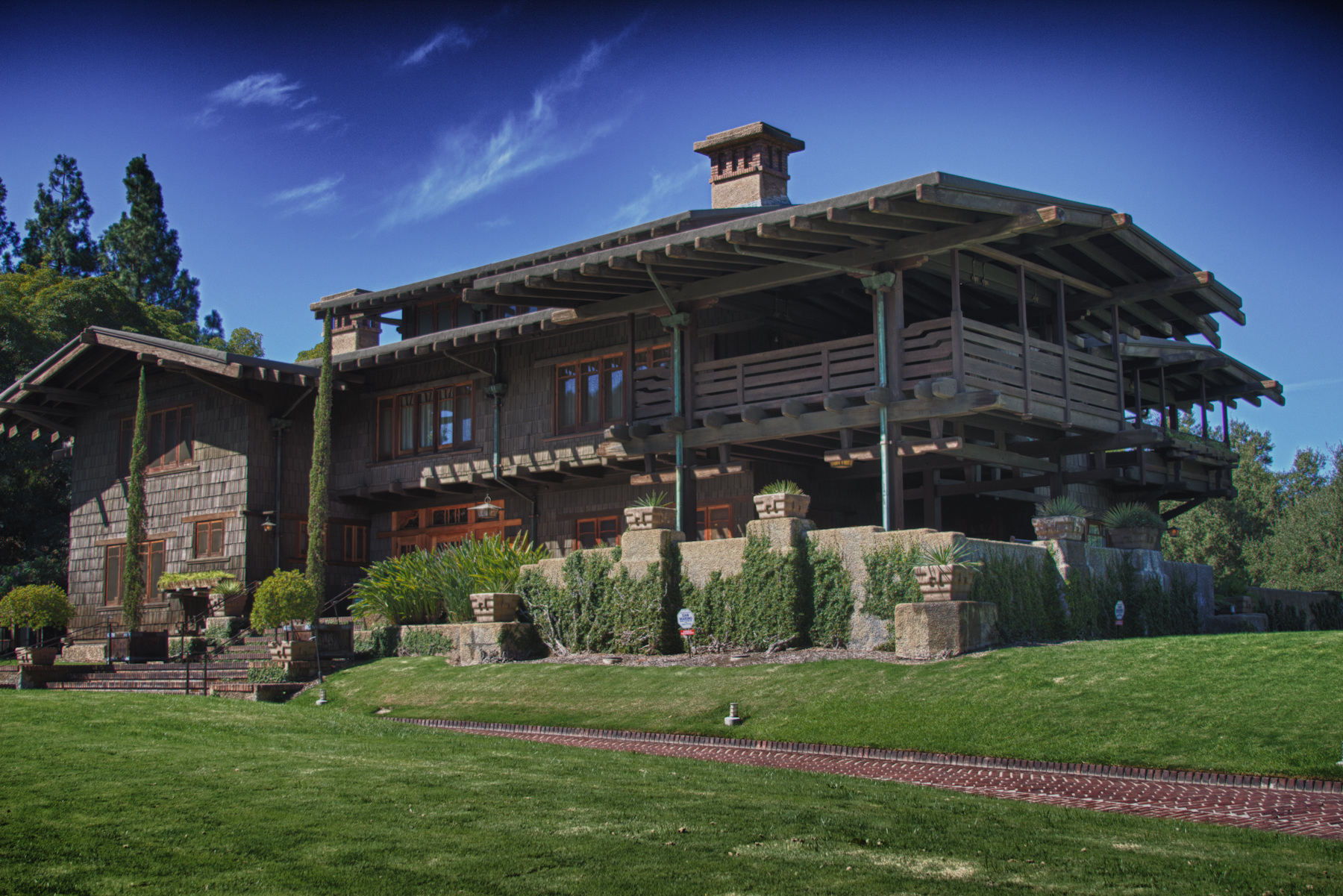
Gamble House (Pasadena, California)
When Doc Brown's mansion appears in Back to the Future, it looks exactly right — the kind of house that belongs to a brilliant eccentric, layered with wood and detail and slightly outside of normal time. The exterior that played the Brown Mansion in 1985 was the Gamble House in Pasadena, designed by Charles and Henry Greene in 1908. The film's producers chose it because it looked like no other house in America. That was also the Greenes' intention.
Soap Money, Craftsman Hands
David B. Gamble was the son of James Gamble, co-founder of Procter & Gamble. Like other wealthy Midwestern families, he and his wife Mary chose Pasadena for their winter home, escaping Cincinnati's harsher climate for Southern California's mild January. They had seen examples of the work done by the Greene and Greene architectural firm and hired the brothers in May 1907.
Construction ran from 1908 to 1909. The house cost significantly more than expected — Craftsman-quality woodwork and custom-designed furniture in every room pushed the budget upward. The result is a building that has remained almost entirely intact and unaltered since completion. Many Greene and Greene houses have lost their original furnishings; the Gamble House still has all of its original pieces, designed by the architects for specific locations within specific rooms. In 1966, the Gamble family transferred ownership to the city of Pasadena in a joint arrangement with USC's School of Architecture. The house was declared a National Historic Landmark in 1977. Two architecture students, selected competitively, live in the house and change annually.
The Language of the House
The Greenes designed for a California that they understood as fundamentally different from the East Coast. Japanese aesthetics — abstractions of clouds and mist, asymmetrical groupings of three, the visual rhythm of horizontal lines — run through every element. The "theme of three" appears constantly: three front entry doors, three window groupings, three decorative elements paired together throughout the rooms. Symmetry is present but not dominant; the design acknowledges nature's preference for variation.
The building appears enmeshed with its site on a grassy knoll above the Arroyo Seco. Granite river stones from the nearby wash appear at the base of the terrace steps. Creeping fig (ficus pumila) grows on the foundations. The exterior materials — brick, stucco, clinker brick, and wood — change texture across the facade. Inside, the wood surfaces (teak, maple, oak, Port Orford cedar, and mahogany) have been rounded to eliminate sharp edges throughout, creating what visitors consistently describe as an overriding softness.
Details That Repay Attention
The entry hall conceals a spring-latch door, disguised as a teak panel, that leads to the kitchen. Another panel opens to a coat closet. The living room has no doors — the Greenes wanted it "as open and inviting as possible." Five rugs manufactured in Bohemia after watercolor designs by Charles Greene cover the floors. The piano was designed by the architects to blend seamlessly into the paneling of the room.
The triple front door features a Japanese black pine motif in leaded art glass — layers of glass creating depth in the pattern. Across the house, the stained glass windows filter the afternoon light into colored patterns on the wood floors. The main terrace has a large curvilinear pond and paths made with water-worn stones from the Arroyo Seco. The third floor was planned as a billiard room; the Gamble family used it as a storage attic. The house is open to the public for tours and events. It is, in the most literal sense, still inhabited — and still revelatory.
From the Air
Located at 34.15°N, 118.16°W in the Westmoreland neighborhood of Pasadena, the Gamble House sits on a knoll overlooking the Arroyo Seco just north of the Colorado Street Bridge. The house and its wooded grounds are visible from low altitude on north-south approaches. Nearest airports: El Monte (KEMT, 5 miles SE), Burbank (KBUR, 8 miles NW). Best viewed at 1,000–2,000 ft AGL.