Gamble Plantation Historic State Park
In May 1865, with the Confederacy in ruins and Union troops closing in across Florida, Judah P. Benjamin -- the man who had served as Attorney General, Secretary of War, and Secretary of State under Jefferson Davis -- arrived at a sugar plantation on the Manatee River and disappeared inside its thick tabby walls. Benjamin had held more high-ranking cabinet positions than any other Confederate official, and the Union wanted him badly. The plantation that sheltered his escape belongs today to the state of Florida, and the mansion at its center is the only surviving plantation house on the entire Gulf Coast -- a rare, uncomfortable artifact of the antebellum South preserved in the subtropical humidity of central Florida.
Shells, Lime, and Sand
The Gamble Mansion was built by enslaved people using tabby, a concrete-like material made from burned oyster shells, lime, sand, and water. It was a regional substitute for brick in a part of Florida where clay was scarce but shell middens -- left by the Tocobaga and other indigenous peoples who had lived along this coast for thousands of years -- were plentiful. The walls are two feet thick. The columns that support the broad front veranda are tabby as well. Construction took five to six years, and the result is a structure that looks Mediterranean at first glance, with its deep porches and thick masonry, but is entirely a product of the Florida landscape and the forced labor that shaped it. The mansion was listed on the National Register of Historic Places as the Robert Gamble House on August 12, 1970, and in 2012 the American Institute of Architects' Florida Chapter placed it at number 76 on its list of Florida Architecture: 100 Years, 100 Places.
Sugar Along the Manatee
Major Robert Gamble Jr. arrived at the Manatee River in 1844, two years after the Second Seminole War opened the Florida frontier to American settlement. Born in Virginia in 1813, Gamble had served in the Florida War and received 160 acres for homesteading under the Armed Occupation Act. He was not alone. Other sugar planters from northern Florida and established slave states soon joined him along the river's rich banks, and by 1845 a dozen plantations were producing sugar for the New Orleans market, shipping their commodity crop downriver and across the Gulf of Mexico to the international port. At its peak, Gamble's plantation covered 3,500 acres. He enslaved more than 200 people to clear the land, plant and harvest sugarcane, process it in one of the South's largest sugar mills, and build the plantation houses and outbuildings. A 40,000-gallon cistern provided the household with fresh water. The ruins of the sugar mill were acquired by the state in 2002 and added to the park.
A Fugitive's Last Stop
Judah P. Benjamin's brief stay at the Gamble Plantation in May 1865 gave the site its formal name: the Judah P. Benjamin Confederate Memorial. Benjamin had served in three successive cabinet posts under Jefferson Davis, a record unmatched in the Confederate government. When the Confederacy collapsed, he fled south through Florida while Davis was captured in Georgia. Benjamin reached the Manatee River, sheltered at the plantation, and then sailed for England, where he reinvented himself as a barrister and lived out the rest of his days. The plantation's role as his refuge was brief but dramatic enough to define its public identity for the next 160 years.
Rescued from Ruin
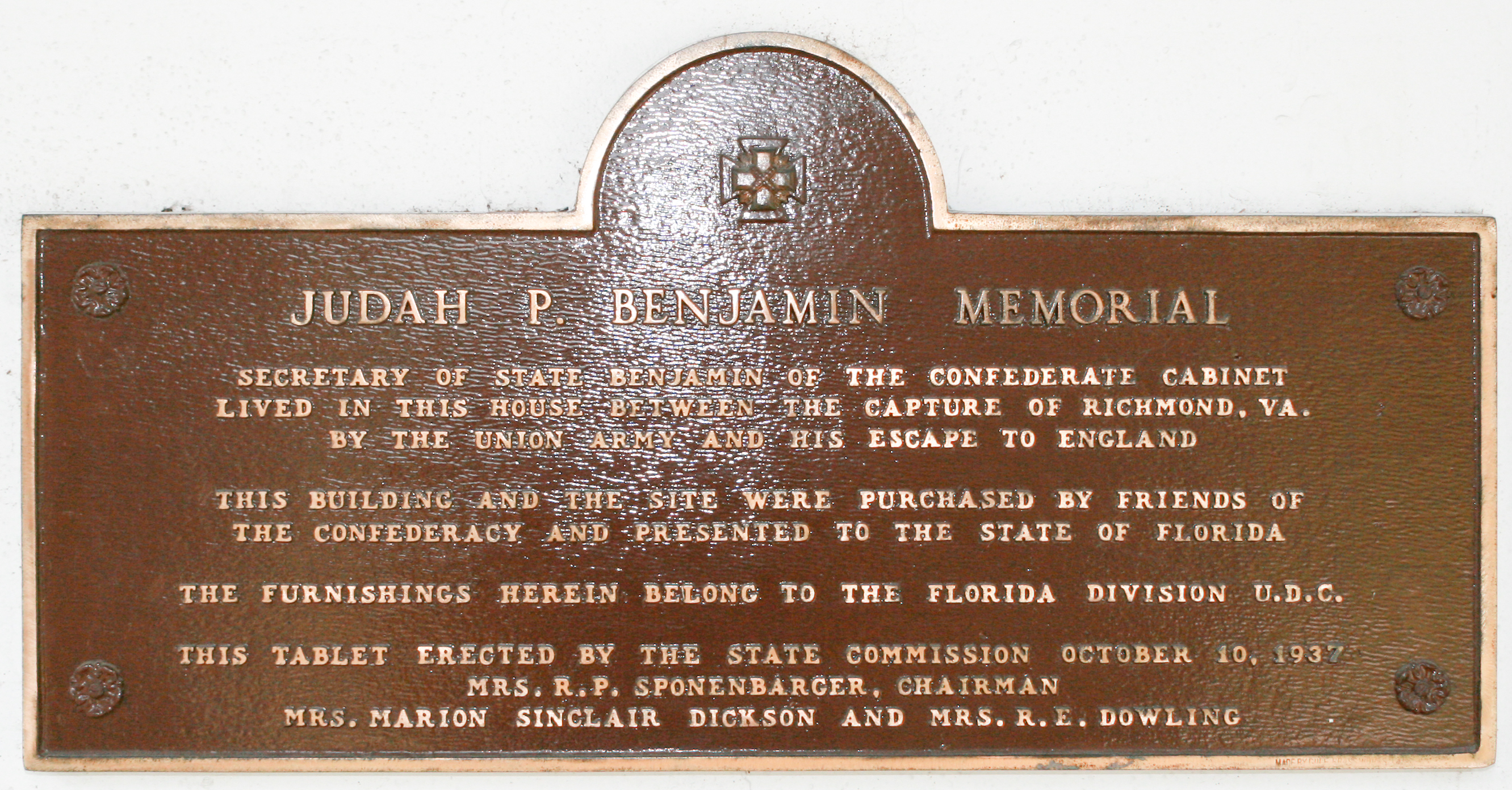
Tabby is durable but not permanent. Without maintenance, the shell-and-lime walls slowly erode, and by 1902 the Gamble Mansion was deteriorating badly. In 1923, the Judah P. Benjamin Chapter of the United Daughters of the Confederacy began raising money to save the building. By 1925 they had purchased the house and 16 surrounding acres and donated everything to the state of Florida for preservation as a memorial to Benjamin. The state completed restoration in 1927. In 1937, the UDC installed a memorial plaque and erected the Confederate Veterans Memorial Monument on the grounds. The park also includes the Patten House, a wood-frame Victorian built in 1895 by Dudley Patten, the son of a later owner. The Patten House was named one of Florida's 11 to Save for 2018 by the Florida Trust for Historic Preservation, reflecting the ongoing challenge of maintaining structures in Florida's humid climate.
Layers in the Landscape
Today the Gamble Plantation Historic State Park is open year-round, with guided tours of the mansion. Walking the grounds, the layers of history press close together: the indigenous shell middens that provided the raw material for tabby, the forced labor that shaped those shells into walls, the sugar economy that drove the plantation system, the war that ended it, and the complicated memorial that followed. The park does not simplify this history. The approximate site of the slave quarters is marked. The sugar rollers sit on display. The mansion is furnished in the style of a mid-19th century plantation home. From the air, the property reads as a small green rectangle along the Manatee River near Ellenton, modest in scale compared to the vast acreage it once commanded, but dense with the kind of history that resists tidy summaries.
From the Air
Located at 27.53N, 82.53W in Ellenton, Florida, along the Manatee River near its confluence with Tampa Bay. The park is a small green area along the river's south bank, east of US 301. Nearby airports: KSRQ (Sarasota-Bradenton International, 12nm south), KTPA (Tampa International, 25nm north), KSPG (Albert Whitted, 18nm northwest). Best viewed at 2,000-3,000 ft AGL. The Manatee River and the I-75 corridor provide useful visual references. Port Manatee is visible to the west along the bay shoreline.