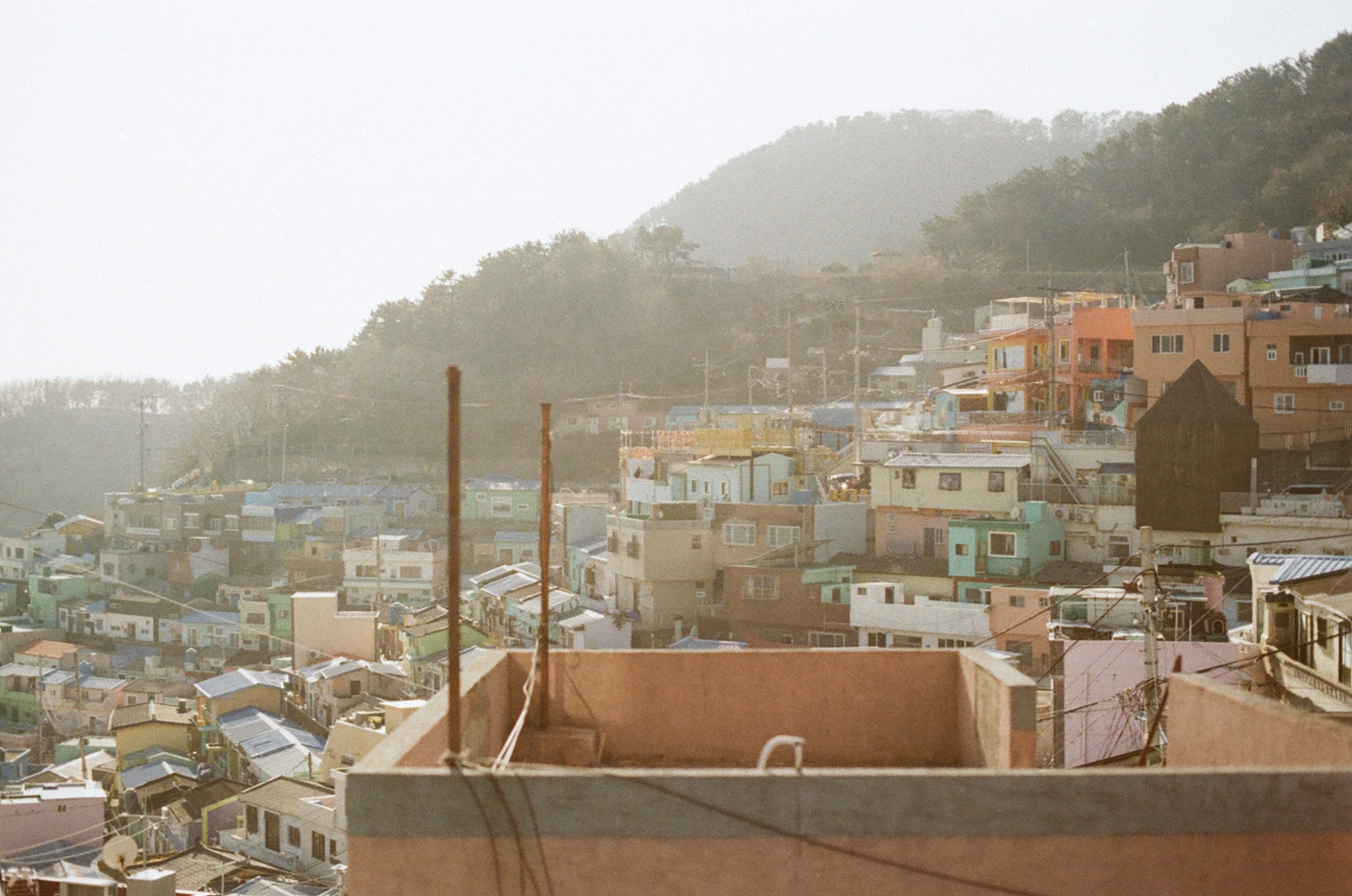
Gamcheon Culture Village
Painted fish swim along concrete walls, guiding visitors through alleyways so narrow that neighbors could shake hands from opposite windows. In Gamcheon Culture Village, perched on a steep mountainside in Busan's Saha District, art has quite literally been painted over decades of poverty -- and the question of whether that is rescue or erasure depends on whom you ask.
Built on the Margins
Gamcheon's story begins in the 1920s and 1930s, when Busan's city administration relocated working-class families to this hillside -- close enough to the port to supply labor, far enough away to keep them out of sight. The neighborhood grew again in 1955, when roughly 800 families arrived during the post-Korean War recovery, many of them followers of Taegeukdo, an ascetic branch of the Jeungsanism religious movement. The village sprawled upward along the slope in terraced layers, houses stacked so tightly that the streets became a labyrinth. As one longtime resident recalled, the neighborhood was a single district in 1950 and had grown to nine by the time wooden houses gave way to two-story concrete structures in the late 1980s and early 1990s. But growth did not bring prosperity. Poor living conditions persisted for decades, and the young drifted away to Busan's modern districts.
The Canvas Project
In 2009, South Korea's Ministry of Culture, Sports and Tourism launched a public art renovation aimed at converting Gamcheon into a cultural hub. Art students, professional artists, and residents were invited to maintain, repair, and decorate the village. The results were exuberant and sometimes surreal: bird sculptures perched on rooftops, Murakami-inspired installations grinned from doorways, scenes from The Little Prince appeared on walls, and painted schools of fish wound through alleys as informal wayfinding markers. The physical transformation was dramatic enough to earn the village the nicknames 'Korea's Santorini' and 'the Machu Picchu of Busan.' Tourism exploded -- from modest numbers before 2009 to approximately 1.4 million visitors in 2015 alone.
The Cost of Color
Not everyone in Gamcheon celebrates the transformation. The surge of visitors has brought noise, congestion, and the steady replacement of daily life with tourist infrastructure. Some residents participated enthusiastically in the renovation, opening small shops and galleries. Others simply left, though selling their homes proved difficult given the cramped, unconventional layout. By 2015, an estimated 300 houses sat empty -- a paradox in a neighborhood drawing over a million annual visitors. Development efforts have converted some of these abandoned homes into art galleries, museums, and shops, blurring the line between revitalization and displacement. The village's inclusion on lists like 'overtourism' and 'tourist trap' in academic and travel literature signals a tension that many gentrifying communities worldwide would recognize.
Walking the Layers
To visit Gamcheon is to experience Busan's social history in vertical cross-section. The lowest streets near the main road feel almost like an outdoor shopping mall, dense with food vendors and souvenir stalls. Climb higher and the crowds thin. The alleys narrow, the art installations become less frequent, and the original character of the village reasserts itself: concrete walls patched and repatched, laundry drying on rooftop railings, the sound of a television drifting from a window. From the upper reaches, the view stretches over the entire neighborhood to the harbor beyond -- a panorama of color stacked against the grey-blue sea. It is beautiful and complicated, a place where the line between living community and living exhibit remains deliberately, uncomfortably, unresolved.
From the Air
Located at 35.10N, 129.01E on a steep hillside in Busan's Saha District, South Korea. The village is visible from moderate altitude as a dense cluster of colorful buildings on the mountainside above Busan's port area. Nearest airport is Gimhae International (RKPK), approximately 10 nm west. The contrast between the painted village and surrounding urban Busan is striking from the air. Best viewed at 2,000-3,000 ft.