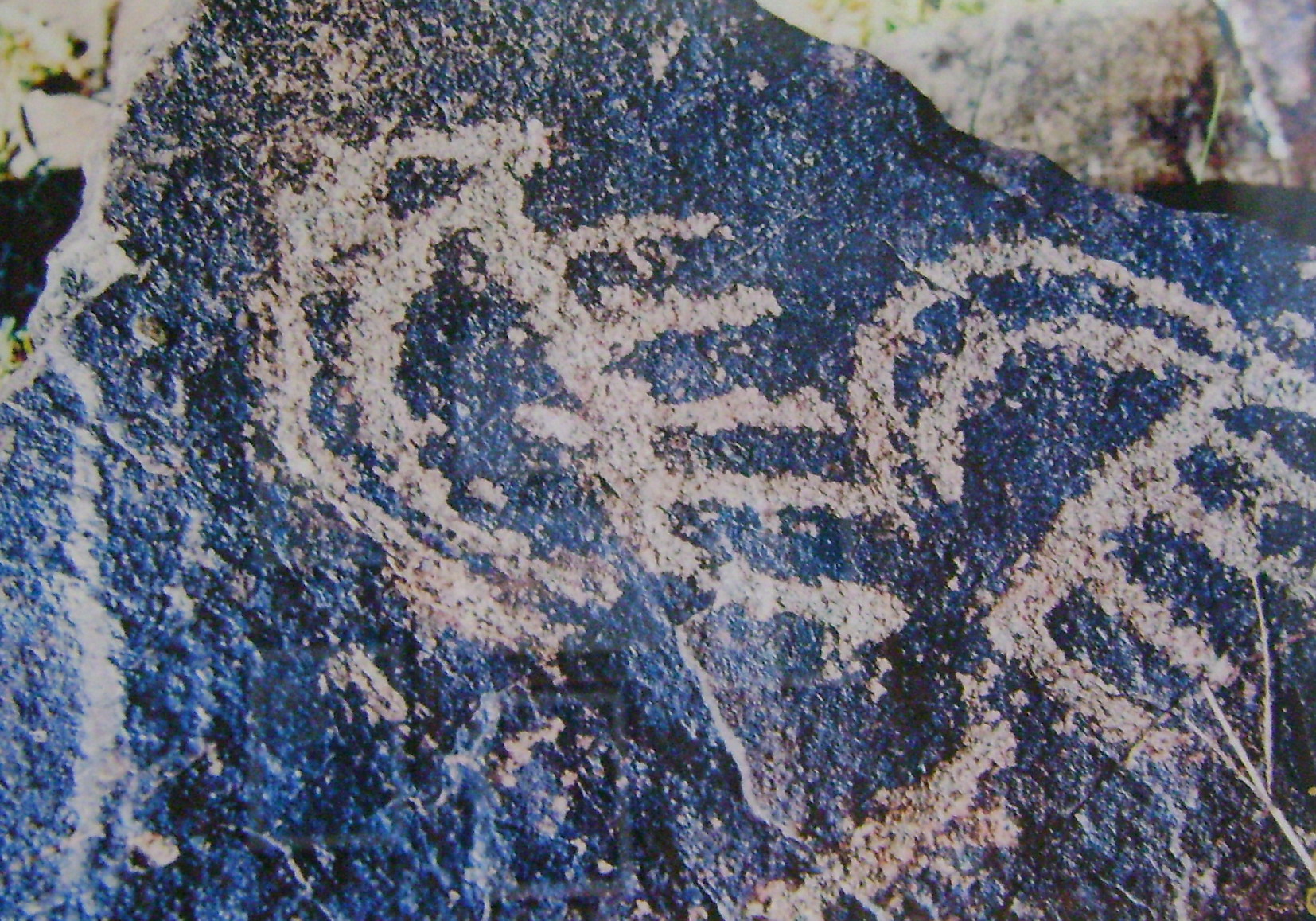
Gamigaya Petroglyphs
The name means "stone ship." Local legend holds that during a great flood, Noah's Ark came to rest on the summit of Gapyjiq, at 3,906 meters one of the high points of the Lesser Caucasus, and slowly turned to stone. Whether or not the mountain sheltered an ark, it preserved something equally remarkable: nearly 1,500 images punched, carved, and scraped into its rocks by human hands over three thousand years, from the Bronze Age into the Iron Age.
An Open-Air Gallery
The petroglyphs spread across the mountain's upper slopes in the territory of Ordubad Rayon, near the village of Nasirvaz, close to Azerbaijan's border with Armenia. Many cluster around natural springs on the Garangush plateau, suggesting that the artists gathered where water surfaced from stone. The images depict deer, goats, bulls, dogs, snakes, birds, and creatures that belong to no known species -- fantastic beings born from imagination or mythology. People appear too, rendered schematically: alone, in pairs, in groups. Chaotic scenes of dancing figures appear alongside more deliberate compositions. One carving, considered especially rare, shows a person standing beside a horse. On another rock, an artist captured a leopard in a posture of tension, muscles drawn taut. The deer are rendered with a realism that suggests careful observation rather than abstract symbol-making.
Techniques in Stone
Three distinct methods shaped these images. Stone chipping produced rough outlines by breaking away the rock surface. Carving created deeper, more precise lines. Scraping wore away the darker outer layer of stone to expose lighter material beneath. The petroglyphs appear on black and gray rocks, and where the artists scraped, the exposed images glow with a pinkish hue -- a natural contrast that has survived millennia of weathering. Beyond the Garangush plateau, additional carvings extend into the Nabiyurdy and Jamishoglan territories, suggesting that the creative impulse was not confined to a single site but spread across the mountain landscape wherever suitable rock surfaces presented themselves.
A Record of Daily Life and Belief
Goats dominate the animal imagery, pointing to their central place in the cattle-breeding economy of the people who lived here. But the carvings go beyond the practical. Circles, triangles, rectangles, and fortune symbols appear among the animal and human figures -- pictographic signs that echo symbols found on clay plaques at Kultapa dating to the Bronze Age. Hunting scenes show people pursuing game. Dancing figures suggest ritual or celebration. Together the images document a span of history stretching from communal society to the beginnings of feudalism, recording not just what these ancient people ate and hunted but how they worshipped, celebrated, and understood their world.
Driven to the Heights
Why did people carve on a mountain nearly four thousand meters high? The answer may lie in the lowlands they left behind. Heavy rains and flooding buried approximately 150 settlements in the Kura-Aras lowlands, driving populations westward and upward into the mountains. These displaced communities established what archaeologists now call the Gamigaya rock art culture. Investigation began in 1968, and expeditions continued through the 1970s and 1980s under researchers including A. Seyidov, N. Museyibli, V. Aliyev, and V. Bakhshaliyev. New petroglyphs were still being discovered as recently as 2008, and the mountain almost certainly holds more images waiting beneath lichen, sediment, and the slow creep of time.
From the Air
Located at 39.16N, 45.92E on the Gapyjiq summit (3,906 m) in the Lesser Caucasus, Nakhchivan Autonomous Republic, Azerbaijan, near the Armenian border. Best viewed from 8,000-12,000 ft AGL. The peak rises prominently above surrounding terrain. Nearest airports include Nakhchivan (UBBN) approximately 70 km south. Look for the high-altitude plateau among the rugged mountain terrain.