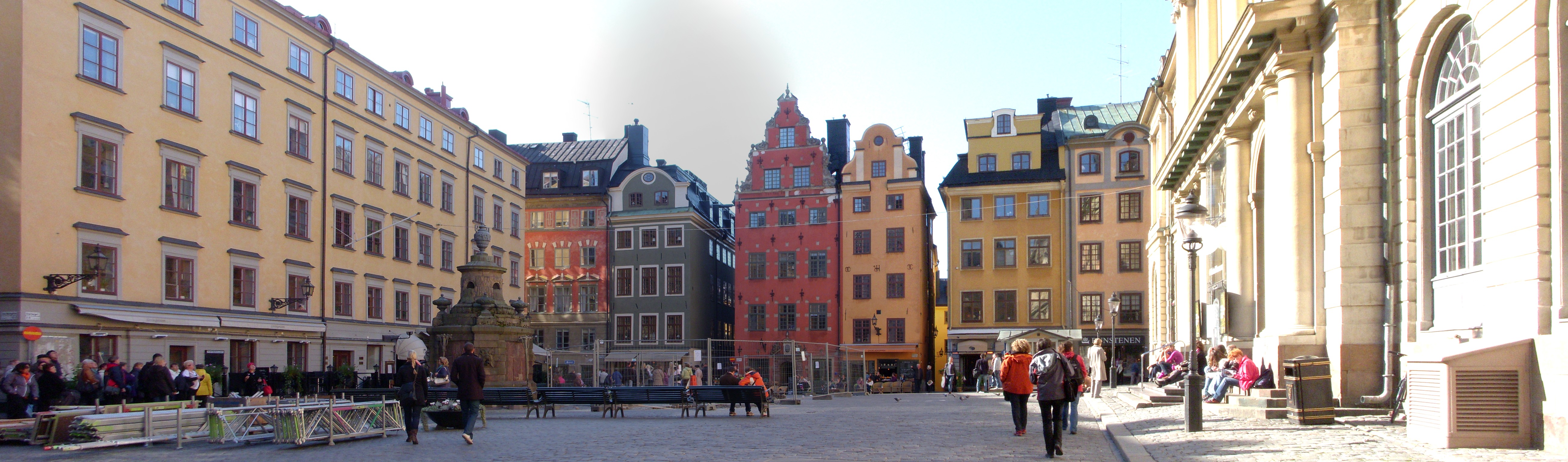
Gamla Stan
Legend has it that a thousand years ago, when Viking raids plagued the old capital of Sigtuna, the city's leaders hollowed out a log, filled it with gold, and set it adrift on the waters. Days later, it washed ashore on a small island at the entrance to Lake Malaren. Here, they decided, would stand the new capital of Sweden. The name they gave it translates simply: Log Island. Stockholm. Today, that original settlement survives as Gamla Stan, the Old Town, a medieval maze of ochre and rust-colored buildings rising from the water, unchanged in its essential character for eight centuries.
Blood on the Cobblestones
The picturesque main square, Stortorget, conceals a dark chapter. In November 1520, the Danish King Christian II invited Swedish nobles to a grand feast under the guise of reconciliation. On the third day, guards sealed the doors. What followed became known as the Stockholm Bloodbath - the execution of over 80 Swedish nobles, bishops, and burghers. Their blood ran down the cobblestones that visitors photograph today. The massacre backfired spectacularly. It galvanized Swedish resistance and led directly to the rise of Gustav Vasa, who drove out the Danes and established the modern Swedish state. The merchant houses ringing the square, painted in their signature shades of red and gold, now house cafes where tourists sip coffee, largely unaware they're seated at the site of one of Scandinavia's most infamous political crimes.
A City Written in Streets
Every street name in Gamla Stan tells a story. Kopman-gatan, Merchant's Street, led from the central square down to the waterfront markets. Svartmangatan, Black Man's Street, takes its name not from any person but from the black-robed Dominican friars whose monastery once stood nearby. Skomakargatan was where shoemakers plied their trade. Marten Trotzigs Grand, at barely ninety centimeters wide, is the narrowest alley in Stockholm - a reminder of how medieval builders squeezed every inch from the island's limited real estate. Three meters below the current street level lies the original medieval city, discovered through archaeological excavations that revealed wooden street pavings from the 1250s. The alleys that once served as open sewers, where latrines gathered at spots called 'fly meetings' so thick with insects they darkened the sky, are now some of the most photographed passages in Scandinavia.
Palaces From Ashes
The baroque Royal Palace dominates Gamla Stan's northern end, but it exists only because of catastrophe. In 1697, the medieval fortress of Tre Kronor, the Three Crowns, burned to the ground. Architect Nicodemus Tessin the Younger designed its replacement, an Italian-inspired palace of over 600 rooms that took nearly sixty years to complete. Surrounding it stand the Bonde Palace, now home to Sweden's Supreme Court, and the House of Nobility, where the Swedish parliament met for centuries. Tessin Palace, the architect's own residence, stands as testament to the creative minds who shaped Gamla Stan over generations. The Storkyrkan, Stockholm Cathedral, witnessed royal coronations and weddings, and still houses the extraordinary medieval sculpture of Saint George and the Dragon, carved by Bernt Notke in the 1480s.
From Slum to Treasure
By the mid-1800s, Gamla Stan had become a place the respectable classes avoided. As Stockholm expanded onto the surrounding ridges, the Old Town deteriorated into overcrowded tenements. Buildings that dated to the Middle Ages crumbled from neglect. After World War II, entire blocks were demolished to make room for an expanded parliament building. The destruction might have continued, but something shifted in the 1970s. Swedes began to value what their ancestors had dismissed as embarrassing decay. Restoration efforts revealed buildings previously dated to the 1600s were actually 300 years older. The charm that medieval builders created by accident - crooked alleyways, buildings leaning into each other, windows at odd angles - became Gamla Stan's greatest asset. Today, roughly 3,000 people call this island home, outnumbered daily by visitors wandering its winding streets.
The Oldest Table in Town
On Osterlang-gatan sits Den Gyldene Freden, the Golden Peace, which has served meals continuously since 1722. The Guinness World Records certifies it as the longest-operating restaurant with an unchanged interior. The Swedish Academy, which awards the Nobel Prize in Literature, now owns the establishment and holds its Thursday luncheons there each week. A few blocks away, in a courtyard behind the Finnish Church, stands one of Sweden's smallest statues: Jarnpojken, the Iron Boy, barely fifteen centimeters tall, sculpted by Liss Eriksson in 1967. Locals leave coins and tiny knitted caps for good luck. These details - the centuries-old restaurant, the tiny statue, the narrowest alley - capture what Gamla Stan does best: preserve the human scale of history in an age of glass towers and broad boulevards.
From the Air
Gamla Stan is located at 59.325N, 18.071E on Stadsholmen island in central Stockholm. From altitude, look for the distinctive cluster of orange and red rooftops concentrated on a small island between Riddarfjarden bay to the south and Norrmalm to the north. The baroque Royal Palace is visible at the northern tip. Nearby airports include Stockholm Arlanda (ESSA, 40km north) and Stockholm Bromma (ESSB, 8km northwest). Best viewed at 2,000-3,000 feet for the island layout or lower for architectural detail. The medieval street pattern contrasts sharply with the grid layout of surrounding modern districts.