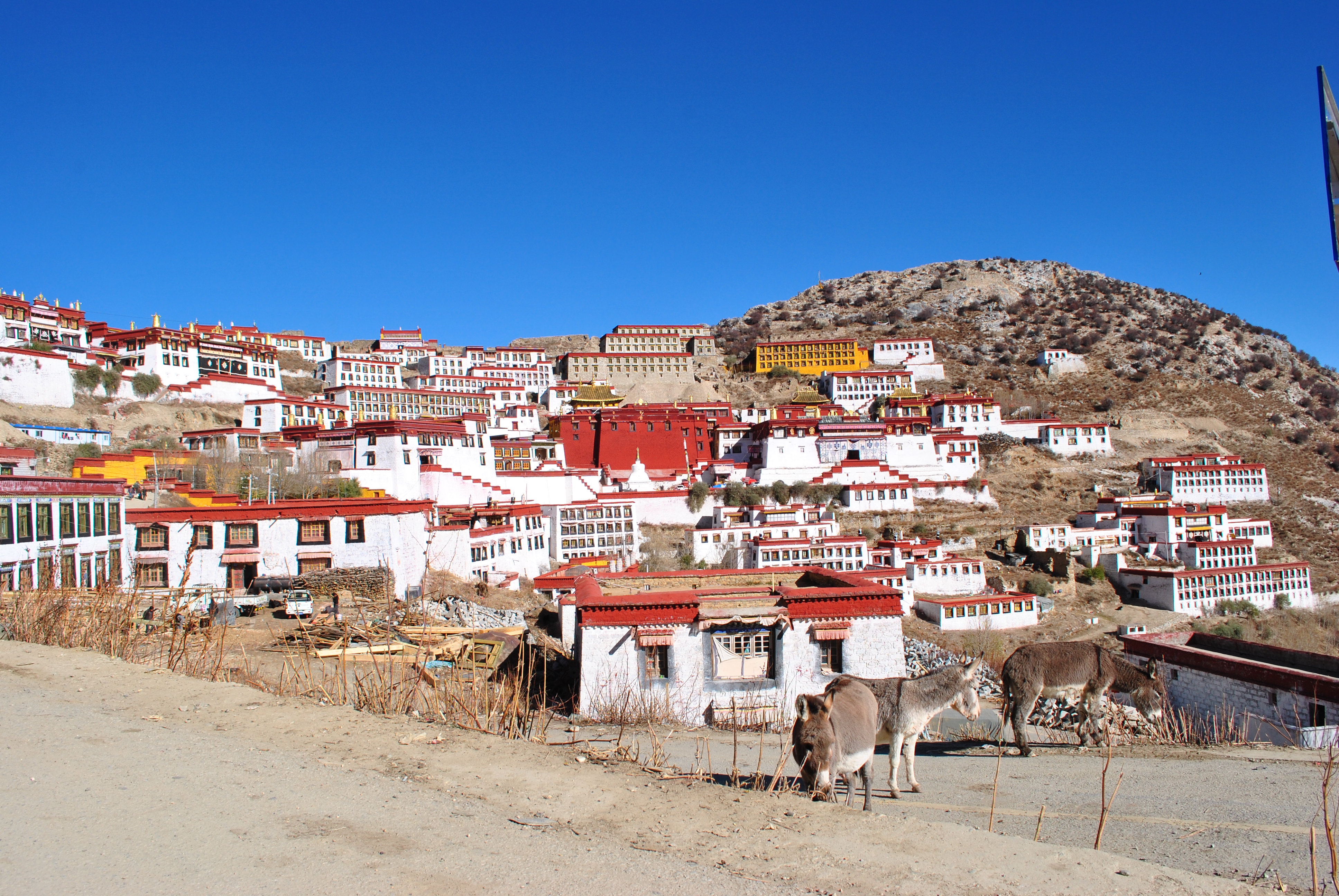
Ganden Monastery
When the Red Guards ordered Ganden Monastery dynamited during the Cultural Revolution, a monk named Bomi Rinpoche was forced to carry the mummified body of Je Tsongkhapa to the fire. Tsongkhapa had founded Ganden in 1409 and died there in 1419; his preserved remains had been entombed in a silver and gold reliquary for over five centuries. As the body burned, Bomi Rinpoche saved the skull and a handful of ashes. Those fragments became the seed around which Ganden has been rebuilt, piece by piece, since the 1980s. The monastery's name means "joyful" -- it is the Tibetan word for Tushita, the heaven where the future Buddha Maitreya awaits.
The Birthplace of a Tradition
Ganden sits at 4,300 meters atop Wangbur Mountain in Dagze County, 40 kilometers northeast of Lhasa. The monastery lies in a natural amphitheater of hills, and the kora pilgrim circuit around it offers dramatic views over the surrounding valleys. Je Tsongkhapa Lozang-dragpa founded it in 1409 as the first monastery of what would become the Gelug school -- the name itself is an abbreviation of "Ganden Lug," meaning "Ganden Tradition." Tsongkhapa built the main temple with large statues and three-dimensional mandalas. He often stayed at Ganden and died there a decade later, leaving his robe and staff to the first Ganden Tripa, Gyeltsabjey. The Ganden Tripa -- "throne-holder of Ganden" -- remains the head of the Gelug school, serving seven-year terms. By 2003, there had been ninety-nine holders of the position.
Power Behind the Prayer Wheels
Ganden was not merely a place of contemplation. Together with Sera and Drepung monasteries, it formed a triad of institutions that wielded enormous political power in Tibetan society. At its peak, Ganden supported over 5,000 monks, though estimates from the 1890s put the number at roughly 3,300. The three monasteries together housed 20,000 monks, sustained by large estates of fertile land worked by serfs. Their collective influence was such that they could effectively veto government decisions. In the 1860s, a lay aristocrat named Shatra organized an assembly of representatives from Ganden, Drepung, and government officials that deposed the sitting regent. This assembly, the Tsondu, went on to choose regents and serve as a consultative body -- a monastic parliament of sorts, operating within a theocratic system.
Destruction and the Bones That Survived
Ganden was completely destroyed by the People's Liberation Army during the 1959 Tibetan uprising. In 1966, Red Guard artillery shelled what remained, and monks were ordered to dismantle the ruins. Dynamite finished what the shells had started during the Cultural Revolution. The destruction was systematic: every chapel, every hall, every statue reduced to rubble. But Bomi Rinpoche's rescue of Tsongkhapa's skull preserved something that blueprints and photographs could not -- a physical connection to the founder. Rebuilding has continued since the 1980s, with the red-painted lhakang at the center housing the Tongwa Donden, "Meaningful to Behold," Tsongkhapa's reconstructed reliquary chorten. The 14th Dalai Lama, who took his final degree examination at Ganden in 1958, has spoken of a particularly close connection with Tsongkhapa.
Ganden in Exile and Under Watch
In 1966, Tibetan exiles re-established Ganden in Karnataka, India, at a settlement near Mundgod on land donated by the Indian government. By 1999, the settlement housed about 13,000 residents across nine camps with two monasteries and a nunnery. The curriculum remained faithful to the pre-1959 Ganden tradition. But even exile brought no peace from factional disputes: in 2008, over 500 monks who refused to accept a ban on the protective deity Dorje Shugden were expelled from the Mundgod monastery and founded Shar Gaden Monastery nearby. Back in Tibet, the original Ganden has seen periodic unrest. In 1996, after a ban on pictures of the Dalai Lama, 400 monks rioted and were fired upon by PLA troops, leaving at least two dead and one hundred arrested. As of 2012, the monastery's population stood at roughly 400 monks -- a fraction of its historic community.
From the Air
Ganden Monastery is located at 29.759N, 91.476E atop Wangbur Mountain at 4,300m elevation, 40km northeast of Lhasa. Lhasa Gonggar Airport (ZULS) is the nearest major airport, approximately 100km to the southwest. The monastery sits in a natural amphitheater visible from altitude as a cluster of white and red buildings on a hilltop. The Kyichu River valley provides the approach corridor from Lhasa. Expect high terrain in all directions with limited emergency landing options.