Gandy Bridge: Five Bridges Across One Bay
"The bridge is built!" George S. Gandy Sr. kept his opening ceremony speech to four words. After fourteen years of setbacks - a partner buyout, World War I regulations that killed his financing, a complete route change from Ninth Street to Fourth Street - the steel-and-concrete span opened on November 20, 1924, carrying automobiles two and a half miles across Old Tampa Bay between St. Petersburg and Tampa. Sixteen visiting state governors and several foreign dignitaries attended. The bridge cost $1.932 million and was, at the time, the longest automobile toll bridge in the world. Gandy had every right to be brief. The structure spoke for itself.
One Man's Stubborn Crossing
The idea started in 1910, when H. Walter Fuller drew a map with a proposed bridge following Ninth Street North in St. Petersburg across upper Tampa Bay. George Gandy was president of three companies Fuller directed, and the two partnered to make it happen. Survey crews shifted the route to Fourth Street. Then World War I intervened: the War Industries Board, headed by Bernard Baruch, required certificates of necessity for any project over $250,000. Gandy's bridge didn't qualify. Financing evaporated. Fuller walked away. Gandy bought out his partner's interests and pressed on alone. By 1922, he'd hired promoter Eugene M. Elliott to attract new investors, sold enough stock to cover the cost, and broken ground in September. The bridge slashed the drive between Tampa and St. Petersburg from 43 miles to 19 - following roughly the same route as the world's first scheduled airline flight, a seaplane service that had connected the two cities for six months back in 1914.
Tolls, Seizure, and the Government Check
Crossing the Gandy Bridge originally cost 75 cents for a car and driver, plus a dime for each additional passenger. The toll funded Gandy's investment until April 27, 1944, when the Roosevelt administration seized the bridge as a war necessity, eliminating the toll. Gandy's company fought back in court. On December 23, 1945, a federal jury awarded The Gandy Company $2,383,642 in compensation, plus $100,000 in interest. By 1947, the bridge had streetcar tracks removed and a counter line added during renovation. That same year, state Senator Raymond Sheldon called it "outmoded, too narrow and a traffic bottleneck." The original span, not yet twenty-five years old, was already too small for the postwar boom it had helped create.
The Bridge That Kept Replacing Itself
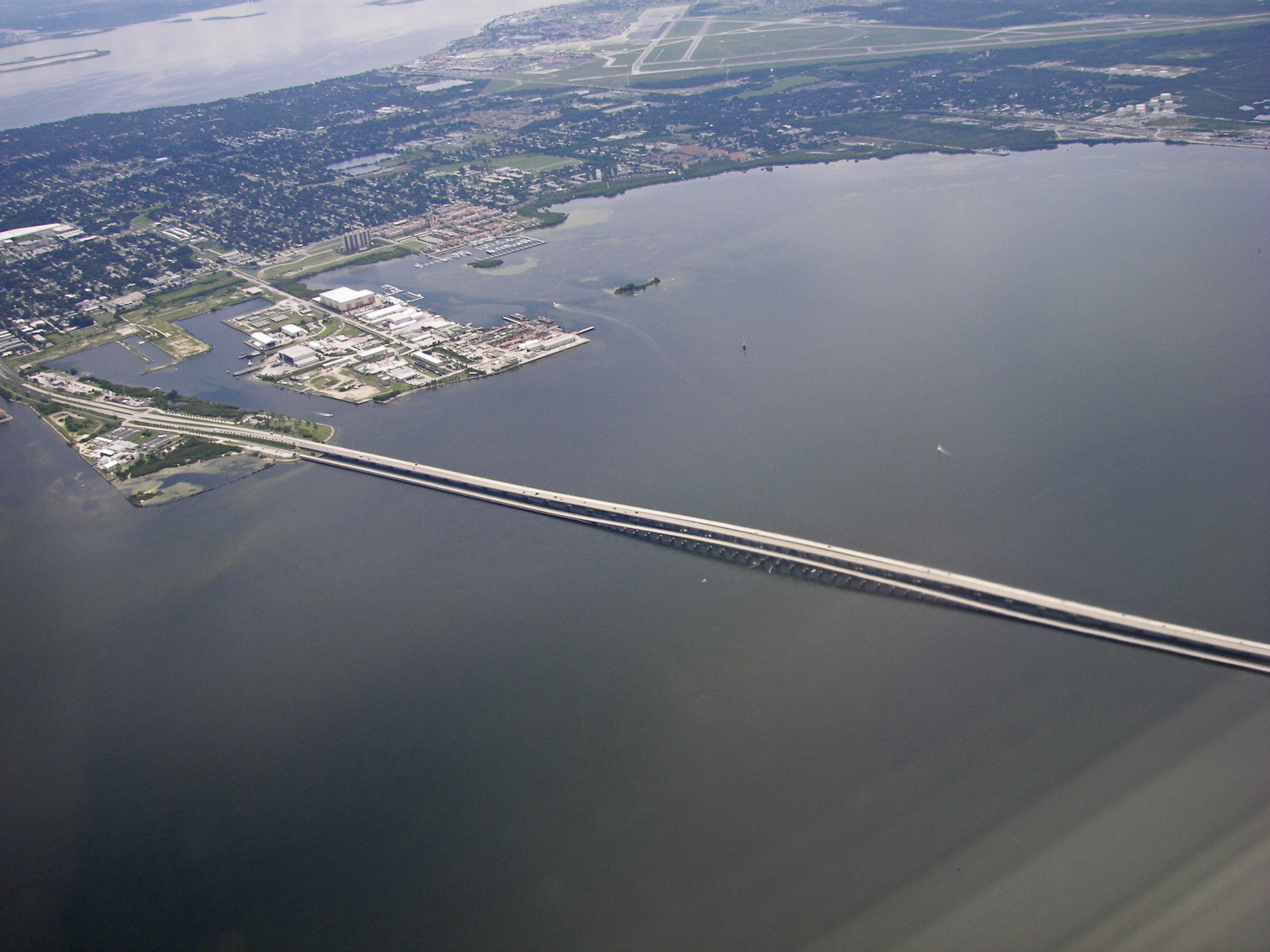
The Gandy Bridge has been built, rebuilt, duplicated, replaced, and demolished in overlapping waves that challenge even locals to keep straight. A second fixed span went up in 1956 for westbound traffic. A third span opened in 1975 along the south side, replacing the original 1924 bridge, which was immediately dismantled. A fourth span arrived in 1996, slotting in between the remaining two. Each new bridge rendered an older one obsolete. The westbound 1996 span sits nine feet higher than the 1975 eastbound span, with a more gradual hump - the two parallel bridges visibly different in profile and era. Almost three miles long, the Gandy is the southernmost of three bridges linking Hillsborough and Pinellas counties, alongside the Howard Frankland Bridge and the Courtney Campbell Causeway.
The Friendship Trail's Rise and Fall
When the 1956 span lost its traffic role in 1997, it was reborn as the Friendship Trail Bridge - a pedestrian and cycling path across Tampa Bay. For eleven years, walkers and cyclists could cross open water on the old roadbed, a beloved recreational corridor. Then a 2008 state inspection found severe structural decay. The bridge had been corroding for years, and the report revealed it could potentially collapse. Estimates to retrofit the entire structure came to $30 million - and that would only buy ten more years. With the nation in recession, neither Hillsborough nor Pinellas County could justify the cost. Citizens rallied to save it, proposing public-private partnerships and winning delays from the county commission, but no funding materialized. Demolition began in 2015 and finished in July 2016. The Friendship Trail was gone.
Barges, Shrimp Boats, and the Next Span
The Gandy Bridge has a colorful history of being struck by watercraft. In 1970, a barge hit the drawbridge when it failed to open in time. In 1985, Hurricane Elena broke two barges from their moorings and smashed them into the southernmost span. In 2006, the 285-foot steel barge Apache slammed into a concrete support column, dropping chunks of reinforced concrete onto its deck. Through it all, the bridge endures. FDOT announced in 2021 a study to build a fifth span, replacing the aging 1975 bridge. The new span would include a trail component, reviving the Friendship Trail link lost when the 1956 span was demolished. A century after George Gandy declared 'The bridge is built,' Tampa Bay is still building his bridge.
From the Air
Located at 27.89°N, 82.56°W, the Gandy Bridge is unmistakable from the air: two parallel spans stretching nearly three miles across Old Tampa Bay between Tampa on the east and St. Petersburg on the west. It is the southernmost of the three Tampa Bay crossings, with the Howard Frankland Bridge roughly 3 miles north and the Courtney Campbell Causeway farther north still. The twin spans of the current bridge are visibly different in height and profile - the 1996 westbound span sits noticeably higher than the 1975 eastbound span. Nearby airports: Tampa International (KTPA) 4 miles northeast, St. Pete-Clearwater International (KPIE) 6 miles northwest, Albert Whitted (KSPG) 7 miles southwest. Best viewed at 1,500-3,000 feet AGL; the bridge's low profile over open water makes it particularly visible against the bay's surface.