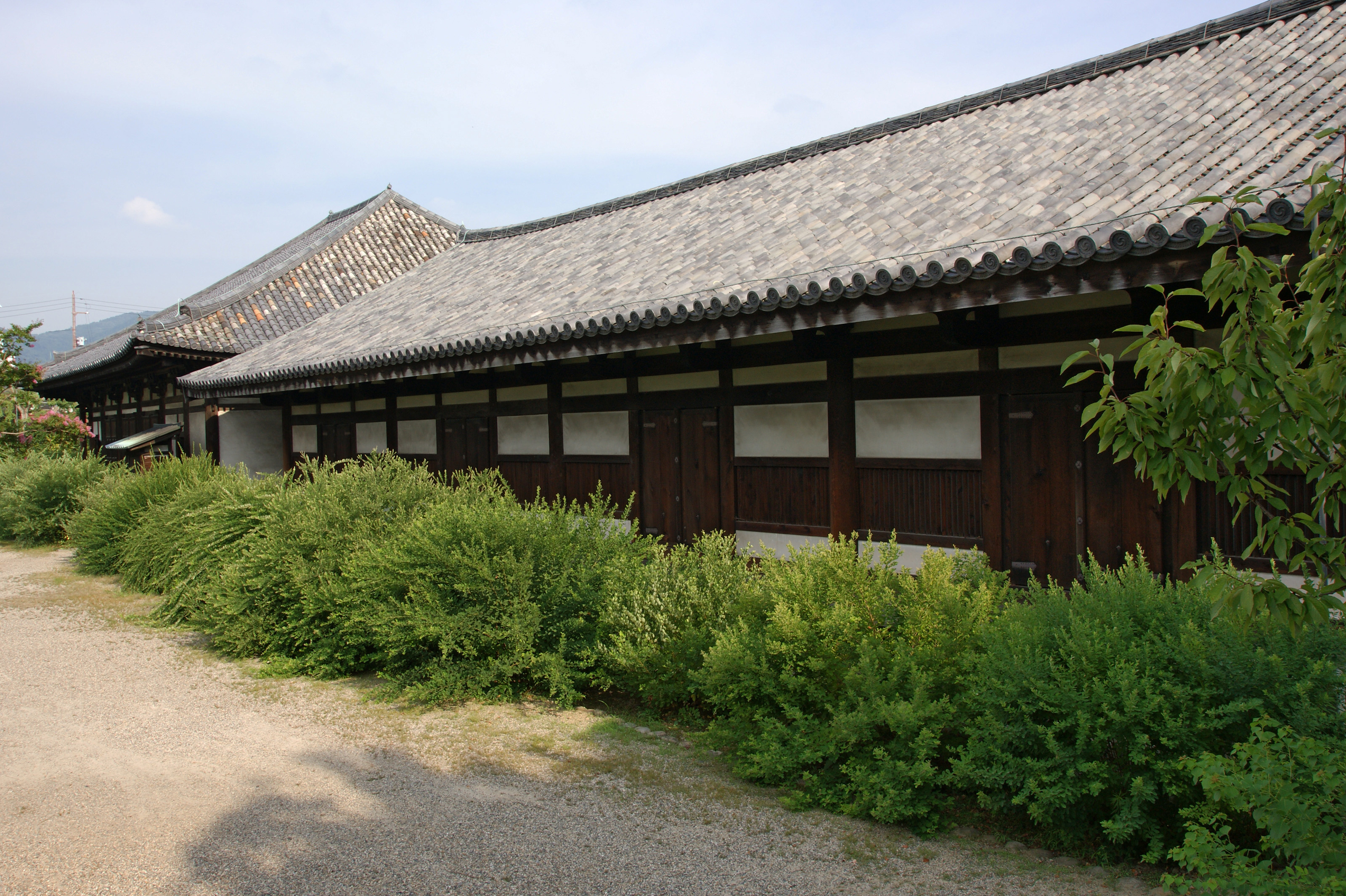
Gangō-ji
Walk the narrow lanes of Naramachi, Nara's atmospheric old town, and you are treading on sacred ground without knowing it. The tidy wooden machiya townhouses, the craft shops, the small restaurants -- all of it sits atop what was once one of Japan's most powerful Buddhist temple complexes. Gangō-ji arrived in Nara in 718, transplanted from the even older Asuka-dera in the Asuka Valley, making its spiritual lineage one of the oldest in the country. At its peak during the Nara period, the temple complex stretched 440 meters north to south and 220 meters east to west, rivaling its famous neighbor Tōdai-ji in sheer ambition. Today, three quiet fragments are all that remain -- each a separate temple, each a window into thirteen centuries of Japanese Buddhist history.
A Temple Transplanted
When Empress Genmei moved Japan's capital to Heijō-kyō in 710, the great temples followed. Hōkō-ji, the country's pioneering Buddhist temple founded in the Asuka Valley, was formally relocated in 718 and reborn as Gangō-ji -- literally "the temple of the original beginning." The original Asuka-dera was not abolished; it continued under its old name, creating an unusual situation where parent and offspring coexisted for centuries. In its new home, Gangō-ji became a complete Shichidō garan: Great South Gate, Central Gate, Main Hall, Lecture Hall, Bell Tower, and Dining Hall arrayed in a strict north-south line, with corridors enclosing the sacred core. To the east rose a five-story pagoda; to the west, a smaller pagoda compound. Rows of monks' quarters stretched behind the Lecture Hall like tenement blocks, housing the scholars who made Gangō-ji a seminary for both the Sanron and Hosso sects of Buddhism.
The Long Unraveling
Gangō-ji's decline reads like a slow-motion collapse spanning half a millennium. When the capital shifted to Kyoto in 794, imperial patronage evaporated. Newer Buddhist schools -- Tendai and Shingon -- eclipsed the older Sanron and Hosso traditions, and the temple's estate income dried up as Japan's old legal system crumbled. By 1035, records describe the head priest selling the temple's treasures to keep the gates open. A survey from 1246 found the five-story pagoda missing its top two stories and spire, the Great South Gate crumbling. Then in 1451, a peasant uprising set fire to the Small Pagoda Compound, and flames consumed nearly the entire complex. The pagoda survived, but the Main Hall burned. It was rebuilt, only to be flattened by a powerful windstorm in 1472 -- and never rebuilt again. Townspeople moved into the ruins, and by the close of the Muromachi period, Gangō-ji had fractured into three independent temples.
Three Survivors
Each fragment tells a different chapter of the story. The Gokurakubō, now the main successor temple carrying the Gangō-ji name, centers on the Gokuraku-dō hall, which was remodeled during the Kamakura period from the old monks' quarters where the scholar-monk Chiko once lived. Inside hangs the Chiko Mandala, a painting of the Pure Land with Amida Nyorai at its center, drawn by Chiko himself during the Nara period. As Pure Land faith surged in the late Heian period, this mandala became a magnet for worshippers, transforming a humble dormitory into a pilgrimage destination. The Gokurakubō is now registered as a UNESCO World Heritage Site under the Historic Monuments of Ancient Nara. The Pagoda Site, designated a National Historic Site in 1932, preserves the stone foundation of the vanished five-story pagoda, its 17.7-meter-square base now sandwiched between private homes. The Small Pagoda Complex, the third fragment, was originally built by Empress Shōtoku to house one million small wooden votive pagodas honoring those who died in the Fujiwara no Nakamaro Rebellion.
Hidden in Plain Sight
The paradox of Gangō-ji is that it is everywhere and nowhere in Naramachi. The neighborhood's entire footprint corresponds roughly to the old temple grounds, yet most visitors wander its charming streets without realizing they are inside a vanished sacred complex. An archaeological excavation in 1927 unearthed jewels, copper coins, and altar implements around the pagoda's central foundation stone, dating the structure to the late 8th century -- about fifty years after the capital's move to Nara. Some of the tiles on the Gokurakubō's roof are believed to date to the original Asuka-dera, making them among the oldest building materials still in use anywhere in Japan. The Gokurakubō sits just a ten-minute walk from Kintetsu Nara Station, quietly holding its ground while the busier attractions of Tōdai-ji and Kōfuku-ji draw the crowds to the north.
From the Air
Located at 34.678°N, 135.831°E in the heart of Nara's Naramachi district, south of the more prominent Kōfuku-ji and Tōdai-ji temple complexes. From altitude, the Naramachi area appears as a dense grid of traditional low-rise buildings contrasting with the open parkland of Nara Park to the north. The nearest airport is Osaka Itami (RJOO), approximately 30 km west. Kansai International (RJBB) lies about 70 km to the southwest. Nara Heliport (RJNN) is the closest landing facility. Recommended viewing altitude: 2,000-3,000 feet AGL for context of the temple fragments within the urban fabric.