Ganjali Khan Complex
One man built an entire city center. Between 1596 and 1621, Ganj Ali Khan governed the provinces of Kerman, Sistan, and Kandahar under Shah Abbas I, and he used that quarter-century to stamp his name onto the urban fabric of Kerman so thoroughly that the city still revolves around his creation. The Ganjali Khan Complex is not a single monument but a constellation of structures -- school, square, caravanserai, bathhouse, water reservoir, mint, mosque, and bazaar -- each designed by the Yazdi architect Mohammad Soltani and inscribed with the exact date of its completion. Walk into the old center of Kerman today and you walk into Ganjali Khan's vision of what a Safavid city should be.
A Square Built for Ceremony
The Ganjali Khan Square measures ninety-nine meters by fifty-four meters, a proportioned rectangle that echoes the grander Naqsh-e Jahan Square in Isfahan and the Amir Chakhmaq Complex in Yazd. In Safavid Iran, civic squares were not empty plazas but functional nodes -- gathering points for ceremonies, markets, and the display of power, always sited near the governor's residence. Bazaar arcades flank the square on multiple sides, drawing merchants and shoppers into the complex the way arteries feed a heart. Caravanserais and schools frame the remaining edges. The effect is of a self-contained urban organism: you could arrive at the square as a traveler, stable your horse at the caravanserai, wash at the bathhouse, pray at the mosque, trade in the bazaar, and never leave the boundaries Ganj Ali Khan laid out.
Where Hot Rooms Became a Museum
The bathhouse, completed in 1611, sits on the southern side of the square off a stretch of Vakil Bazaar known locally as Ganjali Bazaar. Step through the painted entrance -- Safavid-era ornaments still frame the doorway -- and the architecture unfolds in a sequence of domed rooms. A disrobing room leads to a cold room, then a hot room, each ceiling carried on squinches that transition the square floor plan into circular domes above. The tilework, paintings, stucco, and arched passageways rank among the finest Safavid decorative arts in southeastern Iran. In 1971, the bathhouse was converted into an anthropological museum. Lifelike statues now populate the closet section and main yard, depicting the daily rituals of a working hammam. The statues were designed at Tehran University's faculty of fine arts in 1973, lending the space an eerie second life -- as if the bathers paused mid-scrub and never left.
Coins, Caravans, and Calligraphy
On the east side of the square, the caravanserai welcomes visitors through a portal bearing a foundation inscription from 1598, composed by the celebrated calligrapher Ali Reza Abbasi. The layout follows the classic four-iwan plan: double-story halls surround an open courtyard, each side centered on a tall iwan. An octagonal fountain, chamfered at the corners, occupies the courtyard's center. The caravanserai measures roughly thirty-one and a half by twenty-three meters, compact by the standards of the great Silk Road inns but perfectly scaled for its urban setting. Tucked into one corner is a small domed mosque, just five and a half by five meters -- intimate enough that a handful of travelers could pray together between trades. Nearby, the complex's former mint tells its own story. Construction began in 1598 and ended in 1625, its interior decorated with ochre plasterwork beneath a tall dome crowned by a cupola that admits both light and air. Since 1970 the mint has served as a numismatics museum, displaying coins from the Parthian, Sassanid, Safavid, and Afsharid periods.
Wind, Brick, and Continuity
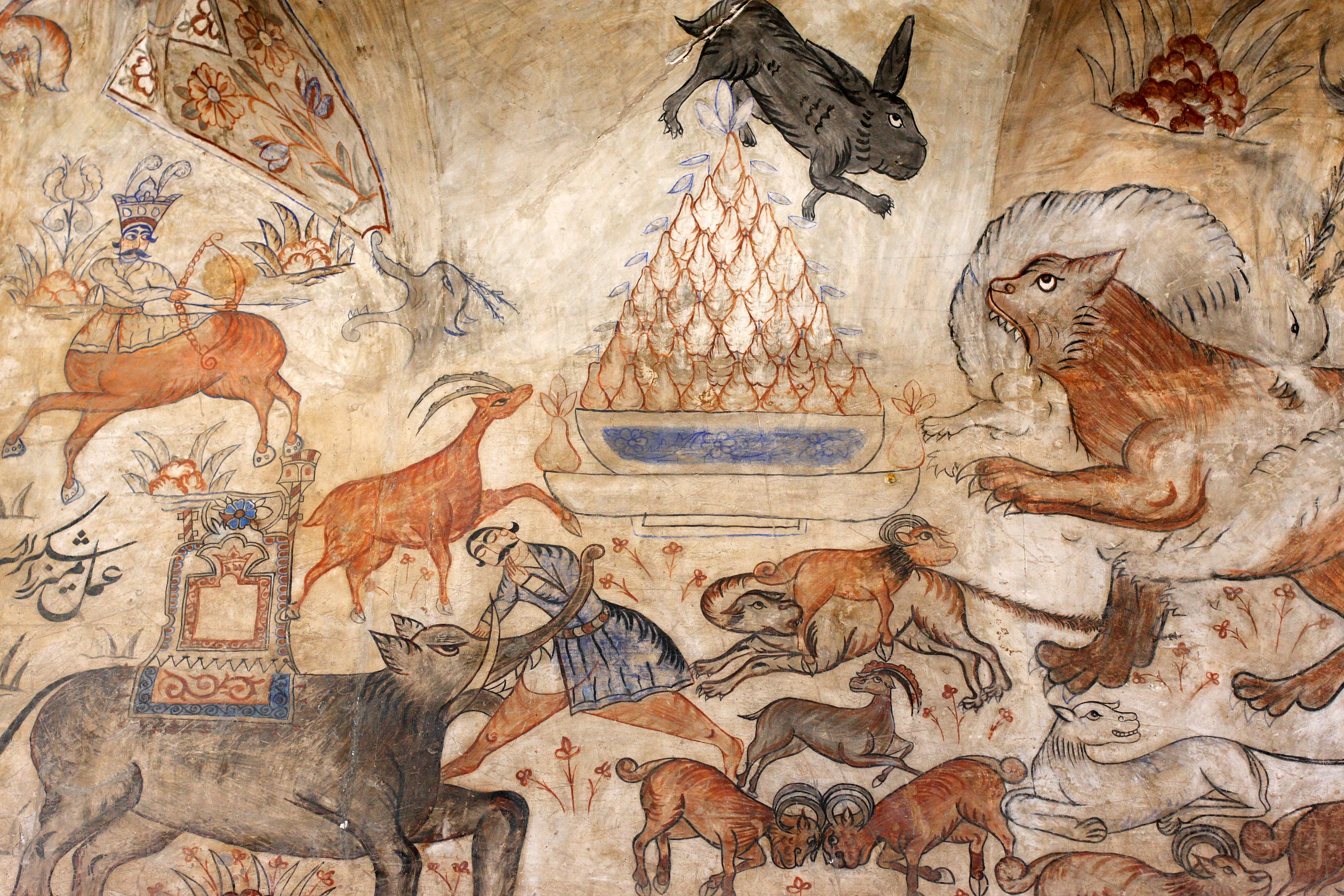
A windcatcher rises above the complex, its tower funneling desert breezes into the rooms below -- a reminder that Iranian architecture has always been a negotiation with climate. Kerman sits on an arid plateau at roughly 1,750 meters elevation, where summer temperatures push past forty degrees Celsius and water has always been precious. The Ab Anbar, or underground water reservoir, is one of the complex's less visible but most essential elements, storing water drawn through qanats for the use of travelers, worshippers, and residents alike. Four centuries after Ganj Ali Khan's architects laid the last tile, the complex remains the beating heart of old Kerman. The bazaar still trades. The square still gathers people. Frescoes in the bazaar arcades survive from the Safavid era, their pigments faded but their compositions intact. What Ganj Ali Khan built was not merely a collection of buildings but a functioning neighborhood, and the fact that it still functions may be the finest tribute to Mohammad Soltani's design.
From the Air
Located at 30.29N, 57.08E in the historic center of Kerman, southeastern Iran. The complex is embedded in the old city's dense urban fabric and is best identified from the air by the large rectangular square and surrounding bazaar rooflines. Kerman Airport (OIKK) lies approximately 12 km to the northeast. The terrain is arid plateau at roughly 1,750 meters (5,740 feet) elevation. Approach from the south for the clearest view of the old city quarter and the complex's relationship to the surrounding bazaar network.