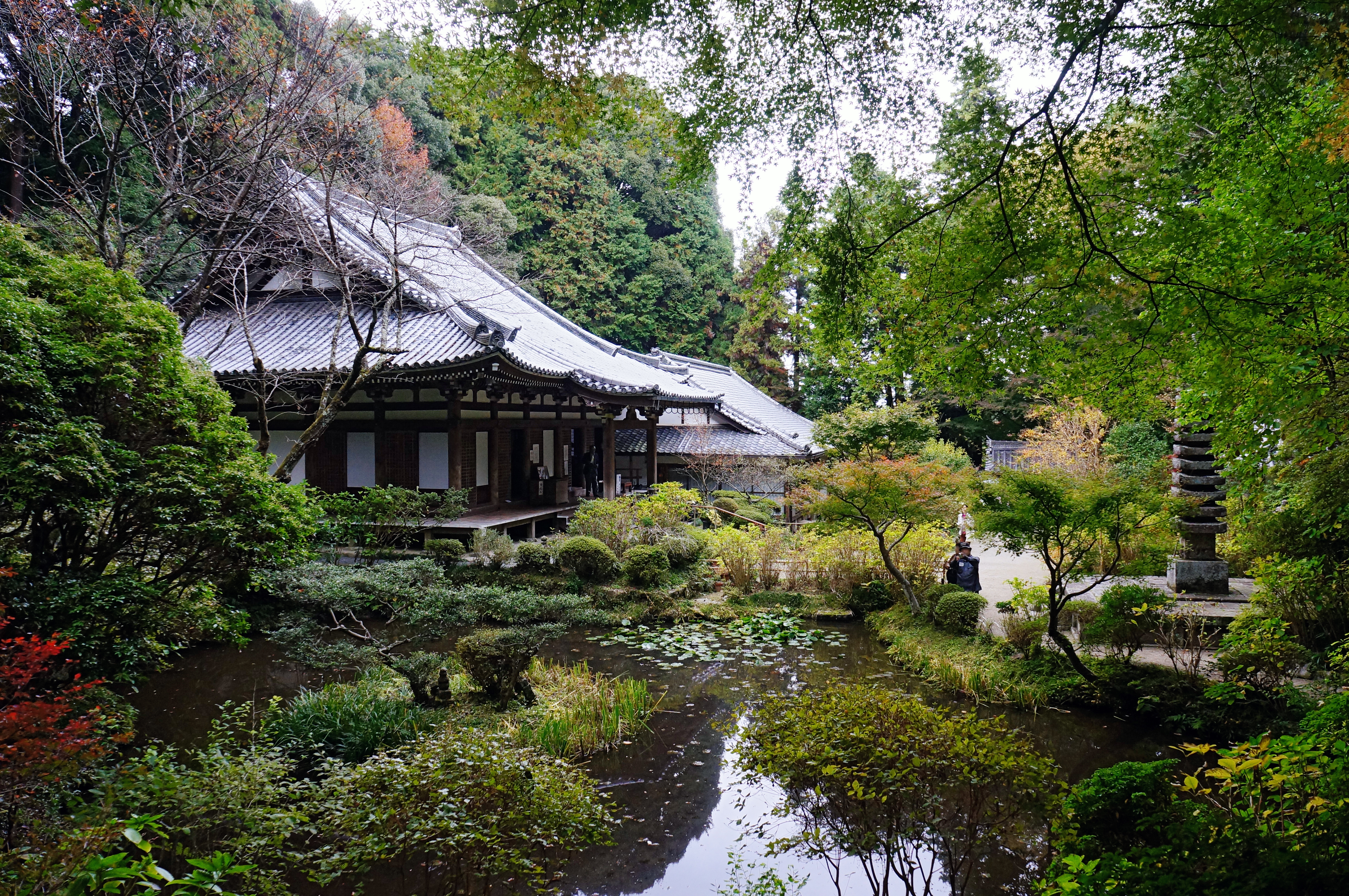
Gansen-ji
Every June, the slopes around Gansen-ji vanish beneath a rolling tide of hydrangea blossoms -- ten thousand bushes in shades of blue, purple, pink, and white transforming this hillside temple into one of the Kansai region's most vivid seasonal spectacles. The flowers are what draw modern visitors, but they are only the most recent chapter in a story stretching back to 729, when the Buddhist priest Gyōki founded the temple by imperial order of Emperor Shōmu. Tucked into the wooded hills of Kizugawa in southern Kyoto Prefecture, Gansen-ji is the fifteenth of the twenty-five Kansai Flower Temples and a stop on two separate Buddhist pilgrimage routes. Beneath the petals, the temple guards a remarkable collection of Kamakura-period stone monuments that rank among the finest in Japan.
Imperial Origins, Repeated Fires
According to the Gansen-ji Engi, a temple chronicle compiled in 1632, the complex was established in 729 at the behest of Emperor Shōmu, one of the Nara period's most devout patrons of Buddhism. The priest Gyōki, famous across Japan for his public works and temple-building campaigns, oversaw the construction. The temple's early centuries are poorly documented, but the Jōkyū War of 1221 -- a failed imperial attempt to overthrow the Kamakura shogunate -- brought destruction when much of Gansen-ji burned. Reconstruction came in 1311, but fire struck again in subsequent centuries. It took the patronage of Japan's most powerful dynasty to restore the temple fully: Tokugawa Ieyasu and his son Tokugawa Hidetada donated funds for a comprehensive rebuilding carried out between 1624 and 1643, during the Kan'ei era. That Tokugawa-era framework is largely the temple visitors walk through today.
Stone Monuments of the Kamakura Age
Gansen-ji's greatest treasures are carved from stone, not wood. The temple possesses four nationally designated Important Cultural Properties, three of them stone. The thirteen-story stone pagoda, rising in slender tiers from a mossy base, was erected sometime between 1275 and 1332 during the late Kamakura period and received its Important Cultural Property designation in 1952. Nearby stands a gorintō -- a five-element memorial tower representing earth, water, fire, wind, and void -- from the same era and carrying the same designation. Close to the thirteen-story pagoda sits a small stone chamber sheltering a haut-relief carving of Fudō Myōō, the fierce guardian deity of Esoteric Buddhism, dated to 1312 and similarly recognized. The fourth Important Cultural Property is the wooden three-story pagoda, which anchors the temple grounds with its elegant proportions. Together, the stone monuments make Gansen-ji an unusually rich repository of Kamakura-era Buddhist art for a temple of its modest size, while the wooden three-story pagoda -- dating to 1442, in the Muromachi period -- adds a later layer of architectural history.
Flowers, Music, and Pilgrimage
Gansen-ji belongs to the twenty-five Kansai Flower Temples, a multi-sect association of Buddhist temples across the Kansai region celebrated for their seasonal gardens. The hydrangea season in June is the main draw, but the temple's forested grounds offer changing displays through the year. The temple also occupies a place in two Buddhist pilgrimage circuits, serving as the fourth stop on one route and the 129th on a broader Kansai-wide pilgrimage. A curious cultural footnote dates to December 7, 1940, when a gagaku ensemble called the Garyōkai performed at the temple to celebrate the 2,600th anniversary of Japan's legendary founding. The concert blended ancient court music with noh dances and a formal Japanese tea ceremony -- a rare fusion of courtly arts in a rural temple setting. Inside the main hall, a wooden seated statue of Amida Nyorai, carved in 946 during the Heian period, watches over the devotions of pilgrims who still arrive on foot along centuries-old paths.
A Quiet Corner of Kyoto Prefecture
Kizugawa sits at the southern edge of Kyoto Prefecture, far from the tourist circuits of Kyoto city, in a landscape of low wooded hills and river valleys where the pace of life slows considerably. Gansen-ji occupies a hillside above the Kizu River plain, surrounded by forests that muffle the outside world. The Shingon Risshu sect, to which the temple belongs, traces its lineage to the Kamakura-period reformer Eison, who emphasized monastic discipline and care for the marginalized -- a tradition reflected in the temple's quiet, unassuming character. For visitors who make the journey, Gansen-ji offers something increasingly rare: a nationally significant Buddhist site where you can stand alone among Important Cultural Properties, listening to birdsong instead of tour group loudspeakers, with nothing between you and eight centuries of carved stone but dappled sunlight filtering through hydrangea leaves.
From the Air
Located at 34.720°N, 135.886°E in the hills of Kizugawa, southern Kyoto Prefecture. From the air, the temple appears as a wooded enclave amid agricultural fields along the Kizu River valley. The nearest major airport is Osaka Itami (RJOO), about 40 km to the west. Kansai International (RJBB) is approximately 60 km to the southwest. The small Shimojima Heliport is closer but limited in access. Recommended viewing altitude: 2,000-3,000 feet AGL. The three-story wooden pagoda may be visible among the tree canopy in clear conditions.