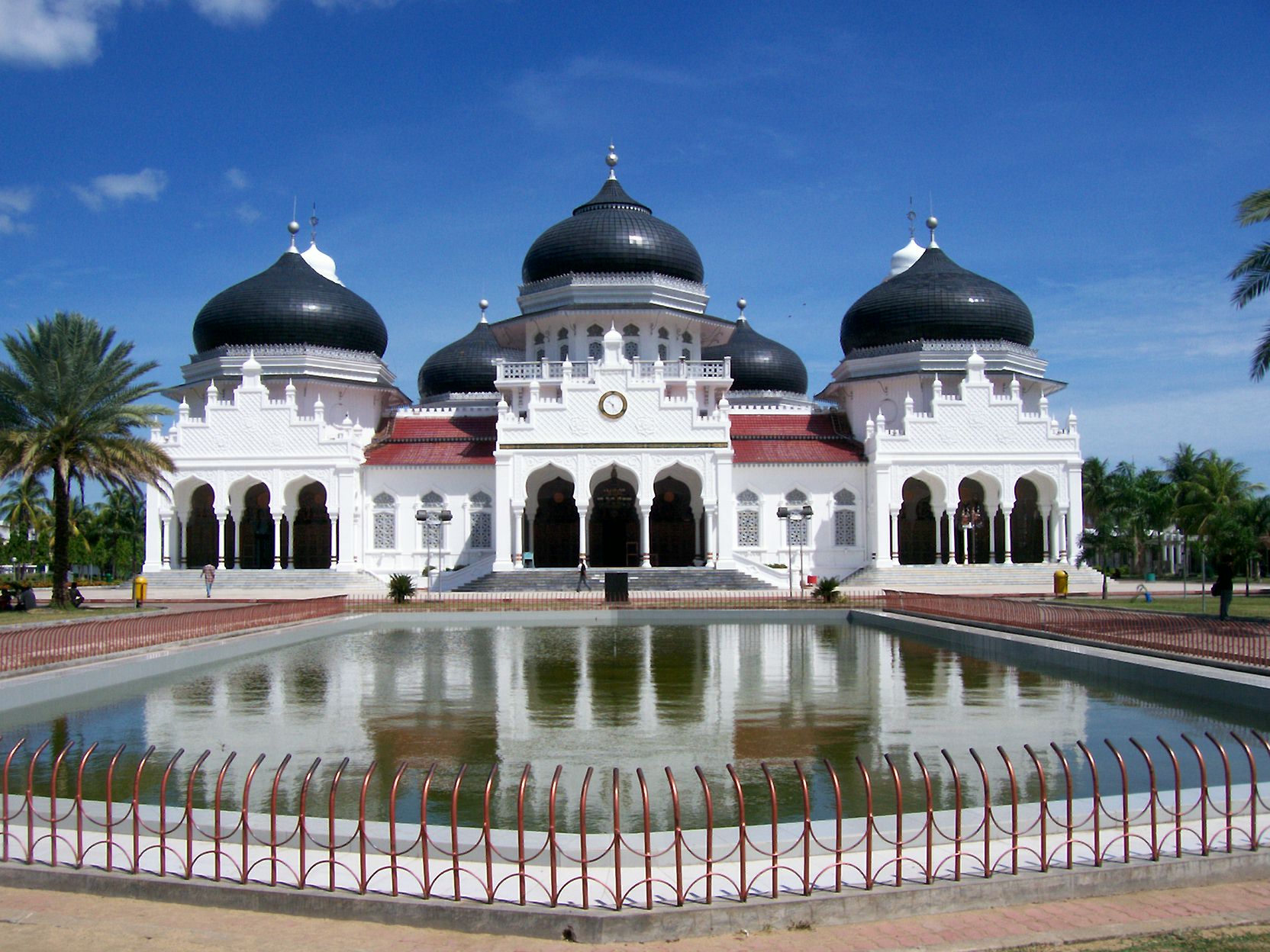
Ganting Grand Mosque
Twenty-five columns hold up the Ganting Grand Mosque, and each one bears the name of a prophet. Made of red brick bound with egg whites -- no iron framework at all -- they are arranged in five rows of five, from Adam to Muhammad. This structural choice is not engineering shorthand. It is theology rendered in masonry, a reminder that every surface of this mosque carries meaning, and that the building's two-century history reads less like an architectural record than like a condensed history of Padang itself.
Three Men and a Mosque
Construction began around 1805, spearheaded by three local figures: Angku Gapuak, a wealthy merchant who provided commercial clout; Angku Syekh Haji Uma, the village chief who contributed authority; and Angku Syekh Kapalo Koto, an ulama who supplied religious legitimacy. Minangkabau businesspeople and ulamas across Sumatra funded the project, and the mosque was erected on waqf land donated by local residents in the center of Padang's Minang district. By 1810 the building was complete -- a modest structure with stone flooring, wood and dirt walls, and a pyramidal roof in the Javanese mosque tradition. From the start, Ganting served a purpose beyond daily prayer. It became the counseling point for hajj pilgrims preparing for the voyage to Mecca, and after Emma Haven Port opened in 1895, it was the first departure point for pilgrims from Central Sumatra. In 1818, during the Padri War, Minangkabau ulamas gathered here to debate how to purge mysticism and superstition from Islam on the island -- a meeting that placed Ganting at the center of the religious reform sweeping West Sumatra.
Four Cultures Under One Roof
Walk through the Ganting Grand Mosque and you cross architectural borders without moving your feet. The Portuguese-style facade was built by the Dutch Genie Command Corps as compensation after colonial road construction claimed a third of the mosque's waqf land in the early 1900s. The octagonal dome was the work of ethnic Chinese craftsmen led by Captain Lo Chian Ko, its shape deliberately echoing the top of a Buddhist vihara. Chinese-style carvings ornament the mihrab where the imam leads prayer. Dutch tiles from the Netherlands, ordered through the trading house Jacobson van den Berg, covered the floor between 1900 and 1910 before German cement replaced them. And underneath it all, the Minangkabau architectural logic persists: the roof rising in five stepped tiers, the first square and the rest octagonal, each pierced with slits for natural light. European, Chinese, Middle Eastern, and Minangkabau traditions coexist here not as a design statement but as the accumulated result of two centuries of construction by whoever had the skill and the willingness to contribute.
The President Slept Here
In 1942, as Japanese forces swept through the Dutch East Indies, the colonial government was evacuating its political prisoners. Sukarno -- the future first president of Indonesia, then a Dutch detainee in Bengkulu -- was being transported to Kutacane. But when the convoy reached Painan, they discovered the Japanese had already taken Bukittinggi, cutting off the route north. The Dutch abandoned Sukarno in Painan. Members of Hizbul Wathan, the Muhammadiyah scouting organization headquartered at Ganting, traveled to retrieve him and brought him to Padang by cart. For several days, Sukarno slept in the mosque and delivered a speech from within its walls. During the three-year Japanese occupation that followed, the mosque served as the military headquarters for central and western Sumatra and doubled as a training camp for Gyugun and Heiho soldiers -- native Indonesian troops recruited by the Japanese, the former organized by ulamas and the latter drawn from santri, Islamic students. After the war, when Allied forces landed and Muslim Indian soldiers brought by the British deserted to join the Indonesian revolutionaries, it was inside this mosque that they planned the assault on a British barracks. One of those Indian soldiers, killed in the attack, was buried in the mosque grounds, where his grave remains.
Shaken but Standing
The Ganting Grand Mosque has a complicated relationship with earthquakes. In 1833, a massive quake along the west coast of Sumatra triggered a tsunami that destroyed much of Padang, but the mosque survived -- its stone floor later replaced with a mixture of clam shells and pumice. On April 10, 2005, a 6.7-magnitude aftershock following the Nias earthquake cracked the columns supporting the roof. Then came September 30, 2009, when a magnitude 7.6 earthquake struck the Padang coast. Ganting was one of 608 places of worship severely damaged. The facade partially collapsed, and the structural damage to those irreplaceable egg-white-and-brick columns was severe enough that the community feared the entire building might come down. For months, prayers were held in the yard while renovations proceeded. The mosque reopened in 2010 and was recognized in 2011 as one of Indonesia's 100 most beautiful mosques by Andalan Media -- the only mosque from West Sumatra to make the list alongside Raya Bayur Mosque in Agam Regency. Today, it still functions as a prayer hall, a pesantren, a tourist attraction, and a living monument to the layers of history embedded in its walls.
From the Air
Located at 0.9545S, 100.369E in central Padang, West Sumatra. The mosque sits in the urban center of Padang near the coast. Nearest airport is Minangkabau International Airport (WIPT/PDG), approximately 23 km north. The Indian Ocean is visible to the west, and the Minangkabau Highlands rise to the east. At low altitude (2,000-4,000 feet), the mosque's five-tiered octagonal roof and dome are distinguishable within Padang's dense urban fabric. The mosque is close to the Batang Arau river and Emma Haven (Teluk Bayur) port area to the south.