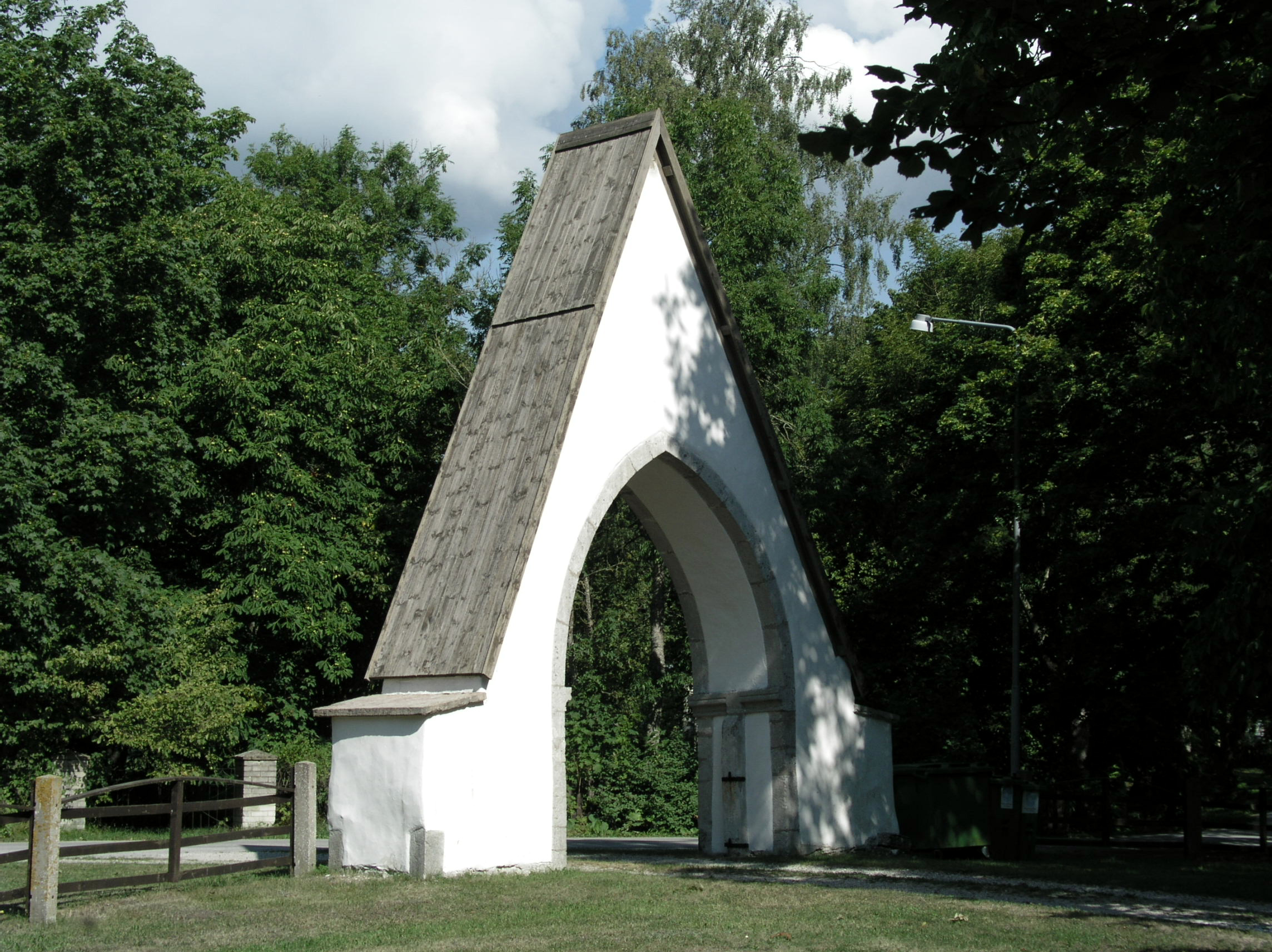
Garde Church
Two male saints stare out from the stone, dressed in Byzantine finery, their left hands raised in blessing, their right hands holding crosses. They have watched over Garde Church for more than eight centuries, painted around 1200 in a style that has no parallel anywhere else in Sweden. Art historians call them the best evidence of a Byzantinizing workshop on Gotland. The question of how Russian Orthodox artistic traditions came to decorate a Catholic church on a Swedish island in the Baltic Sea has occupied scholars since 1911, when Johnny Roosval first identified their Byzantine character. The answer remains elusive, wrapped in the medieval trade routes and cultural exchanges that made Gotland one of the great crossroads of the medieval world.
The Saints from the East
The murals adorn the soffit of the arch connecting the nave to the tower's ground floor, never covered or hidden, remarkably preserved after all these centuries. Each saint stands upright beneath arches decorated with palmettes, supported by pillars with ornate capitals. Their poses tend toward contrapposto, a natural stance that breathes life into the painted figures. Scholars have suggested they depict Florus and Laurus, comparing them to similar representations in the Church of Agioi Anargyroi in Kastoria, Greece. The stylistic parallels with Russian churches are striking, particularly with the murals at Nereditsa and St. George's Church in Staraya Ladoga. There was a Russian church in Visby, now a ruin, and perhaps a Russian artist traveled to Gotland to decorate it, painting Garde along the way. Or perhaps Gotlandic traders brought an artist from the eastern Baltic coast. The paintings also show influences from Greek, Sicilian, and Western art, suggesting an artist trained in Russo-Byzantine traditions but familiar with illuminated manuscripts from multiple sources.
Four Gates to Sacred Ground
Garde Church and its cemetery form one of the most well-preserved medieval church ensembles in Sweden. A low wall surrounds the grounds, repaired through centuries but never substantially changed since its original construction. Four original lychgates pierce this wall, each a portal through time. The western lychgate, the main entrance, rises three storeys of whitewashed tufted limestone, one of the largest medieval lychgates in Sweden, probably built in the first half of the 13th century. The covered space between its two gates holds niches with seats where pallbearers once rested. The upper storeys served as a granary for storing church tithes until 1917. The southern, northern, and eastern gates date from the 14th century, their interiors also fitted with seated niches. A fifth lychgate leads to the vicarage, the only one of its kind remaining on Gotland.
Layers of Faith
Christian graves from the Viking Age lie in this cemetery, their occupants buried with fragments of clothing. Before 1739, the dead were arranged by social standing: the wealthy to the south and east, closest to the church; the poor to the west; criminals to the north. The stone church itself dates from around 1130, making it one of the oldest on Gotland. Holes beneath the floor suggest a wooden predecessor once stood here. The tympanum above the southern portal shows a seated Christ, one hand on a book, the other raised in blessing. The tower has three storeys plus a belfry holding a bell cast in Lübeck in 1608, later recast in Stockholm. Gothic windows with tracery illuminate the chancel, their pointed arches contrasting with the simple round-arched windows of the nave.
Treasures of Byzantios
The baptismal font standing inside Garde Church is the work of a late 12th-century artist known by the scholarly notname Byzantios. Like all his fonts, it has an octagonal basin decorated with figures in low relief between short columns supporting round arches. Traces of original paint still cling to the base; the paint visible on the basin dates from the mid-18th century. The triumphal cross consists of a sculpture of Christ made around 1200, mounted on a later cross. The altarpiece of sculpted and painted limestone dates from 1689, depicting the Last Supper flanked by Moses and Aaron, topped by the monogram of King Charles XI of Sweden. Fragments of picture stones were discovered in the floor during the 1960s renovation. Runic inscriptions and carvings of ships mark the interior walls, messages from medieval worshippers that somehow survived.
Protected for Eternity
In 2019, Garde Church became one of the first 56 cultural heritage monuments in Sweden to be marked with the blue and white shield of the Hague Convention for the Protection of Cultural Property in the Event of Armed Conflict. The designation recognizes what has been obvious to visitors for centuries: this is a place of irreplaceable significance. The church still serves its parish within the Diocese of Visby and the Church of Sweden. Those Byzantine saints continue their silent vigil, their origins mysterious, their presence undeniable. Whether a Russian artist came to Gotland by invitation or by chance, whether trade or faith or simple wanderlust brought these Eastern traditions to a small island in the Baltic, the result stands as testimony to medieval connectivity that we are only beginning to understand.
From the Air
Located at 57.32°N, 18.58°E on the eastern coast of Gotland in the Baltic Sea. The whitewashed church complex is visible from altitude, distinguished by its medieval wall with four lychgates. Nearest airport is Visby Airport (ESSV), approximately 35 km northwest. Situated north of the main road between Ljugarn and Lye, the church ensemble appears as a bright white cluster against the green and brown Gotlandic farmland. The seaside resort of Ljugarn lies to the south.