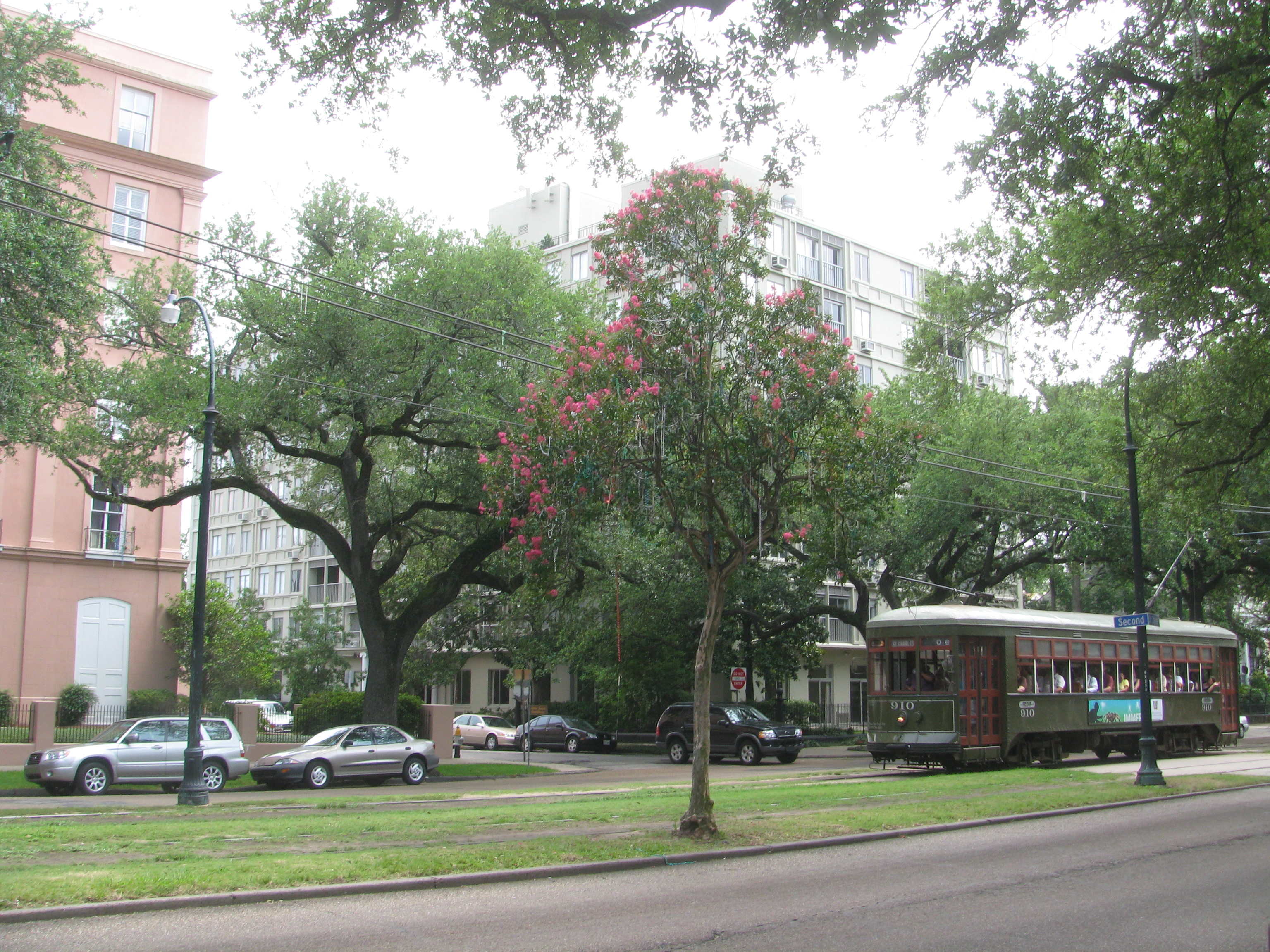
Garden District, New Orleans
Jefferson Davis, president of the defeated Confederacy, drew his last breath at 1134 First Street on December 6, 1889, in the home of Louisiana Supreme Court Justice Charles E. Fenner. A century later, the novelist Anne Rice purchased the Brevard-Rice House at 1239 First Street, one block away, and wove the neighborhood's oak-shaded grandeur into her vampire chronicles. Between those two addresses lies the entire arc of the Garden District: a neighborhood conceived in antebellum ambition, shadowed by war, and perpetually reinvented by the personalities it attracts. Carved from the Livaudais Plantation and laid out by architect Barthelemy Lafon, this enclave of Greek Revival mansions and gingerbread Victorians became a National Historic Landmark in 1974.
The Americans' Revenge
The Garden District exists because of a cultural grudge. When wealthy Americans flooded into New Orleans after the Louisiana Purchase of 1803, the established Creole families of the French Quarter made it clear the newcomers were not welcome. Rather than beg for acceptance, the Americans bought plantation land upriver and built something deliberately grander. The Livaudais Plantation was subdivided into city parcels, and the area became part of the independent City of Lafayette in 1833 before being annexed by New Orleans in 1852. The original lots were enormous -- just a couple of houses per block, each surrounded by sprawling gardens that gave the district its name. These were not modest homes. They were statements, built by sugar planters, cotton merchants, and commission agents whose fortunes flowed through the second-busiest port in America.
Iron Fences and Cornstalk Gates
Walk along Prytania Street today and you pass through an outdoor museum of nineteenth-century architecture. The Bradish Johnson House at 2341 Prytania, built in 1872 for a Louisiana sugar planter, reflects the French Ecole des Beaux Arts and has housed the Louise S. McGehee School since 1929. Colonel Short's Villa at 1448 Fourth Street, designed by architect Henry Howard in 1859, is ringed by one of the district's most photographed features: an ornate cast iron fence of morning glories and cornstalks, furnished by the Philadelphia foundry of Wood and Miltenberger. During the Civil War, the federal forces occupying New Orleans seized the villa as rebel property. It briefly served as the executive mansion of the federally installed Governor Michael Hahn in 1864 and then as the residence of Major General Nathaniel P. Banks. Colonel Short got his house back in 1865 and lived there until his death in 1890.
Where the Dead Rest Above Ground
Lafayette Cemetery No. 1, established in 1833 at 1420 Washington Avenue, is the Garden District's most haunting landmark. Laid out by city surveyor Benjamin Buisson on land that was once part of the Livaudais Plantation, the cemetery holds the remains of many German and Irish immigrants who settled in the old City of Lafayette. Its above-ground burial vaults, a necessity in a city where the water table can be just inches below the surface, create a miniature city of whitewashed stone and weathered brick. Among the interred is Samuel Jarvis Peters, considered the father of the New Orleans public school system, and Confederate General Harry T. Hays. Just across Washington Avenue stands Commander's Palace, founded in 1880 and widely regarded as one of the city's finest restaurants, where diners in the garden room can look directly at the cemetery wall.
Ghosts, Vampires, and Hollywood
The Garden District has always attracted storytellers. The George Washington Cable House at 1313 Eighth Street is a National Historic Landmark. The Buckner Mansion at 1410 Jackson Avenue, an opulent 1856 estate, served as the setting for American Horror Story: Coven. The house at 2707 Coliseum Street provided the childhood home in the 2008 film The Curious Case of Benjamin Button. And the district's roster of notable residents reads like a casting call: Drew Brees, Sandra Bullock, Nicolas Cage, John Goodman, the entire Manning football dynasty, Trent Reznor, and Anne Rice all made their homes beneath the live oaks. In the late nineteenth century, as the original plantation lots were subdivided, Victorian-era "gingerbread" houses filled the gaps between the Greek Revival mansions, creating the architectural layering that makes every block feel like a walk through different decades of Southern ambition.
High Ground, Deep Roots
Like the French Quarter, the Garden District sits on the natural high ground of the Mississippi River's natural levee. When Hurricane Katrina struck in 2005, the district suffered wind damage but escaped the catastrophic flooding that devastated lower-lying neighborhoods. The return rate of residents after Katrina was nearly one hundred percent. The St. Charles Avenue streetcar still rattles along the district's northern edge, one of the oldest continuously operating streetcar lines in the world. The mansions endure, their gardens somewhat smaller than in plantation days but still lush enough to justify the name. The district remains what it was designed to be in the 1830s: a place where the oaks grow tall, the fences are ornate, and the ambitions of the people who built here are preserved in every column and cornice.
From the Air
Located at 29.928N, 90.085W, roughly 2 miles upriver (southwest) from the French Quarter along the Mississippi River crescent. The Garden District's tree canopy is visibly denser than surrounding neighborhoods from the air, with large lots and mansion footprints distinguishable at lower altitudes. St. Charles Avenue forms the northern boundary with its streetcar line. Nearest airports: KMSY (Louis Armstrong New Orleans International, 10nm west), KNEW (Lakefront Airport, 6nm north-northeast). Best viewed at 1,500-2,500 ft AGL. Lafayette Cemetery No. 1 is visible as a distinctive white rectangle among the green.