Garden of Eden, Lucas Kansas
Samuel Perry Dinsmoor was a Civil War veteran, a farmer, a Populist, and, in his retirement, one of America's strangest folk artists. Starting in 1907, when he was 64, Dinsmoor began filling the yard of his Lucas, Kansas home with concrete sculptures - towering figures of Adam and Eve, the serpent, Cain slaying Abel, and, increasingly, elaborate political allegories attacking capitalism, the 'trusts,' bankers, and lawyers. Over 22 years, he created over 150 sculptures, connected by concrete trees with concrete vines, surrounding a log cabin he'd built from limestone posts. He gave tours for 25 cents and promised visitors they'd see his body after he died. He delivered: his embalmed corpse, visible through a glass-topped coffin in a concrete mausoleum, has been on display since 1932.
The Builder
Dinsmoor was born in Ohio in 1843, fought in the Civil War as a Union soldier, and moved to Kansas after the war to farm and raise a family. He was a Populist, a follower of the political movement that opposed banks, railroads, and Eastern financial interests on behalf of farmers. He also had strong opinions about religion, labor, and pretty much everything else. When he retired in 1907, he decided to express these opinions in concrete. Working without formal training, using a mix of Portland cement and native limestone, he created a sculptural garden that was part biblical, part political, and entirely strange.
The Sculptures
The Garden of Eden's biblical sections include Adam and Eve (concrete-gray and anatomically honest), the serpent tempting Eve, Cain murdering Abel, and the angel with a flaming sword. But Dinsmoor's true passion was politics. 'Labor Crucified' shows a worker being crucified by a banker, lawyer, doctor, and preacher. 'The Goddess of Liberty' tramples a trust. A soldier-octopus represents militarism strangling the common man. The sculptures are crude but powerful - propaganda cast in concrete, Populist fury made permanent. Dinsmoor connected everything with concrete trees, their branches entwined, creating an artificial forest around his limestone cabin.
The Mausoleum
Dinsmoor promised visitors they'd see his body after he died, and he made good on it. He built a concrete mausoleum in his garden, designed a glass-topped cement coffin, and arranged for his embalming and display. He died in 1932 at age 89, having remarried at 81 and fathered two more children. His body was placed in the glass coffin as planned. For over 90 years since, visitors have peered in at his remains - shrunken now, but still visible, still on display. It's the world's strangest artist statement: even in death, Dinsmoor remains part of his creation, a final sculpture in his garden.
The Preservation
After Dinsmoor's death, his widow continued charging admission. The site passed through various owners; the concrete deteriorated. By the late 20th century, the sculptures were crumbling. In 1968, the site was added to the National Register of Historic Places, and preservation efforts began. The Kohler Foundation undertook extensive restoration in 2007. Today, the Garden of Eden is maintained by a local nonprofit, Grassroots Arts Center. The sculptures have been stabilized and repaired; Dinsmoor's cabin is preserved; his body remains on display. Lucas, population 393, has embraced its strange heritage, becoming a center for Kansas folk art.
Visiting the Garden of Eden
The Garden of Eden is located at 305 East 2nd Street in Lucas, Kansas. Tours are offered daily; admission includes the sculpture garden, Dinsmoor's cabin, and the mausoleum with his visible remains. The Grassroots Arts Center nearby features other Kansas folk art. Lucas itself has fewer than 400 residents but has leaned into its outsider art identity; several other folk art sites are nearby, including the World's Largest Souvenir Travel Plate. Salina, 30 miles east, has the nearest significant services. Salina Regional Airport has limited commercial service; Wichita's Eisenhower Airport is 130 miles south. The site is open year-round, but hours vary seasonally.
From the Air
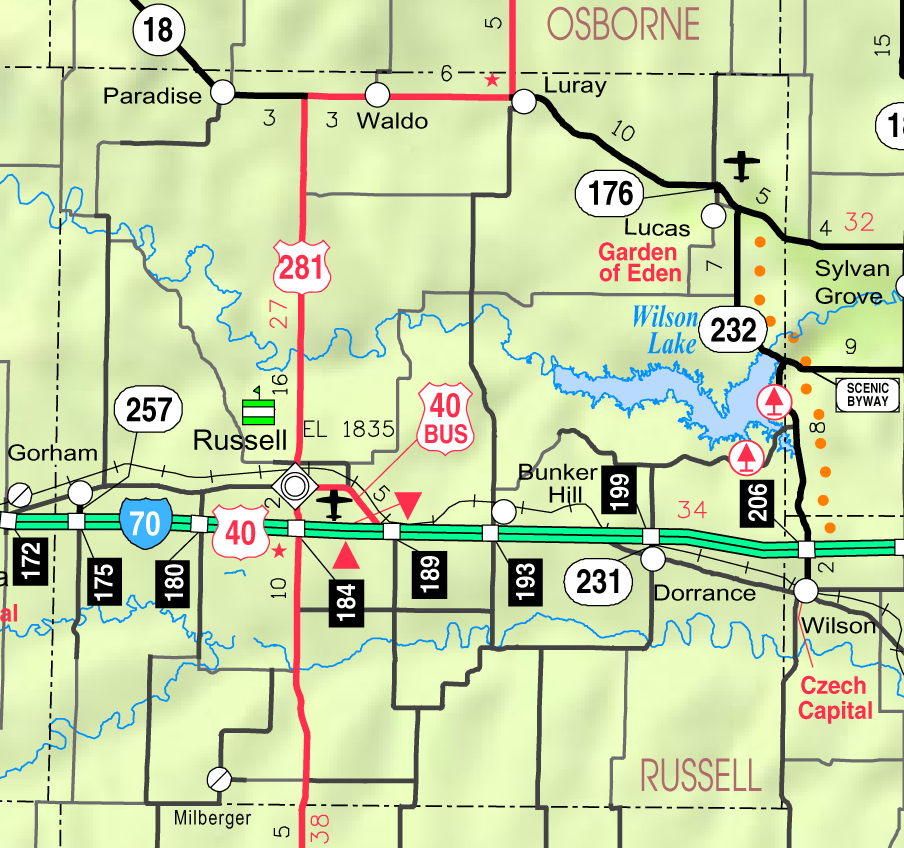
Located at 39.06°N, 98.54°W in north-central Kansas. From altitude, Lucas appears as a tiny grid of streets in the rolling Kansas plains - unremarkable except for what's invisible from the air. The Garden of Eden occupies a residential lot. The terrain is classic Great Plains: wheat fields, section roads, farmsteads. Salina lies 30 miles to the east. The extreme flatness of the region is evident. Salina Regional Airport is the closest commercial service. Lucas represents the far end of isolation - a remote town that became famous for one man's concrete dreams.