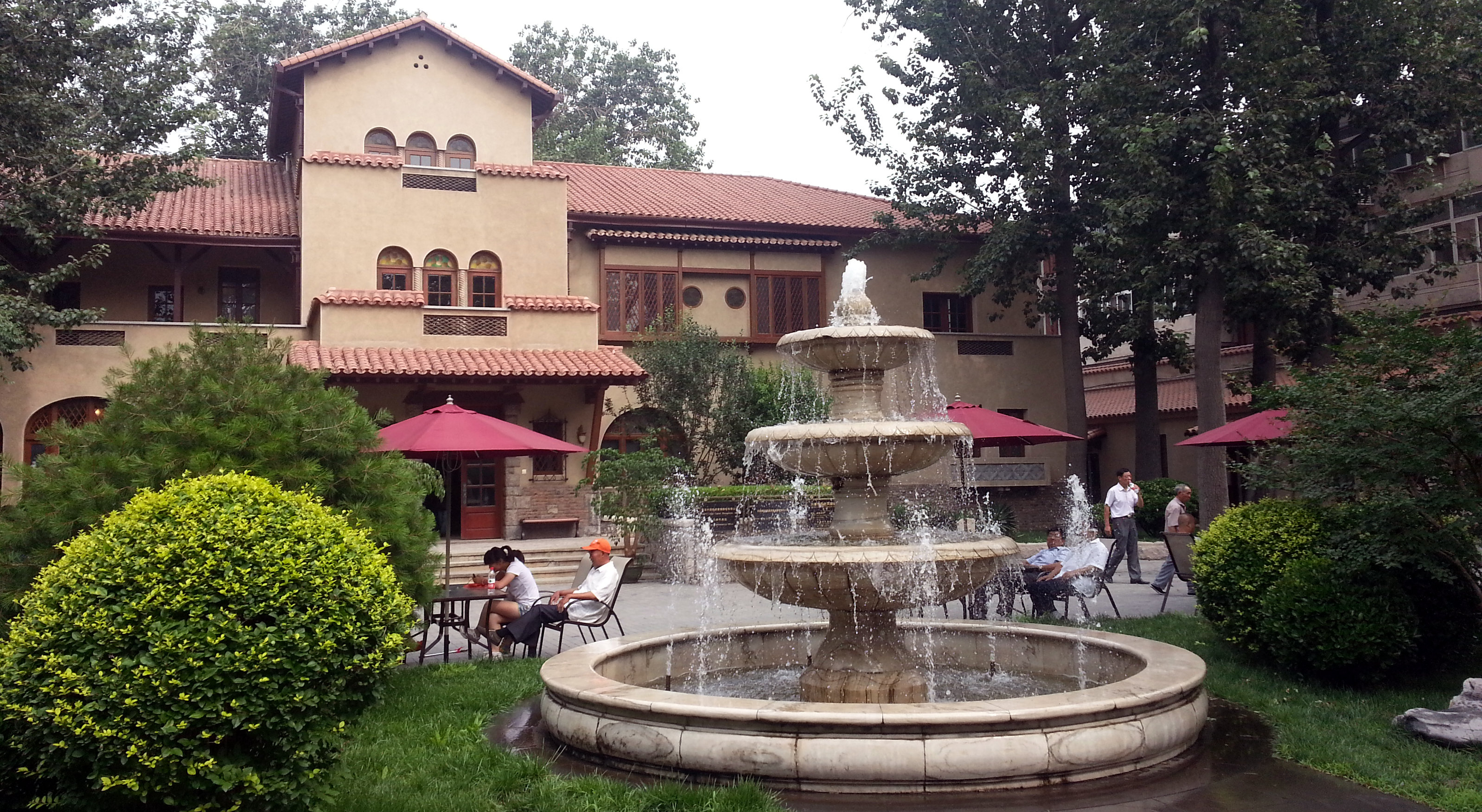
Garden of Serenity
The name tells you everything. When Puyi, the last emperor of China, moved into a warlord's villa on Miyajima Road in Tianjin's Japanese concession in July 1929, he renamed it Jingyuan -- the Garden of Serenity. It was an aspiration, not a description. The man who had been forced from the Forbidden City five years earlier, who had ruled nominally over four hundred million people before his third birthday, was searching for something he had never possessed: stillness.
A Warlord's Villa, an Emperor's Cage
The house at 70 Anshan Road had belonged to Lu Zongyu, a warlord and senator during China's chaotic Republican era. It was a handsome property, situated in the Japanese concession where foreign law offered a measure of protection from the political storms battering the rest of the country. For Puyi, it was both sanctuary and gilded cage. He arrived with his empress Wanrong, his brother Pujie, and the remnants of an imperial entourage that had nowhere else to go. Photographs from the period show the former emperor standing in the garden with advisors like Zheng Xiaoxu, looking every inch the displaced monarch -- formal, composed, and fundamentally adrift.
Two Years of Uncertain Peace
Puyi's time at Jingyuan lasted barely two years, from 1929 to 1931. During this period, the Japanese military was tightening its grip on Manchuria and needed a compliant figurehead. The serenity of the garden's name proved ironic. In 1931, Puyi was taken to Dalian by the Japanese army, beginning his transformation into the puppet emperor of Manchukuo -- a role that would define the rest of his life and earn him the subject of one of the twentieth century's most famous biographical films. The villa he had named for tranquility became just another chapter in a life defined by other people's plans.
From Residence to Relic
After Puyi's departure, the Garden of Serenity passed through decades of institutional use. Offices moved in. Renovations altered the building's character, and portions of the original garden were demolished. The villa that had sheltered an emperor became unremarkable, its history buried under layers of bureaucratic function. But the story proved too compelling to stay hidden. The building was eventually restored and converted into a museum dedicated to Puyi's extraordinary life. Today, visitors walk through rooms where the last emperor once paced, viewing exhibits about a man who wore the Dragon Robe as a toddler, was divorced by his own concubine, and spent his final years as an ordinary citizen tending plants in a Beijing botanical garden.
Statues in the Garden
Bronze statues of Puyi and his empress Wanrong now stand in the restored garden, frozen in a moment that never quite existed -- a composed, dignified couple at ease in their surroundings. The real story was messier. Wanrong would descend into opium addiction during the Manchukuo years. Puyi's other consort, Wenxiu, had already made history by divorcing him in Tianjin, the first imperial concubine ever to leave an emperor by legal proceedings. The Garden of Serenity preserves a moment between catastrophes, a brief pause in a life that careened from imperial splendor to puppet sovereignty to imprisonment to a quiet final act as a citizen of the People's Republic.
From the Air
Located at 39.12°N, 117.18°E in central Tianjin, within the former Japanese concession district. The museum is a modest villa not easily distinguished from altitude, but the surrounding concession architecture creates a distinctive urban pattern. Nearest airport: Tianjin Binhai International (ZBTJ), about 15 km east. Beijing Capital International (ZBAA) is 120 km northwest. Best appreciated at lower altitudes where the contrast between traditional Chinese and Japanese concession-era architecture becomes visible.