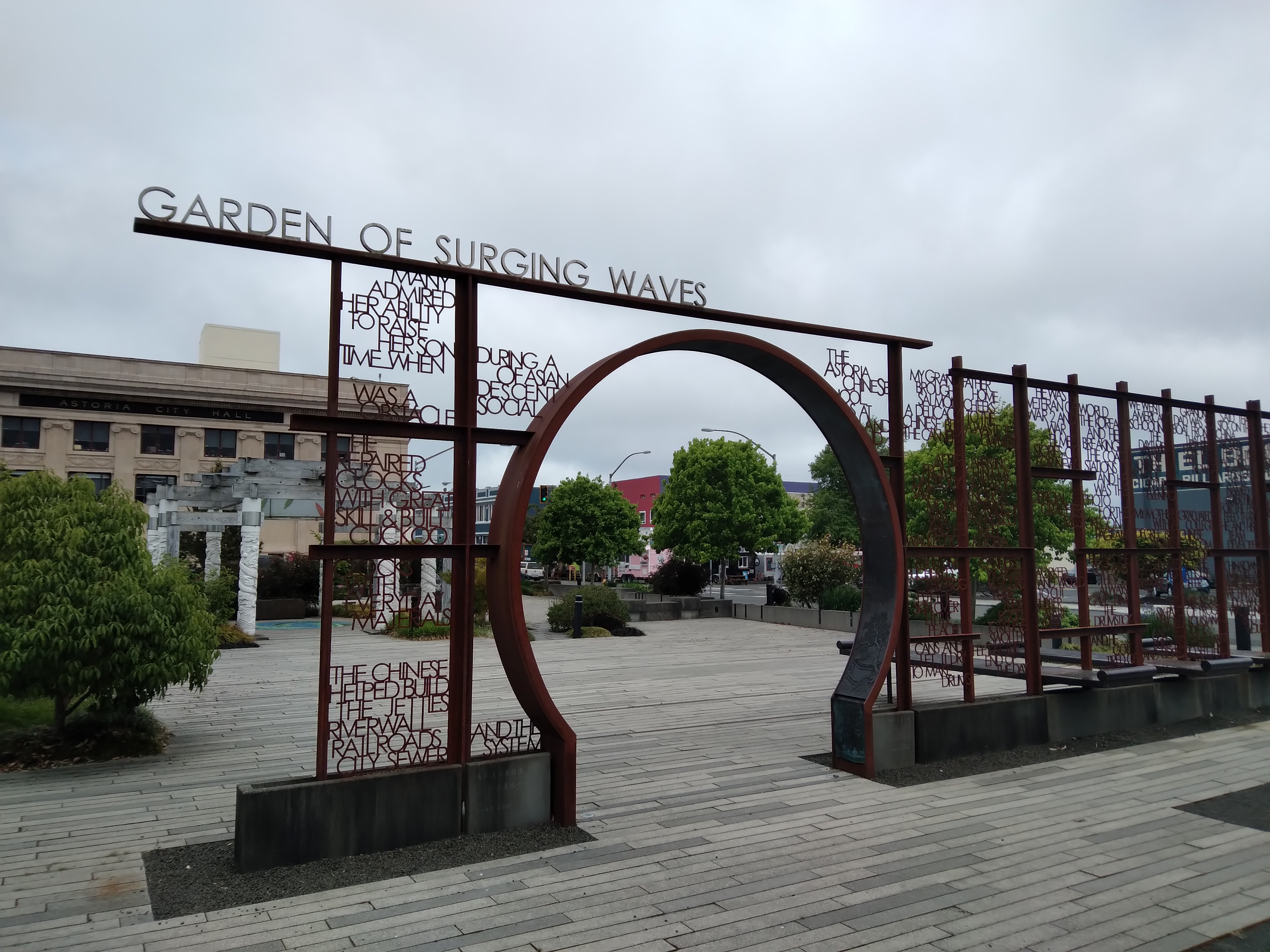
Garden of Surging Waves
To enter the Garden of Surging Waves, you pass through a Moon Gate -- a circular stone portal that in Chinese design tradition marks the boundary between the ordinary world and something more contemplative. The garden sits in downtown Astoria, Oregon, on Heritage Square, a block from City Hall. It is small, quiet, and easy to walk past. But the history it commemorates is enormous. In the 1870s and 1880s, Chinese workers comprised as much as thirty percent of Astoria's population. They canned the salmon, built the sewers, laid the railroad tracks connecting Astoria to Portland, and constructed the jetties that tamed the Columbia River's murderous mouth. The Garden of Surging Waves -- Cang Lang Yuan in Mandarin -- exists because a city finally decided to remember the people it had spent a century trying to forget.
One Dollar a Day, Plus Board
Chinese immigrants, predominantly from Canton province in southern China, began arriving in Astoria in the 1870s to work in the booming salmon canneries along the Columbia River. The work was grueling and segregated. Chinese men cut, sorted, and packed fish in conditions that white workers largely avoided, earning an average of one dollar per day plus room and board. Photographs from the era show the division starkly: Chinese workers on one side of the cannery floor, white workers on the other, performing different tasks at different pay. Beyond the canneries, Chinese laborers took on some of the most dangerous construction work in the region -- building stone jetties at the river's mouth, digging the city's sewer system, and laying track for the railroad that would connect the isolated coastal town to the rest of Oregon.
Exclusion and Erasure
The Chinese Exclusion Act of 1882 began the slow suffocation of Astoria's Chinese community. The law barred new Chinese immigration and denied naturalization to those already in the country. Oregon added its own restrictions: bans on intermarriage with white residents, prohibitions on land ownership, and local ordinances that confined Chinese residents to specific neighborhoods. By the early twentieth century, Astoria's once-thriving Chinatown was shrinking. The community held on long enough to establish a Chinese school in 1913, but the combination of exclusion laws, an aging population unable to bring families from China, and persistent discrimination ground the neighborhood down to almost nothing. The buildings were demolished or repurposed. The street names stayed the same, but the people who had built so much of the city's infrastructure disappeared from its visible memory.
A Bicentennial Reckoning
In 2011, as Astoria approached its bicentennial, the City Council chose an unusual legacy gift: not a monument to the fur traders or Lewis and Clark, but a Chinese garden honoring the immigrant community that had helped build the town. The ceremonial groundbreaking took place on April 14, 2012, at Heritage Square, adjacent to City Hall. The garden was completed in 2014 as the first phase of a larger Heritage Square redevelopment. Its design follows traditional Chinese garden principles -- water, stone, plants, and architecture arranged to create harmony and reflection. The name itself, Garden of Surging Waves, evokes both the Pacific swells that Chinese workers crossed to reach Oregon and the Columbia River currents they labored beside. It is a place designed for stillness in a city that owes much of its existence to the exhausting physical labor of the people being honored.
Stone, Water, and What Remains
The garden occupies the northwest corner of Heritage Square, bounded by Duane, Exchange, 11th, and 12th Streets. Visitors who enter through the Moon Gate find themselves in a compact space that feels deliberately separated from the surrounding downtown grid. Interpretive panels tell the stories of specific Chinese workers and families, grounding the abstract concept of immigration history in individual lives. The garden does not shy away from the uglier chapters -- the exclusion, the segregation, the erasure. But its dominant mood is one of reclamation. Astoria was founded in 1811 as the first permanent American settlement on the Pacific coast. For its two-hundredth birthday, it chose to acknowledge that the hands that built the city were not only those of the European Americans whose names fill the history books.
From the Air
The Garden of Surging Waves is located at 46.19°N, 123.83°W in downtown Astoria, Oregon, on Heritage Square adjacent to City Hall. The garden itself is too small to distinguish from the air, but Heritage Square and Astoria's compact downtown grid are visible from 1,500-2,500 feet AGL. The Columbia River waterfront, Astoria Column on Coxcomb Hill, and the Astoria-Megler Bridge provide strong visual references. Nearby airports: Astoria Regional Airport (KAST) is 4 miles southwest. Expect marine fog and low cloud ceilings, particularly in fall through spring.