Garden of the Gods
"Beer garden! Why, it is a fit place for the Gods to assemble. We will call it the Garden of the Gods." Rufus Cable blurted those words in August 1859, overwhelmed by what he saw while his companion suggested the red rock formations would make a nice spot for drinks. Cable's spontaneous naming stuck, and the place has been living up to it ever since. The deep-red, pink, and white sandstone fins that jut vertically from the earth at the western edge of Colorado Springs look like they belong on another planet - or in another era, which is closer to the truth. These rocks began as horizontal layers of sediment deposited by ancient seas and sand dunes more than 300 million years ago, then were tilted on end and sculpted by ice and water into the spires, balanced rocks, and cathedral-like formations that draw more than two million visitors each year.
Written in Stone
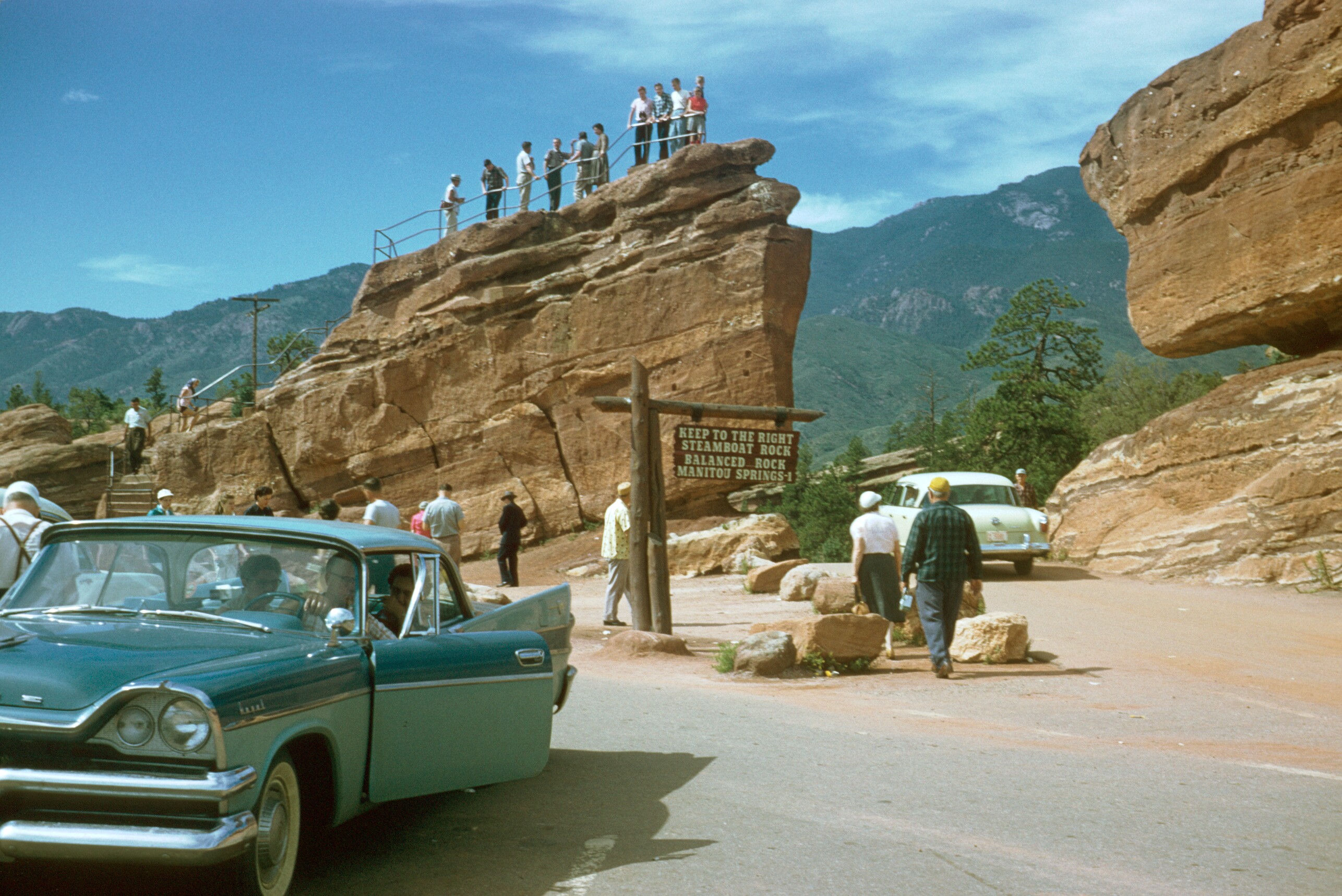
The geological story of Garden of the Gods begins in the Paleozoic era, when the region lay beneath shallow seas. Over hundreds of millions of years, layers of sandstone, conglomerate, and limestone accumulated horizontally. Then the Laramide Orogeny - the same mountain-building event that raised the Rocky Mountains and the Pikes Peak massif - tilted these beds nearly vertical, pushing them up like pages in a half-opened book. The Pleistocene ice ages carved and polished the exposed rock into the formations visitors see today: Steamboat Rock, the Three Graces, Balanced Rock, Cathedral Spires, and the Kissing Camels. The red color comes from iron oxide in the ancient sandstone. Evidence of past ages can be read in these rocks like chapters: ancient seas, eroded remnants of ancestral mountain ranges, alluvial fans, sandy beaches, and great dune fields, all compressed into stone and turned sideways for the world to see.
Sacred Ground, Long Before Cable
Archaeological evidence shows that people visited this site as early as 1330 BC, drawn by the wildlife and plant life that thrived where the Great Plains meet the mountains. By 250 BC, Native American groups were camping among the rocks, using overhangs for shelter. The Ute people's oral traditions say they were created here, and petroglyphs typical of early Utes have been found in the park. The Apache, Cheyenne, Comanche, Kiowa, Lakota, Pawnee, and Shoshone all report connections to the site. The Arapaho name for Garden of the Gods is Ho3o'uu Niitko'usi'i. Multiple American Indian nations traveled through these formations for millennia before the first European surveyors arrived. The Utes considered the red rocks spiritually significant and camped near the creek at Rock Ledge Ranch on the park's border, close to the mineral springs at nearby Manitou Springs.
A Gift That Stays Free
In 1879, Charles Elliott Perkins, a railroad executive and friend of Colorado Springs founder William Jackson Palmer, purchased land that included a large portion of what is now the park. Upon Perkins' death, his family donated the land to the City of Colorado Springs in 1909 with one firm condition: it must remain a free public park, forever. That stipulation holds to this day. No admission is charged. The park opens at 5:00 a.m. and closes in the evening, welcoming over two million visitors annually - making it Colorado Springs' most visited attraction. A Visitor and Nature Center opened in 1995 just outside the park boundary, offering 30 educational exhibits and running a short film, How Did Those Red Rocks Get There?, every 20 minutes. The center is staffed by city employees, and proceeds from its privately operated store support the Garden of the Gods Foundation, which funds maintenance and improvements.
Climbers, Dinosaurs, and Honey Ants
The park is a rich ecological crossroads that retired biology professor Richard Beidleman called 'the most striking contrast between plains and mountains in North America' with respect to biology, geology, climate, and scenery. In 1878, a dinosaur skull was found among the rocks; it was not identified until 2006 as a unique species, Theiophytalia kerri. A subspecies of honey ant previously unknown to science was discovered here in 1879 and named after the park. Mule deer, bighorn sheep, and fox roam freely, and the park is home to more than 130 species of birds, including white-throated swifts and canyon wrens. Rock climbers come for the steep, unusual formations, though permits are required, parties of two or more are mandatory, and climbing is forbidden when the rock is wet or icy. The park's trails draw hikers, mountain bikers, and horseback riders across its varied terrain.
The View from Above
From the air, Garden of the Gods appears as a sudden interruption of red against the green and brown landscape at the foot of Pikes Peak. The sandstone fins run roughly north to south, their vertical edges catching light and shadow in sharp contrast. The hogback ridges - long, narrow, steeply tilted rock formations - are clearly visible from altitude, resembling the spine of some buried creature breaking through the surface. Pikes Peak rises directly to the west, its 14,115-foot summit providing the dramatic backdrop that appears in countless photographs taken from the park below. The park itself covers over 1,300 acres, designated a National Natural Landmark in 1971 in recognition of its outstanding geological features. From ground level, the scale of the formations overwhelms; from above, you can see how neatly they line up along the fault that produced them, a geological story told in perfect parallel lines of ancient stone.
From the Air
Located at 38.87°N, 104.89°W on the western edge of Colorado Springs, at the base of the Front Range. The park's distinctive red sandstone fins are visible from altitude as a band of red rock running north-south against the green/brown prairie. Pikes Peak (14,115 ft) rises immediately to the west. Colorado Springs Airport (COS) is approximately 12 miles to the southeast. Peterson Space Force Base is nearby. The hogback formations create a distinctive geological pattern visible from above. Manitou Springs lies just to the west, between the park and Pikes Peak.