Garden Tomb
The debate has lasted nearly two centuries, and neither side shows signs of yielding. Roughly 600 meters separate the two candidates for Christianity's most sacred site: the Church of the Holy Sepulchre, venerated since the fourth century, and the Garden Tomb, a quiet garden just north of the Damascus Gate where a rock-cut tomb sits beneath a skull-shaped cliff. Most archaeologists side with the older tradition. But for the hundreds of thousands of visitors -- especially Evangelical and Protestant Christians -- who pass through the Garden Tomb each year, the question of historical authentication matters less than the experience: an open-air setting that feels startlingly close to the Gospel accounts, where stone and greenery replace the incense-darkened interior of the medieval church down the road.
The Skull in the Hillside
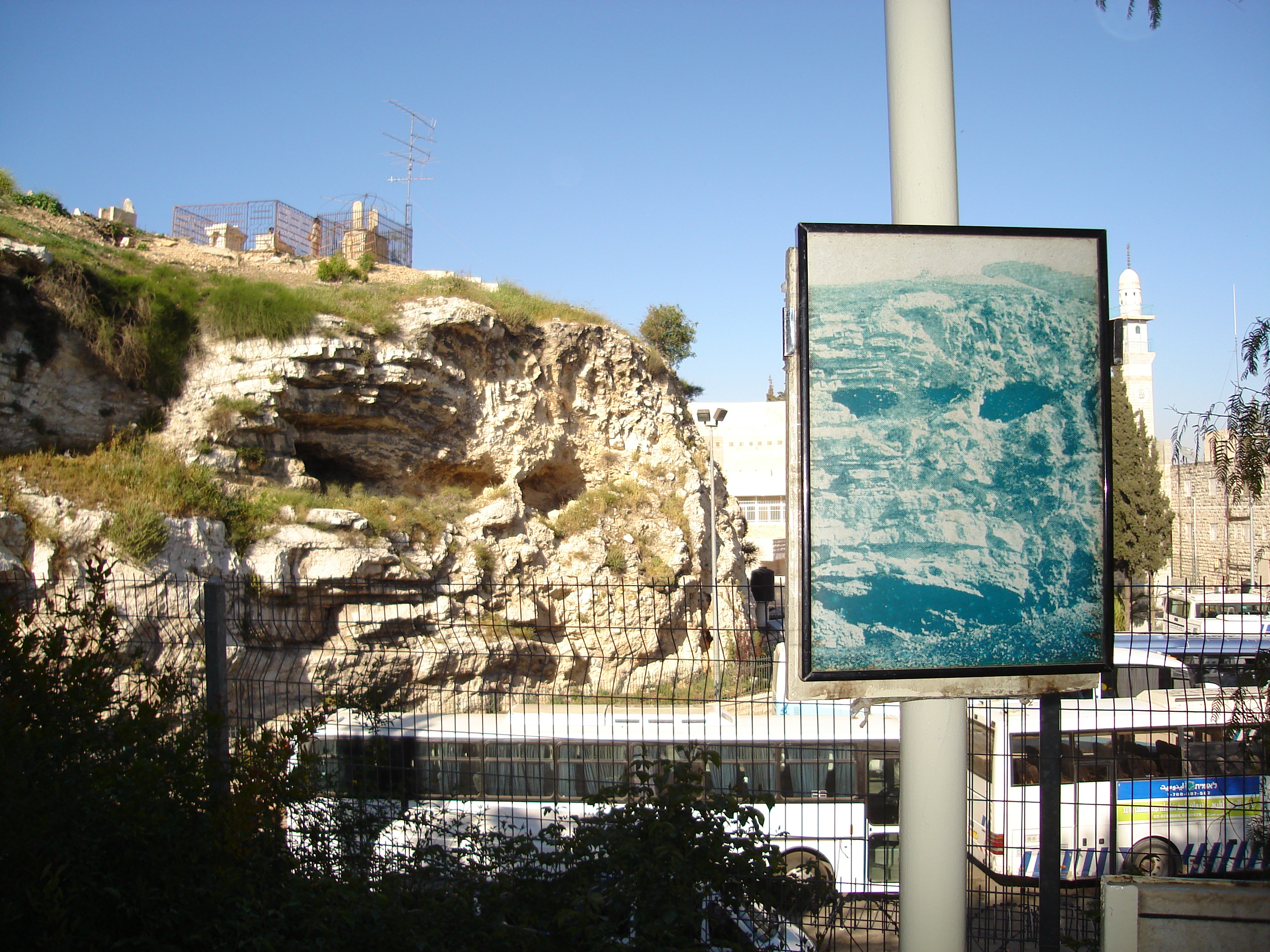
The story begins with a cliff face. In 1842, German theologian Otto Thenius, drawing on earlier topographic work by Edward Robinson, proposed that a rocky escarpment north of Damascus Gate was the biblical Golgotha -- the "Place of the Skull" where Jesus was crucified. The hillside bore what appeared to be two shallow eye sockets and a nasal cavity, giving it a skull-like appearance that matched the name. The idea gained traction slowly. In 1883, British General Charles Gordon, already famous for his exploits in China and Sudan, visited Jerusalem and independently arrived at the same conclusion. Gordon's endorsement, publicized widely in British society, transformed Skull Hill from a theological curiosity into a pilgrimage site. The cliff became known as "Gordon's Calvary," a name it retains among English-speaking visitors.
A Tomb in a Garden
In 1867, German architect and missionary Conrad Schick discovered the rock-cut tomb just below and to the west of Skull Hill. It was a simple burial chamber with a weeping channel cut into the rock floor -- a feature designed to direct fluids away from the body. A low doorway opened onto a garden terrace. The tomb's proximity to the proposed Calvary, combined with the surrounding garden setting, seemed to many Protestants to match the Gospel of John's description with uncanny precision: "Now in the place where he was crucified there was a garden; and in the garden a new sepulchre, wherein was never man yet laid." In 1894, a group of British Christians purchased the site and established the Garden Tomb (Jerusalem) Association to maintain it. The association, still headquartered in London, operates the site as a free-admission pilgrimage destination to this day.
The Weight of Evidence
Archaeology has complicated the Garden Tomb's claim. The tomb itself dates to the Iron Age -- the eighth or seventh century BCE -- far too early to have been "new" at the time of Jesus's death. The weeping channel and bench-style layout are characteristic of First Temple period burials, not the rolling-stone shaft tombs typical of the late Second Temple era. The Church of the Holy Sepulchre, by contrast, sits atop tombs that archaeologists have dated to the first century CE, and its veneration traces back to the Roman Emperor Constantine's construction of a basilica there around 326 CE. Even the skull-like features of the cliff face may be relatively modern: quarrying and erosion over the centuries have altered the rock's appearance, and early descriptions of the site make no mention of facial features. Gabriel Barkay, an Israeli archaeologist who excavated nearby, concluded that the Garden Tomb was "emphatically not" a first-century burial.
The Power of the Place
None of this has diminished the Garden Tomb's appeal -- and perhaps that is the point. The site offers something the Church of the Holy Sepulchre, with its competing denominations, enforced schedules, and perpetually dim interior, does not: simplicity. Visitors walk through a tranquil garden shaded by trees, past ancient cisterns and a wine press carved into the bedrock, to a tomb entrance where a sign reads "He is not here -- for He is risen." Protestant worship services are held in the garden daily. There are no entrance fees, no competing clergy, no centuries of architectural accumulation. The Garden Tomb Association itself takes no official position on whether this is the authentic site, stating only that the setting helps visitors "experience the wonder of the biblical account." For pilgrims who find the ornate Church of the Holy Sepulchre theologically overwhelming, the garden provides a contemplative alternative where imagination fills the gaps that archaeology leaves open.
From the Air
Located at 31.784N, 35.230E, just north of the Damascus Gate of Jerusalem's Old City, at approximately 760m elevation. The garden is a small green space adjacent to the Arab bus station, not individually visible from high altitude but situated along the northern wall of the Old City. Look for the Damascus Gate and the rocky cliff of Skull Hill nearby. Nearest major airport is Ben Gurion International (LLBG), about 50 km northwest. From the air, the Old City walls and the golden Dome of the Rock provide orientation.