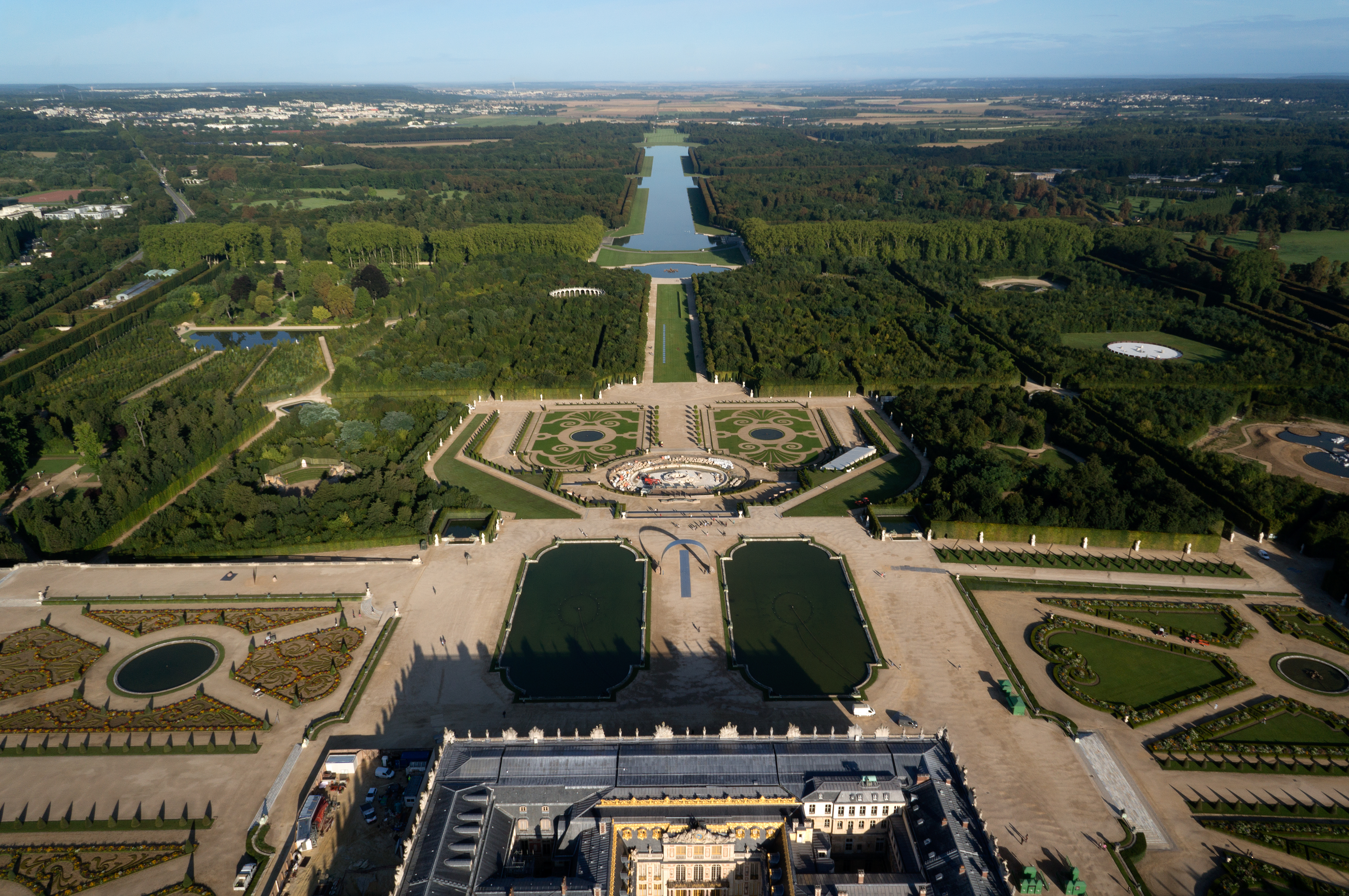
Gardens of Versailles
The fountains consume more water than the entire city of Paris once did. That single fact captures the ambition and absurdity of the Gardens of Versailles, 800 hectares of manicured landscape where Andre Le Notre transformed swampy hunting grounds into the most influential garden in Western history. Every axis, every fountain, every carefully clipped hedge was designed to communicate a single message: Louis XIV controls nature the way he controls France. The gardens are not a backdrop to the palace. They are the argument the palace makes, rendered in water, stone, and living green.
The Sun King's Grammar
When Louis XIV turned his attention to Versailles in 1661, he brought the team he had seized from his disgraced finance minister Nicolas Fouquet: architect Louis Le Vau, painter Charles Le Brun, and landscape architect Andre Le Notre. The garden's design vocabulary was solar from the beginning. The Bassin d'Apollon, completed between 1668 and 1671, depicts the sun god driving his chariot to light the sky, a direct stand-in for the king himself. The Bassin de Latone, sculpted by Gaspard and Balthazar Marsy between 1668 and 1670, illustrates a scene from Ovid in which peasants who tormented Latona and her children Apollo and Diana are turned into frogs by Jupiter. Historians read this as an allegory of the Fronde revolts that terrorized Louis's childhood. Even the word choices mattered: fronde means slingshot, and the Lycian peasants of the myth were punished for slinging mud, linking ancient mythology to 17th-century political insult.
Hydraulic Obsession
The gardens' greatest engineering challenge was water. Versailles sits on dry ground with no natural water supply adequate for hundreds of fountains. Louis Le Vau designed the Pompe, a water tower using windmills and horsepower to draw from the Clagny pond, delivering 600 cubic meters per day. It was not enough. The Machine de Marly, built on the Seine, used fourteen waterwheels driving 253 pumps to push water uphill to Versailles, some of it traveling three-quarters of a mile. It remained in operation until 1817 and was a must-see for foreign visitors. The most ambitious scheme was never completed: in 1685, Louis proposed diverting the Eure River, over 80 kilometers to the southwest of the palace, via a canal and aqueduct system. As many as 22,000 soldiers were pressed into construction. When the Nine Years' War began in 1689, one-tenth of France's military was digging the Canal de l'Eure. The project was abandoned. Had it been finished, it would have delivered 50,000 cubic meters of water daily, more than enough to solve the problem forever.
A Forest of Hidden Rooms
The bosquets, enclosed garden rooms hidden within the wooded groves, are where Versailles reveals its most inventive side. Le Notre created over a dozen of these outdoor salons, each with a distinct character. The Labyrinthe, designed in 1672 on the advice of Charles Perrault, the author of Mother Goose, featured 39 fountains illustrating Aesop's Fables with 333 painted metal animals. The Dauphin learned to read from plaques accompanying each fountain. The Salle de Bal, inaugurated in 1685, functioned as an amphitheater with cascading water and gilt lead torcheres for candlelit evening performances. The Colonnade, designed by Jules Hardouin-Mansart in 1684, was a circular peristyle of 32 arches with 31 fountains. Most astonishing was the Grotte de Thetys, demolished in 1684, where a sea cave decorated in shellwork housed statues of Apollo attended by nymphs. Its roof concealed a reservoir that fed the fountains below by gravity, making the myth itself part of the plumbing.
Five Storms, Five Replantings
Gardens are living things, and Versailles has been replanted at least five times. Louis XVI ordered the first major replanting in the winter of 1774-1775, felling trees dating to his great-great-grandfather's reign in an attempt to convert Le Notre's formal design into a fashionable English landscape garden. The topology defeated him. The land itself favored the French style, and the English experiment was abandoned. In 1870, a violent storm uprooted scores of trees, but the Franco-Prussian War and the Paris Commune delayed replanting until 1883. The most dramatic losses came in 1990 and again in 1999, when storms destroyed thousands of trees in the worst damage in the garden's history. The catastrophe, however, enabled restorers to rebuild bosquets that had been abandoned for two centuries, including the Bosquet des Trois Fontaines, reopened in 2004. Today more than six million visitors walk these paths each year. On summer weekends, the administration sponsors the Grandes Eaux, when the fountains play as they did for the Sun King, and the garden's original purpose reasserts itself: to make human beings feel the overwhelming scale of power made beautiful.
From the Air
Coordinates: 48.810N, 2.110E. The gardens extend west of the Palace of Versailles, with the Grand Canal visible as a prominent cross-shaped water feature. Recommended viewing at 3,000-6,000 ft AGL for the full garden layout. Nearest airports: Toussus-le-Noble (LFPN) and Paris Orly (LFPO).