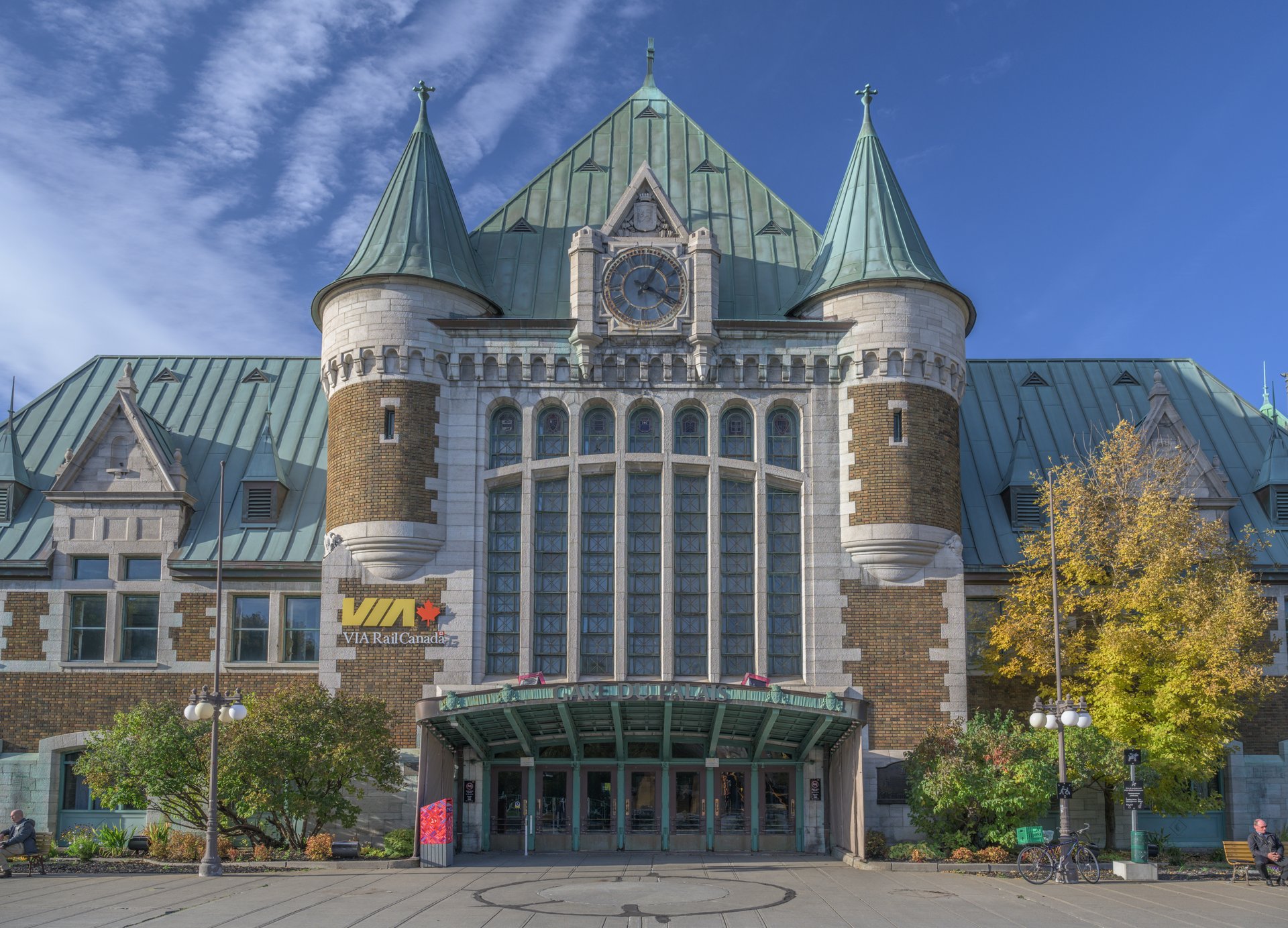
Gare du Palais: The Station That Died and Came Back
In 1976, the city of Quebec City did something drastic: it ripped the rails out of Gare du Palais, its grand railway station, to build the Dufferin-Montmorency highway. For nearly a decade, the elegant chateauesque building -- designed to echo the Chateau Frontenac hotel on the bluff above -- sat without trains, a palace of arrival with nowhere left to arrive from. Then on November 8, 1985, Gare du Palais reopened after a comprehensive renovation, trains rolling in on rerouted tracks from the north. The station that Quebec City destroyed, Quebec City resurrected. It stands today as a designated Heritage Railway Station, the eastern terminus of Via Rail's busiest corridor, and proof that some buildings are too beautiful to give up on.
Where Seven Railways Converged
The station takes its name from nearby Palais Street, itself named after the long-destroyed palace of the Intendant of New France. The first Palais Station was built around 1872 by the North Shore Railway, funded with a million-dollar grant from Quebec City to finally connect it to Montreal by rail. The city had been isolated on the north shore of the St. Lawrence while the Grand Trunk Railway lobbied against competition in London. Once the Quebec Bridge opened in 1917, Palais Station became a true union station, serving seven different railway companies: the Canadian Pacific, the Quebec and Lake St-John Railway, the Great Northern Railway of Canada, the Quebec Montmorency and Charlevoix line, the Canadian Northern, the National Transcontinental Railway, and the Quebec Central Railway, which had relied on a ferry from Levis before the bridge was built. The current building, constructed in 1915 by the Canadian Pacific Railway, replaced the original with a two-storey chateauesque design that deliberately echoed the Frontenac.
The Connecticut Yankee's Last Stop
From the mid-1930s to the mid-1950s, Gare du Palais served as the northern terminus of the Connecticut Yankee, a passenger route running all the way from New York City up through the Connecticut River Valley to Sherbrooke and on to Quebec. The train connected two worlds: the commercial bustle of Manhattan with the fortified French-speaking capital of a province that had been British for nearly two centuries. By the 1950s, the automobile and the airplane were killing long-distance rail across North America, and the Connecticut Yankee disappeared. But the station's role as a hub persisted -- until 1976, when the city expropriated it and tore up the tracks to make way for the Dufferin-Montmorency highway. The Canadian Pacific built a replacement station three miles west in the Saint-Malo industrial park, a utilitarian structure that had none of the grandeur of the original.
Death and Resurrection
The nine years without rail service could have been the end. Railway stations across North America were being demolished in the 1970s and 1980s, victims of declining ridership and rising land values. Gare du Palais survived, though the rails south of the Saint-Charles River were gone permanently. The solution was creative: trains now approach from the north, running on Canadian Northern Railway tracks through the Lairet division, turning south at Hedley Junction, crossing the Saint-Charles River, and arriving at the station from a completely different direction than the original route. On November 8, 1985, the reopened station once again welcomed passengers. In 1992, it was designated a Heritage Railway Station, formally recognizing the architectural and historical significance of a building that had nearly been sacrificed to a highway. The Canadian Pacific Railway itself no longer reaches Palais Station, having sold its north-shore tracks to the Quebec Gatineau Railway.
Palace Station Today
Gare du Palais now serves as the eastern terminus of Via Rail's Corridor service connecting Quebec City to Montreal and Ottawa, handling up to ten trains per day via Drummondville. It doubles as downtown Quebec City's intercity bus terminal, served by the coach company Orleans Express. The building itself remains a landmark. Its chateauesque towers and steep copper roofline stand in architectural conversation with the Chateau Frontenac on the heights above, the two buildings bookending Old Quebec's lower town. Inside, the station's restored interior serves travelers who may not realize they are standing in a building that was once stripped of its purpose, left for dead, and brought back to life through rerouted tracks and stubborn civic pride. The name still carries its original meaning: Palace Station, named for a palace that no longer exists, serving a city that refused to let its station follow the palace into oblivion.
From the Air
Located at 46.8174°N, 71.2139°W in the lower town of Quebec City, northeast of Old Quebec's fortified walls. From the air, look for the chateauesque roofline resembling a smaller version of the Chateau Frontenac hotel visible on the promontory above. The station sits at the confluence of rail lines approaching from the north along the Saint-Charles River valley. The Dufferin-Montmorency highway, the road that nearly killed the station, is visible running along the waterfront. The St. Lawrence River is immediately to the southeast. Nearest airport is Quebec City Jean Lesage International (CYQB), approximately 14 km west. The rail corridor extends westward toward Montreal along the St. Lawrence's north shore.