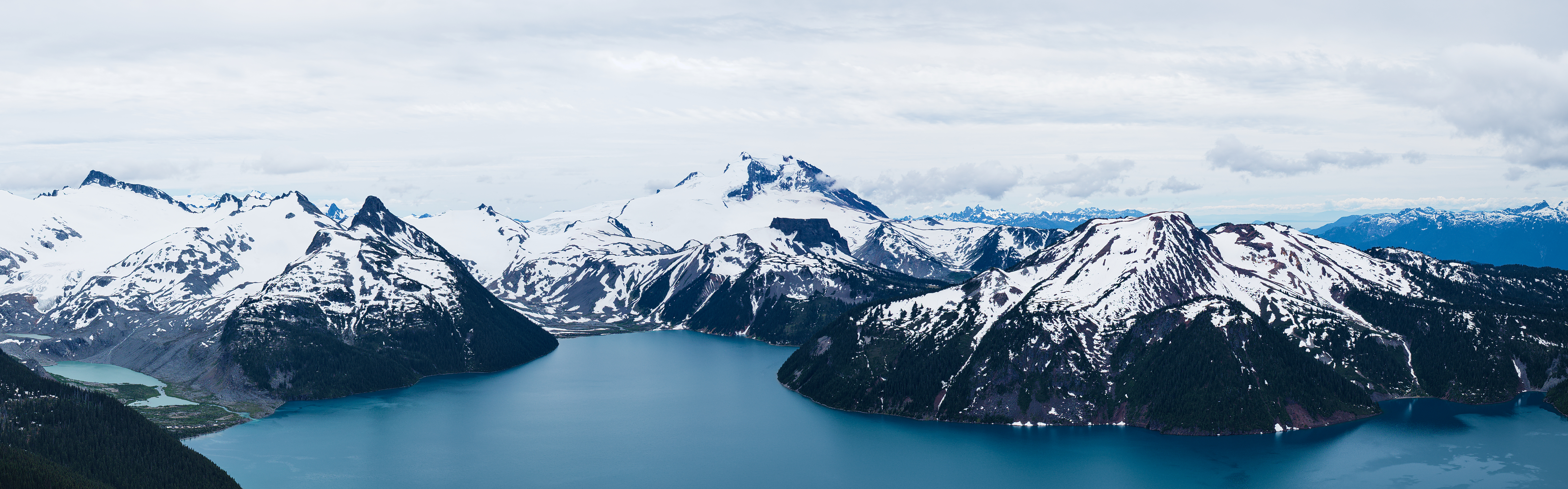
Garibaldi Provincial Park
The Squamish people called this mountain Nch'kay - the Grimy One - for the murky glacial rivers that flow from its flanks. British naval officers surveying Howe Sound in 1860 had different ideas, naming the volcanic peak after Giuseppe Garibaldi, the Italian patriot then making headlines across Europe. Today the mountain anchors a provincial park where volcanic origins meet glacial artistry, creating landscapes so striking that simply reaching them requires hours of hiking through old-growth forest. There are no roads to Garibaldi Lake, no drive-up viewpoints, no shortcuts. The park demands effort, and rewards it with waters so impossibly blue they seem artificially colored, meadows erupting in wildflowers each July, and the jagged silhouette of Black Tusk - an ancient volcanic plug - standing sentinel over it all.
Fire and Ice Architecture
Black Tusk rises like a broken fang from the surrounding ridgeline, its dark rock a stark contrast to the snow-capped peaks around it. This is not merely erosion's work but the remnant of a volcanic throat, the hardened core left standing after softer surrounding rock wore away over millennia. Mount Garibaldi itself and the Cinder Cone tell the same story - this landscape was built by fire, then sculpted by ice. Lava flows created 'The Barrier,' a natural dam that holds Garibaldi Lake captive in its turquoise glory. The lake's color comes from glacial flour - rock ground to powder by moving ice and suspended in meltwater. Walk the trails here and you're walking across the collision of geological forces that most people only read about in textbooks.
The Price of Paradise
Nothing worth having comes easily in Garibaldi. The shortest route to that famous lake view requires nine kilometers of hiking and 820 meters of elevation gain - roughly four hours of steady climbing through forests of Douglas fir, western red cedar, and hemlock before the trees finally release you into alpine meadows. Taylor Meadows and Garibaldi Lake campgrounds require reservations during peak season, and the 50 sites at the lake fill within minutes of opening. Backcountry huts at Elfin Lakes offer shelter for those willing to carry sleeping bags and food, but at $15 per person per night, they're hardly luxury accommodation. The park makes no apologies for these barriers. They're the reason the wilderness remains wild.
Four Seasons of Solitude
Summer brings the crowds - relative crowds, at least, since the hiking requirement filters out all but the committed. July and August paint the meadows with wildflower blooms while golden eagles and bald eagles wheel overhead. By October, the first snows dust the peaks, and the trails empty. Winter transforms the park into backcountry skiing terrain, though avalanche awareness becomes essential and most trails require snowshoes or skis. The dedicated few who venture out find snow depths measured in meters, silence broken only by wind and ptarmigan calls, and views unmarred by other humans for days at a time. Spring brings snowmelt and swollen streams but also the earliest wildflowers and the return of marmots and pikas from their winter dens.
Gateway to the Coast Range
Five access points line Highway 99 between Squamish and Whistler, each opening different corners of the park's rugged interior. Diamond Head offers the most accessible taste of alpine country; Cheakamus Lake provides the only boating opportunity in the park; Wedgemount Lake delivers perhaps the most challenging day hike, gaining over 1,200 meters in just seven kilometers to reach a pristine backcountry lake rimmed by glaciers. There are no restaurants, no gift shops, no cell service in most areas. The towns of Squamish and Whistler bookend the park with all the services modern travelers expect, but inside the boundaries, the twentieth century - let alone the twenty-first - feels very far away.
From the Air
Centered at 49.92N, 122.75W in the Coast Mountains between Squamish and Whistler. Black Tusk (2,319m) is unmistakable from the air - a dark volcanic spire rising from lighter surrounding rock. Garibaldi Lake appears as a striking turquoise oval below The Barrier ridge. Mount Garibaldi (2,678m) anchors the western boundary. The park has no airports; nearest is Squamish Municipal (YSE) to the south or Pemberton Regional (YPS) to the north. Vancouver International (YVR) lies 100km south. Terrain rises from 600m at valley floors to over 2,700m at major peaks. Expect variable weather, heavy precipitation on western slopes, and significant icing in winter.