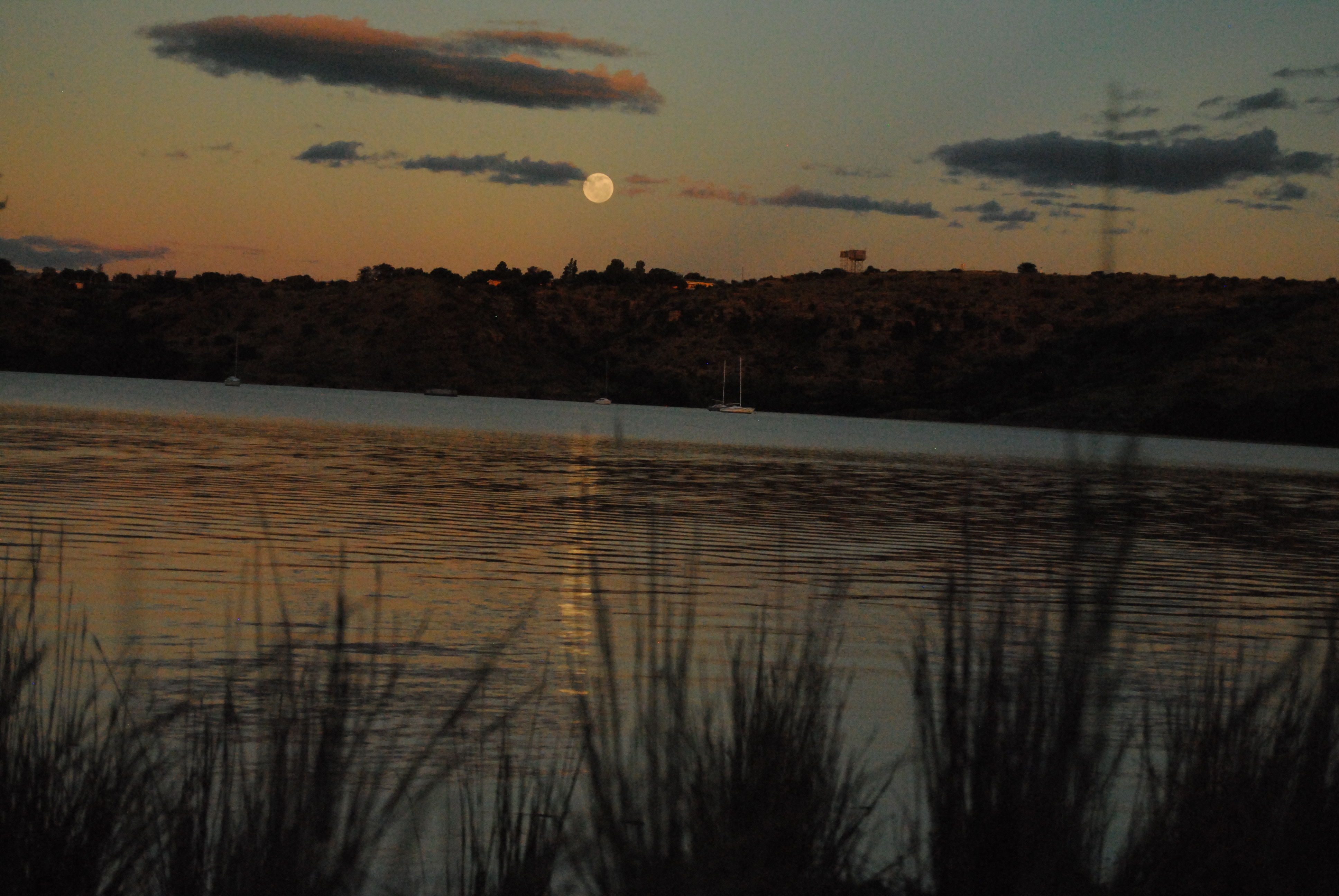
Gariep Dam
When it was commissioned in 1971, they called it the Hendrik Verwoerd Dam, after the prime minister who engineered apartheid into law. Twenty-five years later, in 1996, the name was stripped away and replaced with a word from the Khoekhoe language: Gariep, meaning 'river.' It was the original name of the Orange River itself, South Africa's longest, and the choice was deliberate -- a dam named not for a politician, but for the water it holds. Today, the Gariep Dam remains the largest reservoir in South Africa, an 88-meter wall of concrete and ambition straddling the border between the Free State and the Eastern Cape.
A Gorge Wide Enough to Bend the Rules
The engineers who designed Gariep Dam faced a problem that dictated their solution. The gorge at the entrance to the Ruigte Valley, about 5 kilometers east of Norvalspont on the Orange River, was too wide for a pure arch dam. An arch relies on the compression of curved concrete pressing against canyon walls, and when the span grows too broad, the physics stop cooperating. So they invented a hybrid. The central section curves in a classic arch, transferring its load into the rock, while flanking gravity walls on each side serve as massive abutments, holding their ground through sheer weight. The result is a concrete gravity-arch hybrid, 88 meters high with a 914-meter crest -- a structure that acknowledges the landscape rather than fighting it. Dumez, a French construction company, built the wall using approximately 1.73 million cubic meters of concrete. The dam crest sits roughly 1,300 meters above sea level.
Feeding a Nation
Gariep Dam's primary purpose is not spectacle but survival. It captures the Orange River's flow for irrigation, domestic use, industrial supply, and power generation across a vast stretch of central and eastern South Africa. When full, the reservoir covers more than 370 square kilometers with a storage capacity of approximately 5,340,000 megalitres. The dam feeds multiple river systems through an intricate network of tunnels, canals, weirs, and balancing dams. At Oviston, on the reservoir's south bank, sits the inlet of the Orange-Fish River Tunnel, an 82.8-kilometer engineering marvel that diverts water southward to the Great Fish River valley and the semi-arid Eastern Cape. From there, the water continues through a chain of infrastructure to the Sundays River valley and eventually to Port Elizabeth, arriving at the Nooitgedacht Water Treatment Works -- a connection that has been operating since 1992.
Power from Falling Water
Built into the dam wall is a 360-megawatt hydroelectric power station operated by Eskom, South Africa's state electricity utility. Four 90-megawatt turbines spin inside the structure, and here is the peculiar detail: they are controlled remotely from Gauteng, hundreds of kilometers to the north. The operators who manage the flow of the Orange River through the dam's generators sit in an office in the Johannesburg metropolitan area, watching instruments rather than water. In a country where electricity supply has been a persistent challenge, Gariep's hydroelectric output represents clean, renewable generation that requires no fuel beyond the river's own momentum. The power station's existence was part of the original design vision -- the dam was always meant to do more than store water.
What a Name Carries
The renaming of Gariep Dam on 4 October 1996 was part of a broader reckoning with South Africa's landscape of memory. Hendrik Verwoerd, the dam's original namesake, served as prime minister during the transition from the Union of South Africa to the Republic in 1961, and is widely regarded as the principal architect of the apartheid system. Stripping his name from the largest dam in the country was a statement that infrastructure belongs to everyone who depends on it, not to the ideology that built it. The Khoekhoe word Gariep predates colonial naming entirely. Before European explorers called it the Orange River -- after the Dutch House of Orange -- the Khoekhoe people who lived along its banks had their own word for what they saw. That word simply meant 'river.' In renaming the dam, South Africa returned to a description older and more honest than any political tribute.
From the Air
Gariep Dam (30.623S, 25.506E) is the largest body of water in South Africa and unmistakable from the air, covering over 370 square kilometers when full. The reservoir sits on the Orange River between Colesberg (48 km southwest) and Bloemfontein (208 km north). The dam wall and its gravity-arch hybrid structure are visible on the eastern end near Norvalspont. The town of Gariep Dam sits near the wall. Nearest airports include Bloemfontein New Tempe Airport (FATP) and Colesberg Airstrip. The N1 highway crosses near the dam, and the Orange-Fish Tunnel inlet at Oviston on the south bank is a notable nearby feature.